As an artist, if I find myself thinking about economics, it is usually disparagingly. I’m not alone. For years, artists have rebelled against economics through parody in paintings, music, stand-up comedy and Turner Prize-nominated installation pieces.
Unfortunately, if we want to comment upon economics intelligently in our work, we have to know something about it. We can’t simply hate Capitalism because we sometimes have trouble paying the rent or because we have a vague idea that it’s bad for people in Africa. To hate something intelligently, we need better data than that.
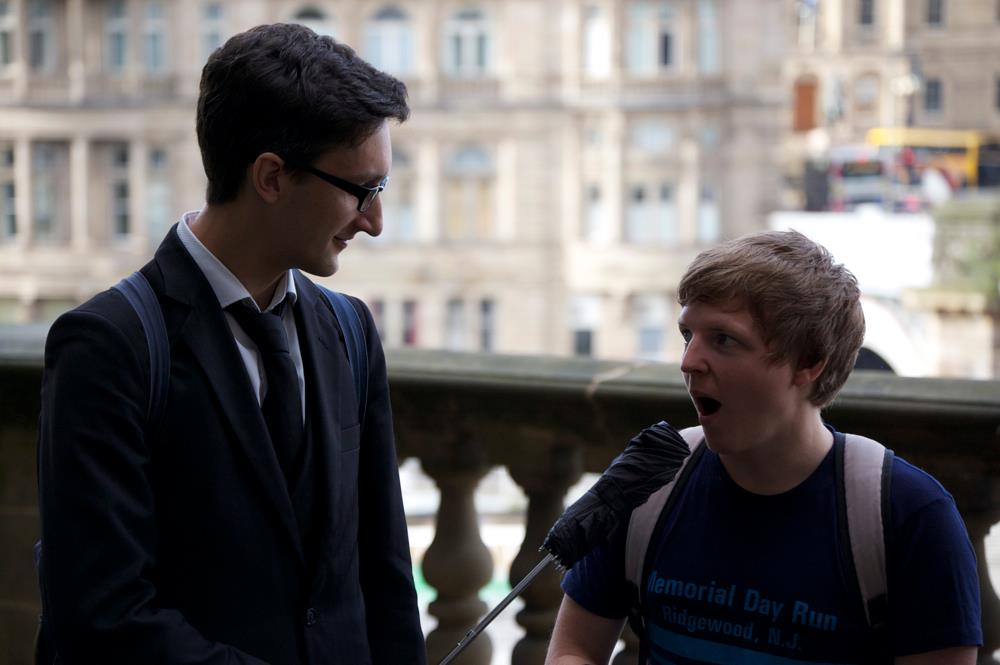
An excellent guide for artists—and people who dislike finance generally—are the books of Joseph Heath. Joseph is a philosophy professor at the University of Toronto and writes popular publications on the subject of money. His most recent book is called Filthy Lucre: economics for people who hate capitalism. I meet Joseph to discuss the complex relationship between artists and money.
“The latest book,” he tells me, “is remedial economics for people on the left. Like me, many people got turned off by their first-year economics class and decided that the whole thing was right-wing ideology and didn’t have to pay attention to it. It happens disproportionately on the left, so we’re often weaker in economics than the right. In the first half of the book, there’s a lot of economic theory that actually undermines classic right-wing positions. In the second half, I show there are things said on the left that don’t make sense from an economic perspective.”
Like many academics now writing for popular consumption, Joseph strikes me as a highly accessible fellow: a man steeped in theory but able to discuss it with the layperson. What took Joseph from academic philosophy to accessible consumerism and economics?
“Consumerism is already a topic in philosophy. Philosophy has some elaborate ideas about consumerism. Sadly, a lot of these are based on fallacies about economics, such as the over-production fallacy: the idea that mass-production has generated an overwhelming surplus of goods and so we resort to marketing. Alas, it’s a fallacy because ultimately in Capitalism—despite the illusion created by money— goods are exchanged for other goods. It’s possible for there to be too many shoes or shares but impossible to be too many goods in general. Based on this fallacy, philosophers have thrown up elaborate theories on how the advertising industry manipulates people’s desires, makes them consume more and generates an homogeneity of desires. Lots of theories but it’s all based on an ignorance of economics.”
Another of Joseph’s books, The Rebel Sell concludes that counter-cultural movements have failed and that there’s no real friction between the counter-culture and the accepted mainstream. The rebellious fringes may actually feed Capitalism:
“Rebellion was advertised in the late fifties and early sixties as having revolutionary consequences with respect to the political and economic system. The book points out that [the counter-culture] didn’t deliver on any of those problems. Rather than being a revolutionary transformation of consciousness, it was just consumerism. Take the sexual revolution: people thought it was going to undermine Capitalism because, in the post-Freudian view, instinctive repression was required to get workers to show up at the factory and this was incompatible with sexual freedom. The sexual revolution was going to lead to a wild freedom in society that would make factories and the tyranny of the clock impossible. If you look at [the psychoanalyst,] Wilhelm Reich, you can see this theme prominently: that the sexual revolution was supposed to undermine the entire political and economic system. Looking back with forty years of hindsight and wisdom, the major consequence of the sexual revolution was [the feeding of] the pornography industry. It’s a classic example of counter-cultural rebellion failing to result in the collapse of the system and in fact feeding into the desire to consume more and more. People thought ‘sex, drugs and rock ‘n’ roll’ was was going to be revolutionary in the way that, say, Marxism was revolutionary. They thought that it was going to emancipate people and fundamentally change things, that war would become impossible. To point out the obvious, it didn’t pan out that way. What’s striking is that everybody has recognised the total failure of these ideals but we’ve not rejected the underlying theory: that the political-economic system is a big machine and culture is the software, so by reprogramming the software you could fundamentally change the way the whole machine functioned. You still see it in contemporary cultural politics and art theory. It’s just that nobody has the radical pretensions for it that people had in the sixties.”
This strikes me as devastatingly defeatist but I’ve always been a dreamer. If the sexual revolution and rock ‘n’ roll—genuinely radical cultural forces—had resulted in the opposite of what was intended, what chance do small-time artists have in a world jaded by artistic rebellion? Should we hand in our pallets and brushes for white collars? Is there anywhere left for artists to rebel against money?
“A journalist recently wanted to interview me about Lady Gaga. Basically, he wanted to know whether the violent imagery in the Alejandro video meant the collapse of Western civilisation. I was like, ‘Jesus Christ, were you born yesterday?’ We live in a society that survived the Rolling Stones! The Stones were drug-using Satanists. The Stones and The Doors were the real deal, right? People thought it was mind-blowingly radical, that music industry would never be the same, that it was going to be Earth-shattering. But it didn’t quite work out. When I came along in the seventies, the Rolling Stones were already neutered. Already they were a joke in terms of rebellion. When punk came along people thought ‘Oh my God, this is the real deal now’, and its gone on and on. By now rebellion is such an empty gesture and so obviously a marketing gimmick, it’s astounding that anyone could think any kind of cultural event could have any significance on anything political or economic.”
At this point in the conversation, I remember a 2002 Adam Curtis documentary called Century of the Self. It mentioned something called the ‘torches of liberty contingent’: a 1929 women’s liberation movement in which hundreds of women marched on New York, brandishing cigarettes. There had been a perception in America that women shouldn’t smoke and so this was a hugely equalising demonstration. Equalising? Certainly. But the real effect was the doubling of cigarette sales. Tobacco companies got richer in the name of personal liberation. Are there other cases in which the corporation has exploited our senses of justice and rebellion?
“Sure. There’s the idea that Capitalism has to increase consumer desire to get rid of a surplus of mass-produced goods. Everyone is somehow threatened into wanting the same house, the same car, the same clothes and so forth. So the idea arose that by rebelling against mainstream tastes, you’re throwing a cog in the works of the industrial system. By refusing to live in the classic suburban home, by cutting your hair a certain way—all the standard counter-cultural gestures—you are exacerbating the crisis in Capitalism. This is the idea of the rebel consumer: that by smoking or getting tattoos or colouring your hair purple, you were striking a blow against the system. The consequence, however, is quite the opposite because rebellion becomes a positional good. The latest rebel style is extremely cool and attracts imitators. The people who want to rebel have to constantly search for the newest, latest thing. This generates competitive consumption and the quest for cool or the quest for rebellion winds up generating consumer desire. Rather than striking a blow against the system it actually ends up promoting consumerism. There’s the idea that rebel styles get co-opted by the system. But the co-option is completely an illusion. All that happens is once-exclusive things become popular. Once people start finding out and jumping on the band-waggon, it generates a snob effect whereby everyone has to get off the band-waggon. What looks like co-option is actually competitive consumption among individuals. But remember: none of this matters at all from an economic or political standpoint. Think of the fifty years of revolutionary rock ‘n’ roll, crap pop or whatever: it’s amazing that the system never collapses, but its because all this stuff is totally irrelevant.”
So what can counter-culture can hope for? Is there any point to being a part of a counter-cultural movement now? “No. I don’t think so. By now, the rebel gesture is so empty and so vacuous. Younger people don’t actually believe any of that. It’s just all been done so many times and the radicality got pushed to the point where there’s nowhere further to go. By the end of the twentieth century, radical music was politically exhausted. The most radical gestures are made already. I think best example is Lou Reed’s Metal Machine Music: the band started out revolutionary and underground, but when a bunch of frat boys started listening to it, the band immediately became mainstream. To maintain their underground credibility, they make another album of less-accessible music in order to lose fans and maintain cachet. You make your music more unlistenable as a way of restoring its exclusivity: you sell people an album of screeching noise. Like, that’s as revolutionary as it gets! And some people actually listen to it! It’s all a matter of exclusivity. I’ve sat through contemporary dance performances that were absolutely inaccessible and when people start to walk out, you can see the look of absolute satisfaction on everybody else. It’s just straight-up snobbery, right? It’s like distancing yourself from the great unwashed, from the people with mainstream tastes who lack true aesthetic judgement”.
Guilty, I explain that my favourite record is Captain Beefheart’s highly-inaccessible Trout Mask Replica: an album recorded under cult-like conditions with highly avant-garde results. I also remember how pleased I was when The Simpsons creator, Matt Groening announced it was also his favourite album. Me and Groening: two pretentious peas in a radical pod.
“When The Rebel Sell came out, a lot of old hippies were extremely upset by it, a lot of people our age—Generation X—reacted to it with ‘Oh, that’s really helpful. It’s something I kinda thought but never articulated,’ but anyone younger was like ‘Dude, tell me something I don’t know’. For anyone post-Internet, this is totally obvious. Stuff on the Internet gets co-opted overnight. It used to be that information moved very slowly. You could have a six-month lead before other found out [about the hip, new thing]. Growing up, a girl I knew would visit New York to check out [the nightclub,] CBGB. She would come back with a band t-shirt and she’d have the [scoop] on what was going on. This allowed us young punks to be cool for about a year because of the long lag. There was no MTV, radio stations didn’t play this stuff and albums were hauled around in trucks. Nobody could find out what was going on at CBGB, so if you got someone with inside intel, you were cool for ages before the ordinary folks found out about it. I used to feel that I was a member of an alternative culture and there was an essential difference between us and the mainstream. I realised later on that it was just a consequence of time lag: the delay in transmission of cultural information. Now, if someone puts something on YouTube, ten-thousand people are imitating it the next day. That’s why no young person was surprised by [the message of The Rebel Sell]. They’ve already realised it: there’s no such thing as alternative music. It took me a long time to figure out! I bought the whole thing, hook, line and sinker.”
So the standard rebel arguments are often just garden-variety inherited wisdom, which doesn’t need to be proliferated through art.
One point that I believe to be important, however, before we give up on rebellion, is that life without it is somehow hollow. Artists—whether musicians, film makers, performers or visual artists—have always gone against the grain or at least held up rebellion as a pretense for getting our blood pumping. There was never a song written about how the government have our best interests at heart and how the bankers do a great job. Without rebellion, sincere or otherwise, we’d never have seen The Wild Ones or Easy Rider or One Flew Over the Cuckoo’s Nest. We’d never have felt the love of John Lennon and Yoko Ono’s ‘Bed In’. We’d have never experienced the punk phenomena of the Sex Pistols or Patti Smith or The Clash or The Fall; or felt the surge of naive adrenaline when absorbing the crimson ink of comic books by torchlight under the covers. Exposure to rebellious art will often leave the feeling of new neural pathways being cut, often painfully, through the brain and of new mental muscles being flexed. Something that disconcerts (the grotesque pornography of Jake and Dinos Chapman), challenges the way you perceive the world (Douglas Gordon’s ’24-hour psycho’ video installation) or rocks the boat of social norms (Mark Quinn’s ‘Alison Lapper Pregnant’, the sculpture of a pregnant quadriplegic, which stood beautiful on Trafalgar Square’s fourth plinth in London) has surely more value than a work that simply confirms what you know (stand-up comedy by Michael McIntyre) or agrees with the status quo. If rebellion in art is an empty gesture and is ineffective against Capitalism, it is still the best way I know for art to feel like the result of independent thought and in favour of a beautiful, vigorous life, which goes against the grain.
It’s also important to remember that artistic rebellion doesn’t only go against Capitalism. Artists can rebel against unethical government policies, animal cruelty, environmental collapse, racism, poor public amenities and infringements upon our human rights: things that bring shame upon every one of us if they go unaddressed. It is not direct action but through rebellious art, we can generate a discourse around these things and heighten public awareness. Art can be the conscience required to temper the crimes of governments and individuals and the corporation. If an artist intelligently and opaquely rails against (for example) the war in Dafur or low standards of living closer to home in the US and Canada, it can be the spark required to ignite mass comprehension and ultimately mass action.
Personally, I wonder if the counterculture’s failure to derail or temper Capitalism is not a failing of rebellion intrinsically but that the counterculture has simply been rebelling in an unproductive fashion. Thanks to Joseph Heath’s observations, we now know that rebellion has backfired and lead to the stimulation of rebel desires and the identification of a rebel market. With this knowledge, perhaps artists should strive to create a non-marketable, non-profitable commodity and promote, through this, a form of anti-consumption. If art could successfully manufacture an anti-product: something which could neither be bought or sold with money and didn’t rely on further extraction of materials from the Earth, could we not exploit the rebel desire without the rebel dollar? Could we not appeal to people’s rebel instincts and desires for a better world without selling them the t-shirt? Can we not create a kind of ‘outwardly projected hunger strike’ to discourage the unnecessary consumption of material products? When will the truly minimalist home (ascetic as opposed to designer) become fashionable? When will empty space be perceived as the next luxury good? I think, if any rebellious artistic movement can affect Capitalism, it lies here. We now know that the acquisition of haircuts and records and magazines—what Heath described to me as “the standard rebel gestures”—only serves to fuel the system. If we want to properly throw a spanner into the works of Capitalism, we’ve got to pull our funding and stop consuming these empty symbols of a fake revolution. That is the message of this rebellious artist. Now, where’s my commission?
 I’m researching a book about Simon Munnery’s Cluub Zarathustra (1993-1997).
 On 10th October 2011, I’ll take part in