Look at my Hermit

“Sorry brain, back in the freezer.”

This is what I say when it’s time to go out in the Montreal winter. At -30°C, you become aware that your physical brain might not be having a terrific time.

That’s not really acceptable in the civilized world, is it? You should never be put in a situation where you’re moved to apologise to your brain.

When my brain didn’t complain about the cold today, I felt genuine concern. Had it died? Had Quebec murdered my brain?

No. Something was different. The snow was melting. Green buds had appeared on the trees. All around, I could hear the rumbling tummies of a million defrosted tardigrades.

Were we above zero? Spring! Spring was here!

“Spring is here, old woman!” I said to an old woman.

Va chier,” she said (or in English: “Rejoice, rose-cheeked young sirrah!”)

“Spring is here, bedraggled pigeon!”

Coo,” said the pigeon, perched on a plastic owl.

“Spring is here, plastic owl!”

The plastic owl looked pissed off.

A small man with a bushy beard and a red cycle helmet was standing and stinking on the street corner with a can of something called Pabst Blue Ribbon.

On seeing him, I stopped dead in my tracks. Scrotters? It was Scrotters! His presence was as surprising and wonderful as the spring itself.

My instinct was to plant a big wet kiss on his mouth and say “Spring is here, Scrotters, old friend, and–what’s more–I love you!” but kissing a tramp is inadvisable even if you’re a tramp yourself.

Besides, “Scrotters” is probably not his real name, merely the one I’ve rather offensively given him in the privacy of my head.

If only there were some way to learn his real name. But there’s not.

I’d been worried about Scrotters and it was a relief to see him after such a long time. He’d disappeared from his corner four months earlier, mysteriously replaced by a far-stinkier and more aggressive tramp. The new tramp’s secret name was Lion Man because he looked like a lion and ate raw meat.

Lion Man, I imagined, had frightened Scrotters away and stolen his lucrative corner.

I didn’t think the battle for the corner had been too bloody, just that Scrotters had been forced to move along by a trampier tramp. After all, Scrotters had that helmet. He was indestructible.

All the same, I didn’t like Lion Man. When I didn’t give him money, I got the impression he was silently hating me. Scrotters, under the same circumstances, would always growl and call me a shit owl, but there was never any malice in it.

Before his disappearance, Scrotters rarely if ever left his corner, which provided our neighbourhood with a welcome sense of certainty. Lion Man, on the other hand, spent half of his time on the opposite side of the street, spreadeagle on the ground, catching snowflakes.

You never knew what to expect with Lion Man. It was chaos.

Before the tramp replacement, we’d always been able to see Scrotters from our kitchen window. Every morning, his helmet would catch the bleary eye across the granola.

Each day, one of us would remark to the other something along the lines of “Oh look, someone’s bought Scrotters a massive pizza,” or “Oh look, Scrotters is wearing his cross-country skis.”

When I arrived back home today, I was very excited to report to my girlfriend that our favourite tramp was safely back on his corner of choice.

“Scrotters is back!” I said.

“Scrotters?” she said, “Where do you suppose he’s been?”

For a brief moment I wondered if his triumphant return was actually a tragedy. What if Lion Man had been nothing to do with his absence and Scrotters had actually been living in a luxuriously-carpeted house for four months but he’d lost it all again and wound up back on the corner.

“He must be the summer tramp,” I said, dismissing the rags-to-riches-and-back-to-rags-again story I’d witnessed in my head like Captain Picard in The Inner Light, “Lion Man must be the winter tramp.”

“Of course,” she said sarcastically, “Lion Man can withstand the winter because of his glorious mane. Scrotters probably goes down to Florida. He’s a snowbird.”

“See for yourself,” I said pointing out of the window, “One Scrotters.”

There he was. Standing on the corner, as was his way, like a stranded astronaut. A harbinger of spring. Skinny with his red cycle helmet, from this distance he looked like a safety match.

“Are you sure it’s him? Lion Man didn’t nick his helmet?”

“Nah, it’s Scrotters,” I said. “He’s unmistakable.”

“Aw. Prince of Tramps,” she said, finally getting into the spirit of things.

“The Original and Best,” I said.

“Captain Corner,” she said.

“The Pedigree Chum,” I said.

“Can we stop talking about Scrotters now?” she said.

“Okay, I said.”

I was glad he came back though. From now on, I’m going to give him a coin every single time I pass him. I’m also going to pretend I’m a wealthy country gent and that Scrotters is my personal hermit. “Look,” I’ll say to visitors, “look at my hermit.”

And there he’ll be.

Who, Me?

School assembly, circa 1991. Age 9. We all sat on the floor in rows.

Our headmaster, Mr Noakes, addressed his audience, doubtless amazing us with a wildly apocryphal Biblical story for children, probably involving some normally-adversarial animals learning to cooperate on Noah’s Ark.

Suddenly, Mr Noakes singled me out of the crowd.

“You there,” he said, “Don’t be so silly.”

He must be talking to someone else, I thought. I hadn’t done anything silly. I looked down at my pumps.

“Don’t ignore me,” he said, “you there, in the blue tee-shirt.”

I was wearing a blue tee-shirt. Did he mean me? I hadn’t done anything silly. I didn’t know what he was talking about.

“That’s it,” he said, “Get out and wait for me in my office.”

Being sent to the headmaster’s office was the most-feared disciplinary action in our little school. It was usually a last-resort threat from an exasperated teacher. I’d never seen the headmaster himself send anyone to his own office. This was serious. Someone was in trouble. Not me though, because I’d not done anything silly.

“YOU!” he shouted, “OUT!”

I chanced a glance at Mr Noakes. We made eye-contact. His were blazing with headmasterly rage.

It felt like he was talking to me. But he couldn’t have been. I hadn’t done anything silly.

“Am I talking to myself?” he asked the room, and I was beginning to think quite desperately that maybe he wasn’t. He was almost certainly talking to me.

I felt sick. Children in the front rows were starting to look around behind them to get a look at the idiot or rebel who was disrupting everything. I was keeping them from knowing whether Noah would be able to teach the spider and the fly to be friends.

I pointed at my chest and silently mouthed the word, “Me?

“Yes! You!” said Mr Noakes, “If you can’t act appropriately in an assembly, you’ll have to leave.”

Blimey, he really was talking to me. But I’d not done anything silly at all. I hadn’t even been aware of anything silly happening in my vacinity.

I looked around for signs that maybe someone else was being silly and I’d been caught in the crossfire.

“Don’t look around!” he commanded, “You know who I’m talking to. You. You!

“Me?” I said again, pointing at my solar plexus, “Me-Me?”

“Yes!”

Nah, I thought, he can’t be talking to me. I hadn’t done anything silly at all. I wasn’t even sitting with my friends, vital accessories in the pursuit of silliness. Who on Earth could he be talking to?

“I’m not going to say it again. You. You! In the blue tee-shirt. Leave!”

Cujo spume frothed in the corners of his mouth.

My refusal to believe he was talking to me was reinforced by the fact that Mr Noakes knew my name but wasn’t using it. I was famous at school. Everyone knew me, especially Mr Noakes. He’d personally approved my second and third entries into the school talent show. He’d spent hours in his office talking to Mum and Dad about my allergies and my persistent refusal to do a forward roll.

Why didn’t he say “Robert Wringham” instead of “You there, you in the blue tee-shirt”? He knew who I was. And he knew I wasn’t a trouble-maker.

Not a deliberate one anyway. Maybe he was picking on me as some kind of revenge because I was too afraid of heights to climb the gym rope or because I’d caused him extra work by suggesting our school participate in the Blue Peter can drive.

By now, the other children were getting restless. They were all looking around and asking each other “who is it, who is it?” They were desperate to know whether Noah could unite the lion and the antelope in a rare example of predatory-prey harmony.

“Who, me?” I asked again.

YOOUU!” he whined childishly. I thought he was going to tear some of his hair out. It was getting really bizarre.

There was no way I was making the walk of shame and leaving the assembly hall when I’d done nothing wrong, especially as I’d held fast for so long. One of us would come out of this looking like a complete idiot and it wasn’t going to be me. So I did the only thing I could think to do. I tucked my head between my knees and acted like a balled-up hedgehog.

Eventually, he lost interest. Wise birds, hedgehogs. He must have sensed that he’d completely derailed his own assembly and that the other children were dying to know whether Noah would be successful in getting red and grey squirrels to put aside years of bitter sectarianism and sign a mutually-beneficial non-aggression pact.

“Who do you suppose he was talking to?” I asked a friend once the assembly was over. I still wasn’t convinced it had been me. It couldn’t have been. I wasn’t being silly.

“Dunno,” he shrugged, “wanna trade some Pogs?”

I did! I did want to trade some Pogs. And in doing so I forgot all about the strange assembly episode until today. Seriously, what the fuck was that about? Had he really been talking to me? I’ve a good mind fly back to England right this minute, drag him out of retirement and straighten this all out.

A Loose Egg

“Be careful when you open the fridge,” I said, “there’s a loose egg rolling around in the door.”

My girlfriend laughed. “You should start one of your blogs with that,” she said.

“With what?”

“With that. That there’s a loose egg rolling around in the fridge door.”

“Why?”

“Because it’s funny,” she said, “a loose egg.”

“Is it?” I said.

“Yes,” she said.

“Why?”

“A loose egg,” she said, “it’s just an aesthetically-pleasing combination of words. The two ohs. The two gees. The gloopiness of ‘loose’ and the suddenness of ‘egg’. And the word ‘egg’ doesn’t often follow the word ‘loose’ so it’s unpredictable too.”

I was impressed by this level of comic analysis. Good value, my girlfriend.

“Loose,” I wrote in my notebook, “Egg.” And then because it didn’t seem like enough, “Unpredictable.”

“Honey,” she said, this time less sure of herself.

“Yes,” I said.

“Why is there a loose egg rolling around in the fridge door?”

I explained.

“Because,” I said, “we have new eggs.”

We’d done the groceries that morning and I’d done the unpacking.

“Why do new eggs mean a booby-trapped fridge?” she asked, reasonable.

I’d gone to put the new eggs in the fridge to find the old box still there, still containing a single egg.

I couldn’t bear to leave it there, the old guard occupying an otherwise empty box, surrounded by eleven empty spaces once occupied by now-eaten fellow eggs.

To put the fresh box containing twelve new eggs–twelve promises–next to last week’s lone survivor felt cruel.

I binned the old box and nested the lone egg carefully in the top compartment of the fridge door, vowing to have it for breakfast tomorrow. It would be safe in there for one night and it would never have to meet the newbies.

Our fridge, for reasons best known to the good people at Benelux Electronics, does not have one of those molded plastic compartments for eggs. Don’t go thinking it’s got one of those. The egg just rolled about loose in the door.

I gently wedged the egg in place with two bars of fancy chocolate, but wasn’t convinced it would stay put. This is why I mentioned it to my girlfriend. To be on the lookout for it.

“A loose egg,” she said, “in the door.”

“Yes,” I said, “because of the new eggs.”

There was a pause.

New eggs,” I said, “Is that funny too?”

“No,” she said, “Because it’s plural.”

“Correct,” I said, “Just testing.”

I looked down at my notebook. It said, “Loose Egg. Unpredictable.” It was exactly the kind of note that would haunt me in a few weeks’ time when I tried to work out what on Earth it meant.

To help its meaning stay in my memory, I showed the note to Samara.

“Are you going to remember what that’s about?” she asked.

“Yes,” I said decisively, “I will”.

“What do those other notes mean?”

Further up the page, my handwriting showed that I’d once been excited about “False Tales” and “Stoat:Hospital”.

Intriguing colon, that. Possible ratio.

“I don’t know,” I admitted, “But I’ll definitely remember this time. The loose egg, I mean.”

A loose egg,” she corrected me.

“Yes,” I said.

It had been a productive morning.

A little later on, I went to the fridge for some orange juice. I opened the door gently and looked for the egg. Samara had cut a single cardboard eggcup out of the old box and, in it, the egg now sat like a little ovoid king.

“The egg,” I said.

“I made it a little holster,” she said, “you know, because of the new eggs.”

We closed the door slowly and watched the fridge light blink out.

*

If you’ve been enjoying this strange weekly blog, perhaps you’d consider backing my book at Unbound.co.uk.

Sneeze Conformity

As a repulsive hipster with an exaggerated sense of self importance, I sometimes place convenience over safety when crossing the road.

Even though I’ve committed to various fitness regimes with an eye to living a long and healthy life, I’m perfectly happy to launch myself into oncoming traffic given the slightest opportunity of saving a few seconds.

Reckless, I know, but the real problem is when other pedestrians follow my lead. They must mistake my impulsiveness and impatience for some kind of magic knowledge. Perhaps they think I’ve noticed that the oncoming truck is actually just a trick of the light, incapable of reducing them to a mound of twisted gristle.

It’s the dangers of conformity. Follow and be damned.

This being said, I’m a terrible conformist myself. I even conform when I sneeze.

By nature, my sneezes don’t sound like sneezes at all. They’re like something between a cough and a cry for help. They go BLASH!

I find myself deliberately altering them to more closely resemble the normal human sneeze. I put a vocal spin on them. My manufactured sneezes go Choo!

It’s not so ill-founded. Do you think Beethoven had such pathetic sneezes as mine? Was Moses’ flight from Egypt punctuated with such ill-defined nasal expulsions? Not on your nelly. By conforming, I can sneeze like the greats.

And then there are accents. I’m especially suggestible when it comes to accents. If I’m in the company of someone with a particularly alluring accent–if they’re from New York, say, or Ireland–I gravitate unconsciously toward it. If I stand between two people with different but equally alluring accents I risk being mistaken for, say, a Brooklyn Leprechaun.

Mannerism reproduction is something I’m prone to as well. Sometimes, in the company of people I like, I find myself mirroring the way they sit, speak, laugh, and generally position themselves. I’ve always seen this as friendly rapport more than conformity but what’s chilling is how I sometimes use my friends’ mannerisms when the originator isn’t even present. “I’m inclined to agree” is something my friend Johnston says and I’ve inadvertently added it to my lexicon wholesale. I’ve got laughs borrowed from other people too, particularly a kind of dry wheeze lifted from my friend James.

That’s not normal is it? And if it is, to what extent are we ourselves? What if James took his dry wheeze laugh from someone else? A third-hand laugh. I want don’t want a laugh with that many miles on the clock.

And then there’s rucksack straps. At school, we’d use rucksacks to carry our books from class to class. For some reason, it was universally agreed that to carry a rucksack using both of its straps was a dorky way to carry a rucksack, even though they were clearly designed to be worn that way. Instead, we’d carry our rucksacks with a single strap over one shoulder. Casual. Nobody was strong enough to be the only one to wear a rucksack with both straps, so we all grew up wonky, spines distorted into nightmare treble clefs. The behaviour is so ingrained that, even as an adult, I think twice before strapping myself fully and symmetrically into a rucksack.

This could cause a problem if I ever go parachuting, but it’s a risk I’m willing to take. I’d rather plummet to my death than go around looking like a two-strap dork.

So there we go. A modest bestiary of minor conformities. I don’t think they matter in the grand scheme of things. Unless you think they do, of course, in which case I’ll probably modify my opinion to coincide with yours.

Chapped Thighs

Thursday was laundry day and, as usual, I’d left it to the last minute.

In swimming shorts and a pair of knitted slippers, I rolled up the sleeves of my formal dress shirt and set to it.

A sou’wester hat would have completed the look, I know, but I don’t have one because I don’t live in an episode of Murder She Wrote. Yet.

We live on the fourteenth floor of a tall apartment building and the communal laundry room is in the basement. I generally enjoy doing laundry (the coins! the bounce sheets! the lint guard!) but all that up-and-down in the elevators is a bit of a bind.

You have to use the elevator six times when you do laundry. Six. You go down once to load the washing machine; a second time to switch the load into the drier; and a third time to collect the finished load.

You have further seventh and eighth trips to make if the bastarding dryer hasn’t done its job properly or if you’ve forgotten to bring your detergent like some sort of forgetful crane operator.

I can’t help but think all this would be easier (and more fun!) if the building only had a fireman’s pole.

Would that be too much trouble? Would it be too much to ask for? Would it be too extravagant in the current political climate?

Now, I’m not suggesting that a single fireman’s pole take us all the way down from the fourteenth floor to the basement. Even if you survived the plummet, think of the chapped thighs.

Especially on laundry day when you’re wearing swimming shorts. Yowza.

But you could have a staggered system of multiple fireman’s poles (firemen’s poles?), allowing you to descend two floors at a time.

Laundry is not the only reason we have to go downstairs, of course, and I can’t help thinking of the potentially horrific pile-ups that would certainly happen in a Towering Inferno-style evacuation scenario. Neighbours’ shoes upon neighbours’ shoulders, a teetering tower of impatient urbanites, fourteen storeys high.

Oh, the ironic indignity of being injured on a fireman’s pole during a fire.

But, madam, you’re overlooking an added benefit of the fireman’s pole system: the super-duper mood you’d be in after each slide.

This would translate to a social benefit when the purpose of your descent is to confront a UPS man who wants to charge you an unexpected customs tax, or if you’ve been pulled away from your lounge party to open the door for your stupid mate who can’t figure out the intercom.

And you know full well it would be life-affirming to begin your daily commute with the words “Geronimo!” or “Wheeeeeeeee!”

A word on attire. Additional fireman garb — helmets, galoshes, galoshes, helmets — would be forbidden when “riding the poles” (as it will become known). Like wearing a band tee-shirt to a show fronted by the same band, it’s just too much. You may still dress like a fireman on the street and when you’re at home, but never on the poles. You should also refrain from dressing as a Ghostbuster or a 1960’s television-era Batman, though all other eras of Batman (Batmen?) are fine.

Fast and fun, the fireman’s pole was originally invented by peppy Chicagoans to speed up firemen’s response time. But why limit this technique to emergencies? If we make the fireman’s pole a fairly standard way of getting about, it’ll put pressure on the emergency services to come up with even more efficient ways of averting crises. It’ll become an ongoing tug-o-war between the emergency services and regular society. Before we know it, we’ll all be zipping around the planet in lubricated tubes.

Naturally, the fireman’s pole is a one-way street. You couldn’t scale the pole to get back up to your apartment. For that, some kind of “lift” would be in order.

Oh, alright Hitler, we’ll just leave things as they are. If it’s not broke, don’t fix it. But if you ask me, the elevator-centric society we live in today is just another form of FASCISM.

If you enjoyed this story, (a) shame on you, and (b) please consider buying my books A Loose Egg and Stern Plastic Owl for countless other flights of fancy.

Llama

Collapsed on the chaise with a book, it slowly dawned on me that I was being watched.

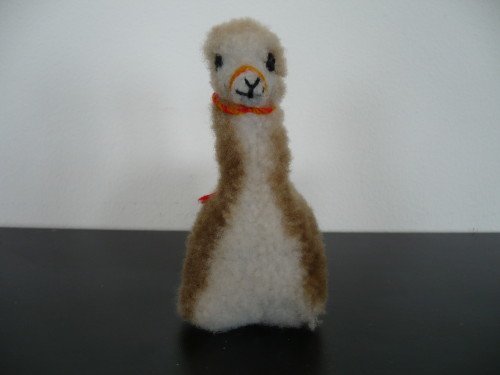
I gingerly lifted the book and saw this:

P1010060

A miniature llama. Sitting on my stomach.

He hadn’t been there a moment ago, but there was no disputing that he was there now. Sudden Llama.

What was he doing there? Smiling mainly.

My silly girlfriend must have come into the room, seen that I was absorbed by the book, and quietly put the llama there. She can be unpredictable in that way.

I, on the other hand, am a serious man–wholly predictable, thank you–and I was reading a serious book. I was not about to be undone by such silliness.

I did what any serious man would do and ignored the llama.

If I didn’t see him, he wasn’t there. I adjusted my glasses and returned to the book:

The trajectory of Freud’s and Lacan’s theory, said Žižek, goes from desire to drive…

But I knew the llama was there. Silent, with his friendly smile, on the other side of the book.

But what if he wasn’t. What if he’d llamaed off?

Maybe he was both there and not there. Schrodinger’s Llama.

Worse, maybe he’d never been there. I’ve been waiting for that to happen. I’m the ideal candidate for a pooka.

I peeked over the top of the book to check on the situation. I affected nonchalance, so that the llama wouldn’t know he was getting to me.

I saw this:

P1010060

Yes, he was still there. Obviously. Piercing gaze. Vacant smile. Elderly Welshman’s haircut for some reason.

Nonsense, I thought and returned to the book.

The trajectory of Freud’s and Llama’s theory goes from desire to drive.

What?

The trajectory of Freud’s and Lacan’s theory goes from desire to drive.

Samara came in. “I see you two are getting along!”

“Yes,” I said, “like a house on fire. I’m trying to read and he’s distracting me.”

“How,” said Samara utterly reasonably, “is a toy miniature llama distracting you?”

“It’s the look on his face,” I said, “it’s mesmerizing.”

“Don’t let him get to you,” she said, “you’re more sophisticated than he is.”

I wondered for a moment whether she was talking to me or the llama.

“I won’t let him get to me,” I said, “My mind is a fortress”.

She sat beside me and began to toy with the llama. “Read something out loud to me,” she said.

“The trajectory,” I said, “of Freud’s and Lacan’s theory goes from desire to…”

I could feel his llama gaze burning a hole through the cover. Like this:

P1010060

“Oh, it’s no use!”

Needless to say, Samara found this hilarious.

I snatched the llama up in my hands. I was surprised by how soft he was, hand-made possibly from alpaca fleece. I brushed him softly against my cheek. He was actually rather lovely.

“What is this anyway?” I asked “Who’s out there turning out miniature llamas?”

“He’s so silly,” she said dreamily, “and I have no idea where he came from.”

I thought it had come from the box of Samara’s childhood things her parents had recently pulled out of storage.

“Nope,” she said, “We’ve had him for longer than that.”

We thought about this for a while. The mysterious origin of the llama, how it arrived in our home.

It didn’t seem to trouble Samara, so I steadfastly decided not to let it trouble me either. I would not be tormented by this:

P1010060

Seriously now. Where did this thing come from? An egg?

The Shalom Aleichem Calls

Darkest February and we’re getting nuisance telephone calls from a person who says “Shalom Aleichem!” and “Shalom Aleichem?” and then hangs up.

The line is always crackly and the caller speaks neither English nor French, so I suspect he’s calling from overseas. I think I can hear good weather happening in the background too.

It would certainly explain why the calls invariably arrive between 2 and 6am, when I’m in my absolute best mood for receiving telephone calls from people I don’t know.

The typical Shalom Aleichem call goes something like this:

Caller: Shalom Aleichem!
Me: Look, you fucker, it’s four in the morning here.
Caller: Shalom Aleichem?
Me: I’ve told you before, you’re dialling the wrong number!

There’s a pause followed by a frustrated little sigh, which says he knows he’s speaking perfectly clearly so he must be dealing with a complete imbecile, and he hangs up.

Honestly, it’s like something from a Muriel Spark novel.

And doesn’t “Shalom Aleichem” mean “Peace be upon you”? What a phrase to be shaken awake with.

I’ve tried again and again to tell the man he’s got the wrong number and that he shouldn’t call here.

An early attempt involved putting my girlfriend on the line. Samara speaks Hebrew so, I figured, she’d be able to clear this up once and for all.

When the phone rang in the middle of the night last Friday, I took the handset into the bedroom, woke her up and put the still-ringing phone in her hand. There’s no way this is a bad idea, I was thinking.

“In Hebrew!” I said.

“שלום,” she said into the phone.

A pause and then, “?מה קורה”

She handed me back the phone.

“That’s not Hebrew!” she hissed, “it’s Arabic. And I’ve got work in the morning.”

I was going to protest, but thought better of it. The moonlight illuminated her face for a second and in that second it became clear to me that writing about our domestic life in a blog is not actually work no matter which way you slice it, that bed-related stories are forbidden and that this had better not make it into the blog.

Arabic, eh?

The next morning, I Googled around for the Arabic for “You have the wrong number,” so I could be prepared for the next call. I couldn’t work out the exact phrase but I got as far as Asif, al-rakm khate’e, which means “incorrect digit”.

Caller: Shalom Aleichem!
Me: Asif, al-rakm khate’e!
Caller: Shalom Aleichem?
Me: Look, it’s four in the morning. I don’t know what language you speak. And what’s that sound? Volleyball? Are… are you on a beach?

And he hung up.

So now I’ve taken to sleeping with a list of foreign-language phrases by the side of the bed.

This Tuesday’s attempt: Yeh aap ka matlooba number nahi. With a slight accent, I grant you.

Maybe the caller is trying to reach the Ukrainian humourist Sholem Aleichem, whose work provides the basis for Fiddler on the Roof. It’s possible.

Sadly, Sholem Aleichem has been dead since 1916 so he’s not going to be much help.

What is hopefully a final turning point in the Shalom Aleichem phone calls happened this morning. For once, the call arrived as we were having breakfast instead of in the middle of the night so I was somewhat more sensible to deal with it.

Caller: Shalom Aleichem!
Me: Shalom Aleichem!
Caller: Haha. Shalom Aleichem?
Me: Shalom Aleichem.
Caller: Ah.

He hung up.

Is that all he wanted? For me to say the same thing back to him? Is that possible?

It’s a prediction based on absolutely nothing, but I think that’s the last we’ll hear of him.

☎️

If you enjoyed this story, (a) shame on you, and (b) please consider buying my books A Loose Egg and Stern Plastic Owl for countless other encounters with Earthlings.

A Quiet Domestic Miracle

Sunday morning had drifted into our lives like a bowling ball down a metal garbage shoot.

Doing my best to solidify after a night of merriment, I’d been flopped upon the chaise for an hour, leafing through a book that I hoped would help me to understand the antics of sparrows.

Over on the other couch, Samara was doing embroidery.

“What are you embroidering?” I asked.

“The truth,” she said.

Samara is a witty lady. She’s a snappy dresser too. And she has a fearsome left hook.

Suddenly, she stood up with what I took to be a modicum of determination and declared that if I wanted her, she’d be fixing a snack.

This was unusual. I usually take the lead on snacks, because I’m inevitably the first to cross the finish line when it comes to reaching an appetite, but also because I’m the family cook and I know where everything lives in the kitchen.

“Okay,” I said.

She went over to the little kitchenette and began taking things out of the fridge, lining them up on the counter like a parade of delicious soldiers.

I did not bristle at the things in my territory being moved about.

She produced the tub of fake vegan butter and what remained of a loaf of bread.

“Can I make you something too?” she offered.

“Why not?” I said, even though I was a good half hour away from needing anything. But here I was, reading about sparrows and being offered a snack. Who was I to turn it down? Live for the now, I thought.

“Would you prefer jam, marmalade, Marmite, hummus or just plain old bread and butter?” she asked.

I thought it over for a second or two without taking my eyes off the book about sparrows.

“Cheese,” I said, pushing my luck.

A cheese sandwich was quite an upgrade to the level of snack she’d been offering. When all is said and done, a cheese sandwich is basically lunch.

“Cheese?” she said.

“Yes,” I said, “the fancy goat’s cheese.”

A pause.

“And some crunchy lettuce?”

“That would be nice,” I said.

“Okay,” she said, “one sandwich with crunchy lettuce and the cheese of a fancy goat.”

But then:

“We don’t have enough bread. There are only two slices left.”

“That’s okay,” I said. “You should have the last two slices yourself and use one of the skinny burger buns for mine.”

“Burger buns?”

“Yes,” I said.

“Okay,” she said.

One moment I’d been reading a book. The next, I was having a pretty serious cheese sandwich hand-delivered to my seat.

I felt like Eugene Polley must have felt when he came up with the idea for the television remote.

Suddenly there was a sandwich. And I was eating it. It was a quiet, domestic miracle.

The Nap: modern man’s final refuge

Originally published at Playboy.

When I was a kid I found it hilarious when my dad took a nap in the middle of the day. If I caught him in the act my response would be to strut about the room crowing at the top of my lungs, “DAD’S ASLEEP! WHAT A LAZYBONES!”

If he’s written me out of his will, I’ll deserve it.

Only now, at 31, do I fully understand the need for the nap. With pressures from every quarter, what refuge is left for the modern man? Gone is the time when dragging home an animal carcass once a month could constitute a job. A 50-hour work week is normal now, on top of which you’re expected to keep fit, look good, be up to date on international affairs and know where the good restaurants are. No wonder my father stole so many naps.

Naps are always stolen, of course, never given to you. Not since the heady days of kindergarten have we been encouraged to nap. Perhaps the unions could sort this out and instate a naptime in the workplace. I like to imagine a manager going around the desks saying, “Nap time, everyone. Put down that Blackberry, Kevin, it’s time for your snooze.” Cubicles would get quiet as employees would lean back in their swivel chairs and catch 40 winks en masse.

Spain and Greece provide a precedent with their notion of the siesta. Is there any finer achievement of civilization than this socially sanctioned noontime nap? After all, the whole point of civilization is to make life more bearable, more enjoyable. So instead of scheduling lunchtime meetings, let us schedule lunchtime naps.

I’ve tried several times to build a nap into my working day and failed. I once worked in a building that backed onto a public park. It seemed like the ideal opportunity to steal a lunchtime nap.

On my first stealth nap attempt I couldn’t get to sleep because a hobo was eyeing my shoes quite avariciously, which made me uneasy. The second time I scurried out for a park nap, I managed to drift off but woke up 20 minutes later to find a squirrel had stolen my sandwich. The last time I tried it, I awoke in a cold sweat to see my boss watching me from a second-floor window.

I could never relax again after that.

Today I work from home, so I can nap whenever I like. True, time is money, and an overlong nap can cost me anything up to $200, but it’s a sacrifice I’m prepared to make. If having a surreptitious snooze while my empire crumbles to dust is wrong, then I don’t want to be right.

Napping is forgiven on a plane or a train, but the sleeping experience could hardly be described as fun. The most delicious nap is the forbidden nap, taken when you’re supposed to be doing something else. If you can find a way of napping when fate has sentenced you to work, you’re destined for the finest nap of all and I salute you. Accidentally nodding off in a meeting does not count! To take your place in the higher echelons of nappers, you’ve got to nap deliberately and with intention to shirk responsibility, preferably in a stationery cupboard jammed shut with a box of copier paper or beneath your desk, like George Costanza.

An added benefit of taking a nap in the afternoon is that you can stay awake later into the night. When you don’t collapse from exhaustion at 10 P.M., you can have the social life they talk about in magazines. You can be James Bond or Noël Coward, schmoozing the ladies with an elaborate cocktail. Or you could just stay at home reading Playboy into the night.

Fight for your right to doze. Take your naps where you can get them.

Published
Categorised as Features

Toast and Jam

We resorted to toast and jam for breakfast this morning. We’d run out of cereal and the thought of a chilly pajama dash to the shops was too much to bear.

Wowee, you’re thinking, this is whiz-bang stuff. Toast and jam. Tell me more.

Don’t worry. It’s not your fault you were cursed with a sarcastic tone of voice. I know you’re fascinated by this.

The toast and jam turned out to be delicious, but this shouldn’t have come as a surprise. Whenever I eat toast and jam I think, “This is the business. From now on, I’m a toast-and-jam man,” but then I forget all about it and don’t have it again for years.

Something in the jam must wipe my memory. An amnesiac pectin, evolved in the wild to stop jam becoming popular among predators.

I could barely restrain myself. I had six slices. Three of strawberry jam and three of black-tea-and-pear jam. (Christmas hamper in case you’re wondering).

As I spread the jam between rounds, I took pride in getting the jam efficiently into the four corners of the bread (not much of a problem if you use bagels) and making sure there were no uneven patches. It made me feel like a master brick-layer who’d taken a blow to the head, retained all of his brick-laying prowess but inexplicably started using fruit preserve in place of mortar.

And this little fantasy occurs to me every time too. But for some reason, toast and jam remains my absolute last breakfast choice. I almost accept it as a punishment for having not done the groceries on time.

It’s the height of breakfast luxury and it’s one of the easiest things in the world. There’s nobody out there saying “I wish I could have toast and jam but I can’t really justify it, the way the economy’s going.”

This time, I’m going to commit to it. I’ll be loyal. I’m going to save up the golliwog tokens and send away for the brooches.

But all of this is a waste of ambition if I don’t remember it. I never learn. This is why I’m writing this in my diary today. Dear Diary: I had toast and jam for breakfast this morning and I enjoyed it. I always enjoy it. Try and remember that this time.

It’s the same with grapes. Whenever I buy grapes and sit around eating them in bed or on the chaise, I feel like a hedonistic emperor, the lord of all I survey. “This is the business,” I think, and then I don’t buy them again for a year. It’s very, very odd.

Feeding the ducks. That’s another one. If, for some reason, I end up going to a park and feeding the ducks, I’m struck by how fine an activity it is. Pulling bits off the loaf and flipping them into the pond. Superb. It’s probably been three years since I last did that.

Note to self: YOU LIKE GRAPES. YOU LIKE FEEDING THE DUCKS. ABOVE ALL, YOU LIKE TOAST AND JAM FOR BREAKFAST.

If it doesn’t work this time, I’ll have those words tattooed on my body like the bloke from Memento.

Whither Cheeky Cat?

Like any other person at any given point in history, I’ve not watched an episode of Coronation Street in about twenty years.

Perhaps inspired by the curious portrait of Hilda Ogden we spotted in a British import store, my Canadian partner has been pestering me to introduce her to the cobblestone soap opera.

She was doubtless enchanted by the idea of tabard-wearing pub landladies, smoking a fag and eating a bacon butty on the front step with a headful of curlers.

I wasn’t sure if that particular ideal still existed. It certainly used to. I remembered purple-haired Phyllis Pearce and her ongoing courtship with reluctant Percy Sugden. I remembered Vera Duckworth and Betty Turpin and Mavis Wilton and Ivy Tilsley and Emily Bishop and Bet Lynch: all true Valkyries of the North.

My childhood nickname for Bet Lynch was “Betty Hee-Hee” because I felt shy and giggly whenever she was on the screen. I was humbled in the thrice-weekly presence of my phosphor-dot telly aunt.

But I also remember these sinewy, arm-wrestling women being gradually replaced on the show with rather drippy youngsters with tedious modern problems like how much hair gel to slather on one’s pimply, dot-eyed head. By 2014 an even newer guard would surely be in place, twerking and selfieing and krokodilling their way around Weatherfield.

So it was with some trepidation that I installed the possibly-illegal computer programme to bypass the keep-the-Canadians-out protocols on the ITV website.

I can’t believe I’m actually saying this, but watching Corrie again after all this time was nothing short of utterly, utterly wonderful. I saw the planet Jupiter through a telescope recently and saw sea turtles in Hawaii but none of that shit has anything on returning to Coronation Street for twenty minutes.

The show has had a nip-and-tuck and looks somehow cleaner, presumably due to advances in how television is made, but it’s far from sterile. Everything is still pleasingly rickety and riddled with woodworm. Coronation Street is reassuringly the same as it always was.

Deirdre Barlow-Hunt-Langdon-Rachid-Sideshow-Bob-Terwilliger is still there, now with the most incredible baritone voice, prompting us to turn down the settings on our sub-woofer. Meanwhile, Steve McDonald has grown up to become an amalgamation of all recent Facebook photographs of every boy I went to school with.

Roy Cropper is there, reassuringly still looking like a buffalo who’s learned to talk and been crammed into a pair of pleated polyester trousers.

The Duckworths’ blue-and-yellow stone cladding is still there. People’s living rooms have been redecorated but the general architecture remains as it was in 1982.

Something I’d forgotten about is a kind of post-argument euphoria Coronation Street sometimes captures. When someone tells everyone off and storms out of the room, the camera stays for slightly too long on the stupid chastised faces of the remaining characters. It used to crack me and my sister up, and it made me explode with laughter tonight. I don’t really know why.

The internal continuity and logic of Coronation Street has remained intact for all this time. Whatever you think of soap operas, this is quite the artistic accomplishment.

But one thing has changed. Where the hell is Cheeky Cat?

Cheeky Cat, I should explain, was the name I gave to the ginger cat who appeared every week — without fail! — in the opening sequence of the programme, settling down for a cheeky nap (hence his name, I assume) among some red bricks and lumber.

I turned to YouTube to introduce my girlfriend to Cheeky Cat. I found him easily enough by searching for “Coronation Street 1990” but in doing so I discovered that almost every single episode of Coronation Street is on YouTube.

Mental.

Thanks to Coronation Street‘s intact internal logic, it became terrific fun to jump around in time between the 1960s and 2014, looking at how things had evolved.

My favourite find was a 1970 episode in which Emily Bishop is clearly played by the League of Gentlemen‘s Mark Gatiss. Go and look. You’ll see it’s true.

Ah, well. Cheeky Cat and Betty Hee-Hee may be gone, but the Street is still there. I recommend you watch it again, just once. It’s like going home for a visit. And if new Corrie somehow isn’t to your taste, just go to YouTube and time-travel back to the 70s and 80s, marvelling at the fags and curlers.

The Joy of Sickness

Originally published as ‘The Anatomy of the Man Cold’ in Playboy.

I recently spent four days in bed with the ‘flu. I say ‘flu but I have no idea what it was. It may have been a dodgy breakfast. It may have been some kind of voodoo inflicted by one of my enemies. I’m not sure. But something made me spend four days in bed, and it wasn’t such a bad deal.

On the evening of the first day of my man cold, my girlfriend’s brother came over. He was wearing a tuxedo, on his way to an awards ceremony. I answered the door in my pajamas and dressing gown, eyes rolling around in my head from the ibuprofen. “I’m jealous,” he said, “I’ve not been ill for ages.”

I’ll say this from the get-go: I don’t like being ill. I prefer to be in control, to feel healthy, and for my biology to remain silently functioning without bothering my conscious mind whatsoever. There are things to be getting on with. Plus, I’m frightened of pain and death. But my girlfriend’s brother raises a good point. There’s a silver lining in illness.

To start with, there’s pleasure to be found in complaining. When life is otherwise good, it can be fun to adopt the role of a moaner when you get ill. “Oh, my poor head!” “Oh, my ovaries!” “Oh, my self-inflicted gunshot wound to the foot!” Damn you, world!

You also have an honest-to-goodness Get Out of Jail Free card. For once, you don’t need to fabricate an excuse to get out of parties or baptisms or pagan volcano ceremonies. You can’t come to Eleanor’s long-anticipated shoe swap because you’re tucked into bed with a touch of the plague. Sorry, Eleanor.

As has so frequently been documented (William S. Burroughs, Keith Richards, others) drugs can be fun. Take some cough syrup and watch your consciousness stretch out and distort like the title sequence of The Outer Limits. Smear some VapoRub beneath your nostrils and pretend you’re “Menthol Chaplin.” When I was little, my parents were into homeopathic medicine; given that homeopathic tablets are mostly sugar, they’re actually rather tasty and very pleasing to crunch between your milk teeth.

There’s absolutely no need to feel guilty about an unproductive day when you’re sick. Maybe you’ve spent the whole day reading Sherlock Holmes stories in bed. But so what? You’re unable to do anything else. You owe nobody anything. You’re ill. Relax into it.

Your most coldhearted friends and relatives are duty-bound to be sympathetic when you’re ill. It’s the law. If they don’t bring their kind words, homemade soup and bunches of grapes to your bedside, you’re legally permitted to give them an Indian burn the moment you get well.

A good rattly cough is a wonderful thing. As are the sensations of picking at a scab, hocking up oysters of intriguingly colored phlegm, doing farts that smell like airplane fuel. And then there’s the finest of all malady sensations: post-puke euphoria.

The main silver lining of illness, however, is that it acts as a contrast to health. How wonderful it is to be healthy. To run without wheezing, to breathe without coughing, to be able to concentrate, to feel uneczematous, uncongested, laryngeally lubricated and generally able to soldier on without ailment, discomfort or psychological distraction. Santé!

Published
Categorised as Features

The Cargo Cult

“I don’t want to go to the suburbs,” I complained. “It’s creepy. Everyone wears tracksuits and trainers like they’re in a cult.”

It’s true. The tiny swimming pools in the front lawns disturb me too. They’re too small to accommodate humans so who are they for? The horned miniature beings they’re trying to summon forth, that’s who.

A Canadian friend, Shanti, had invited me along to a British import store on the outskirts of town. I could not think of a single thing that could persuade me to visit such a place.

“Come on,” she said, “they sell those cookies you’re always on about.”

“Hobnobs?”

We got into her car.

In a strange hinterland between the airport and Ikea stood a proud little strip mall unit with a red telephone box outside it.

The popular exports were all represented there: Monty Python posters, Royal wedding commemorative china, Beatles albums. What I hadn’t anticipated were the Man about the House and Doctor at Large DVDs, the multi-packs of Penguin biscuits, and the life-sized plastic statue of Geo Compario, the opera-singing corporate insurance mascot.

A video screen showed an episode of The Ed Sullivan Show featuring the Rolling Stones looking like medieval peasants with barely a tooth between them, and a young Tom Jones strutting his hairy stuff. It struck me as incredible that Wales had landed a man on America as early as early as 1965. I think they faked it and filmed it in a quarry near Llandudno.

The crosses of Saints George and Andrew hung festively from every available surface. At the centre of one was a miniature portrait of Hilda Ogden.

It struck me that at least one Canadian visiting this shop must have taken Hilda Ogden to be our queen.

Coincidentally, you can fit the lyrics of “God Save the Queen” into the metre of the Corrie theme tune precisely. Try it and see.

I also wondered what these artifacts told the Canadians about my home. There’s only so much one can divine from a display of remaindered Susan Boyle records and a bucket of Jif lemons made to resemble Jeremy from Airport. On the other hand, maybe it’s all you need to know.

“Hi! I’ll take all of these,” said an anglophile to the young woman at the cash register.

Onto the counter, she bundled a fluffball of Welsh dragon, Loch Ness Monster, and Lil’ Peter Sutcliffe plush toys. I may have made up one of those items for my own amusement. See if you can spot which one.

“Look!” said Shanti, holding a familiar pink shape, “Clangers!”

Great!” I whispered.

“Why are you whispering?” she boomed.

BecauseBecause I don’t want them to hear my voice.”

I gestured towards the other customers. I had no desire to become the central attraction at this house of Britch. They’d have me stuffed and mounted, glass eyeballs staring eternally at the Mr Bean video carousel.

“What a disgrace,” one of the customers said to me in a Mancunian accent, “Twenty-two dollars for six Kinder Eggs. Where are you from, love?”

I sighed. Rumbled.

“I’m from Dudley,” I confessed, “but I lived in Glasgow for a long time”.

She was from Salford and had been in Canada for thirty years, her husband having being headhunted for a Canadian oil company. I was interested that she’d retained her accent after such a long time. I’ve only been here for two years and I can feel the aitches being restored to their former beauty as if by magic.

“Phew! Ten dollars for frozen pikelets” she laughed, “Whatever next”.

She described herself as an expat and asked whether I was one too. Bureaucratically speaking I’m a permanent resident, but I’ve never considered myself an expatriate. When I say “expat” I think of middle-aged white people in South Africa, wearing panama hats and duck suits and calling the embassy every five minutes about how they can’t get a copy of the Mail on Sunday.

“If you live here,” she said with a tone of finality, “you’re an expat.”

I didn’t want to be an expat. It implied I’d be here forever, longing for home like a disgraced army colonel, wistfully following the World Service and being entertained by the mark-up on imported Tesco Value baked beans.

Shanti drove me home with two packets of hobnobs in a Union Jack carrier bag. Not bad for eighteen dollars.

Snack Birds

I have returned from a trip to Hawaii with my spouse Samara “Don’t fall off, you’ll spoil the holiday” Leibowitz.

We’ve become interested in natural history so, among other things, we went to Hawaii to look at its fairly unique animal life.

We saw humpback whales rising from the Pacific like rubbery islets; green turtles sunning themselves on the shores; and parrot fish shitting out their little skeins of rubble.

My favourite animal, however, was rather more common and could be found scattered chaotically over the lowlands like someone had upset a box of plastic skittles.

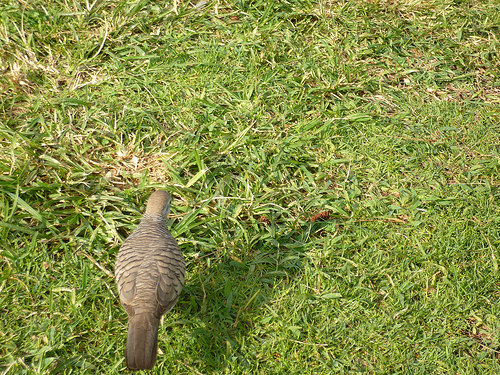
Meet the zebra dove: a miniature grey pigeon with a brain the size of a bogey.

Zebra doves are the most consistently baffled animals I’ve ever met. Their whole raison d’etre seems to be to bibble about idiotically, narrowly avoiding death like Stan Laurel on a construction site.

On one occasion, as we were hiking in a volcanic crater called Diamond Head, a zebra dove emerged from a thicket and ran closely around Samara’s marching feet like a penny around a magician’s fingers.

I watched the event unfold, heart in mouth. The dove seemed completely unaware of the danger, yet somehow dodged the falling boots for two figure-eight laps before retreating pointlessly into the thicket.

I do not know how zebra doves are so numerous in Hawaii, for they seem so terminally puddled and forever pootling into the path of doom.

It cannot help their survival prospects, moreover, that they happen to look exactly like a chicken drumstick.

Even I, a committed vegetarian, frequently felt the urge to grab one of these feathered morons and shove it in my gob.

The zebra dove must have been at the back of the queue when Nature was handing out the attributes. Nature, dividing up the groups like an enthusiastic grammar school PE teacher must have said, “Right, you chaps are Peregrine Falcons so your job is to be glamorous and deadly. You lot over there are Barn Owls, aloof and mysterious. Now you fellas…”

The zebra dove looks to Nature with gloopy-eyed expectation.

“You fellas… Hmm. Well, you have the most important job of all!”

“What’s that then?”

“Why, you get to be snacks.”

“Snacks?”

“Yes, snacks. You’re the snack birds.”

“Me?” says the snack bird looking behind him for the real target and looking more conspicuously like a chicken drumstick than ever before. “You’ve got to be kidding. The cuckoos get polygamy. The magpies get jewelry and a Saturday morning television programme. I get to be snack birds?”

“Yes,” says Nature, “snack birds. Nothing wrong with snack birds. Look at the Turkey.”

“No way, mate,” says the Turkey, basting itself with glee, “I’m special. I’m Christmas Dinner.”

“Yes,” says the zebra dove, “He’s Christmas Dinner. You want me to be the snacks? Like Pringles?”

Somewhere at the back of the room, a stately bald eagle hollers “Oh, do stop squawking and get on with it.”

“Yes!” says a budgerigar, already salivating at the prospect of unlimited millet, “get on with it.”

“Snack Birds?” says the zebra dove and feeling pressure from all quarters accepts its fate and gets, as they suggest, on with it.

Having said such insulting things about the zebra dove today, one must admire the fact that it so flourishes against the odds. I also found them to be surprisingly sprightly when I tried to get a half-decent photograph to accompany this diary entry. They’re extremely camera shy and, after spending half an hour of my last precious Hawaiian day chasing an idiot zebra dove around a park, I couldn’t get him to show his face to the camera. The nincompoop.

zebra_dove

Wringham reads Sherlock

rsz_green-tweed-deerstalker-500x500

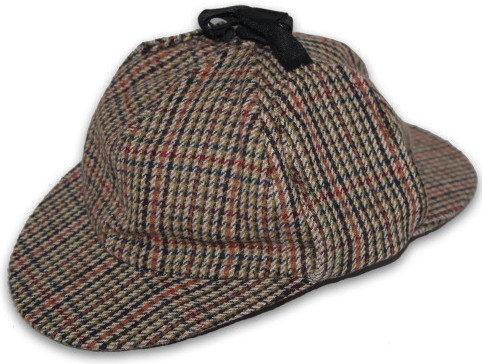
You can listen to me stammering through the Sherlock Holmes short story The Blue Carbunkle on Montreal’s CKUT Radio Station here.

It was originally broadcast over 90.3FM on New Year’s Day 2014 and recorded earlier in December 2013. It was produced by Courtney Kirkby for CKUT.

This came out of my hobby of reading Sherlock Holmes stories aloud. I never imagined I’d do it for an audience but somehow I was asked to read The Speckled Band to a small group at a charity event, and this lead on to the radio record. I’d love to do another one, but we’ll have to see.

To Resuscitate a Fly

My New Year’s Resolution of two years ago was to stop murdering.

Yes, from a young age I had been a devotee of insecticide. It all started with the casual swatting of a mosquito and culminated in the systematic poisoning of an entire family of earwigs.

If I hadn’t have stopped when I did, I might have ended up as the Osama Bin Laden of insects, emptying a kettle over an ant hill. And for what? Politics?

But on January 1st 2012, I stopped. With a rolled-up newspaper hovering over a moth, I asked myself: does the world need more death in it? My bug-bludgeoning days were behind me.

Today — almost two years to the day of my resolution — I took pause to notice just how far I’ve come.

There had been a fly buzzing around our apartment for almost a week. He was one of those lethargic flies, committed only to his desire to pass through a single window pane, so I hadn’t been motivated to kick him out. Besides, it was twenty below zero outside and my non-killing rule had cornered me into granting asylum.

As a point of fact, the fly had been around for so long that it felt rude not to gave him a name. Flyey.

I suppose I could have chosen a name that was easier to pronounce but there was just something about him — the fact that he was a fly, perhaps, and seemed pretty enthusiastic about flying — that made the name so right for him.

My human friend Anton is a pilot and spends a lot of time in flight. I suppose he could be named Flyey too, but he’s not a fly and so Flyey has two claims to the name for Anton’s paltry one. Besides, Anton is called Anton presumably because he has an ant on, though I’ve never been able to spot it.

Flyey was around for so long that I had begun to wonder when natural causes would take him off my hands, but I didn’t like to think about it.

This morning, after a total of eight days of Flyey’s company, my girlfriend found his tiny body on the window ledge.

She said: “Ew, gross, there’s a dead fly over here” or some other callous thing.

Could it be?

I went over to investigate.

No!” I said, “Flyey!”

It seemed to me he lived his life like a fly candle in the fly wind.

Why?!

“It’s only a fly,” said my girlfriend.

“That,” I said, “was Flyey. And he was the best darn…”

But I couldn’t finish.

And then it occurred to me. There could still be time.

I remembered hearing something on the radio about how to cheer up an ailing bee with a spoonful of royal jelly. Flyey had never shown an interest in honey though.

“Quick!” I said, thinking on my feet, “fetch me a spoonful of turds.”

Mercifully a neighbour heard the commotion and came to our assistance. It’s amazing how quickly and selflessly human beings can act in a crisis.

It was all too much for my girlfriend’s feminine sensibilities and she quite understandably left the room.

Doubtless, you will be relieved to hear that we were able to resuscitate Flyey. You should have seen the look on his fly face. Somewhere in the confusion, I knew he was glad to be back from the fly dead. It was not yet his fly time.

The neighbour and I drove him to the emergency room, where Flyey now regains his strength, supping meekly upon the tear duct of a generous volunteer.

Blimey, I just realised something. None of this happened. I must have replaced murder with lying. That’s the problem with giving up habits. It’s one in, one out.

🪰

If you enjoyed this story, (a) shame on you, and (b) please consider buying my books A Loose Egg and Stern Plastic Owl for countless other encounters with wildlife.

Don’t Break the Chain

Back when I worked as a library assistant, we had a cash register at the circulation desk for the overdue charges.

With each transaction, the cash register would sputter out a receipt.

“Would you like a receipt?” we’d ask the punter, to which they would say “No.”

Nobody wants a receipt for a 15p library fine.

So we’d tear off the receipt and put it in a little bin. The receipt bin.

What a futile life that cash register had.

During a busy spell one summer afternoon, we stopped asking people whether they wanted a receipt and we stopped tearing off the receipts and we stopped putting them in the receipt bin. The receipts just kept on sputtering out uselessly and soon they formed a long chain.

On one occasion, we took notice when 27 receipts had printed without breaking off. It was glorious.

“Nobody tear off a receipt!” someone said. “Let’s see how long we can get it.”

It was one of those little survival techniques–little games you make up for yourselves–when you have a boring job.

Sometimes, a new staff member not yet indoctrinated into the game would break the chain and put it in the bin.

“What have you done?!” we’d all shout. “Don’t break the chain!”

Sometimes, a persnickety customer would ask out right to be given a receipt and you’d be forced to break the chain.

“Are you sure you want a receipt?” you’d ask.

“Yes,” they’d say.

“Why?” you’d ask.

“Because I’ve spent some money and I am entitled to a receipt,” they’d say.

We’d hate that person forever. If the library had been a restaurant, we’d have all gobbed in his soup.

On one occasion, I saw a library assistant writing out a receipt for 50p by hand. I didn’t have to ask why. She didn’t want to break the chain.

Sometimes, a supervisor would tell us to stop being so silly.

“Break the chain,” he would say, “it is a pointless mess.”

Needless to say, I was suddenly driven to pass my supervisor exam as soon as possible. With me in charge, we could let the chain grow as long as we liked.

The longest chain we ever cranked out was 136 receipts long. It was the most beautiful thing any of us had ever seen.

We sent it to the Kelvingrove Museum along with a letter explaining how we’d like to submit it to their exhibition about working-class life in Glasgow. We got no reply.

A Geiger Counter for Christmas

Shrug this off if you like, but Montreal is set to suffer a deadly dose of Christmas Radiation.

“Christmas Radiation?” you ask. “What are you talking about?”

I’ve tried to warn you about it before. Pay attention. I’m doing a public service.

Overtly Christmassy objects emit Christmas Radiation. Got that?

We can withstand it for a month or so, but soon afterwards it begins to warp our minds.

If you know someone who is mentally ill, check their home for holly wreaths left up all year round or Christmas trees moldering in the spare room. Remove these objects and your friend will be fine. No need for therapy or drugs. I personally guarantee it.

After a month, Christmas things must be packed into cardboard boxes and stowed safely in an attic or crawlspace. These are the only environments in which Christmas Radiation can be stabilised.

Montreal is especially at risk. I live in Montreal and I can tell you that every year, all through the spring, people leave their decorations up. I’ll be out on my routine voluntary Christmas Radiation Inspection (RVCRI) and I’ll find decorations left up until April or May.

This is why there are so many people hanging out on Montreal street corners, wearing cycling helmets and shouting “Nipples!” at innocent passersby. They’ve had their minds warped by too much tinsel.

Check desk drawers for rogue baubles. Check the fridge door for excess nog. Check inside your anus (or have a friend check for you) in case any half-digested roast chestnut has become lodged there.

You owe it to your sanity.

Madness in the workplace can all too often be traced to an obvious source: tiny remnants of streamer stuck to blue-tack in the corners of ceilings. So enthusiastically raised in December, so mercilessly torn down in January. Ghosts of Christmas Past, I call these little dods of glittery tack. They haunt the office all year round, pulsing their radiation into the aching brains of otherwise happy data entry clerks.

How could such pretty objects emit such harmful rays? Well as everyone knows, Christmas decorations are forged by elves in the mines of Lapland (or Greenland or the North Pole or wherever it is you think Santa lives) and it is in these mines where Christmas Radiation spumes forth from subterranean figgy pudding deposits.

They’d ban this practice but it’s where Saint Nicolas derives his supernatural powers. How else could he visit every child in a single night? By commanding the power of the mighty element Festivium is how.

Don’t look for it on your periodic table. You won’t find it. Its position is so far south of Cadmium that it’s off the map.

Holly wreaths? Christmas radiation.

Candy canes? Steeped in it.

Nutcrackers? Don’t get me started.

Be safe this New Year. Take your Christmas shit down on Twelfth Night. To be extra safe, ask for a Geiger Counter next Christmas.

The Lives of Crane Operators

Tower cranes. They protrude from our cities like candles from birthday cakes.

I like cranes. I can see two from my window right now. They go about their heavy lifting as I go about mine. (What? I’m a humour writer. I lift people’s moods).

In idle moments, I watch the cranes and wonder what it’s like to be a crane operator.

The job is blue-collar, but their offices have the best views in town. White-collar psychopaths schmooze their way to what they think is the top, but the humble crane operator watches silently from an even higher top. Wanking.

It’s possible. Who knows what goes on up there? When I train binoculars on the cabin of a crane, all I see within is a tiny swiveling head.

Maybe that’s all there is. Tiny swiveling heads, all using their surrogate metal appendages to drop the imprisoning lids on new office blocks.

Unlikely I suppose. But the whole idea is unlikely to begin with: that there are humans in the sky, yanking on joysticks, under orders to plant sewer pipes. It’s a world gone mad.

The lives of crane operators are different to ours. They surely do not, for example, take elevators to their offices. They take ladders. A hundred rungs? A thousand? Just one big leap? Nobody knows.

They have special privileges. In most offices, workers are reprimanded if they so much as stand on a chair to unscrew a bulb. These people climb the sky.

Do crane operators bring their own lunches to work? Only two alternatives occur to me: food bundles delivered by owls; cheese rolls and oranges honked neatly into the cabin by the fancy air cannons used to distribute t-shirts at hockey games.

What do they most enjoy for lunch? If altitude numbs the senses, maybe crane operators like it salty. Does this mean they’re always thirsty? And if they’re always thirsty, do they quench their thirst or suppress it lest they have to climb all the way back downstairs for a wee?

I hope it’s not too big a slur on their character to suggest crane operators wee over the side. It must be better organised than that. Perhaps they take advantage of surface tension and wee down a 250-foot cable into an awaiting toilet. If so, the wees of crane operators must be among the world’s longest wees.

I once looked after my mum’s cat. She’d sit in the bay window, making eyes at next door’s cat who in turn was sitting in her own bay window, staring back at ours. Two blister-packed cats, locked in eternal speculation. I wonder if crane operators do that. Do they look out from their cabins into the cabins of other cranes? Or is that a faux-pas and crane operators all have to pretend they can’t see each other?

On the other hand, maybe they’re all good friends. Between cranes would be a exquisite way to play tin can telephone.

Do they ever get to work and realise they’ve forgotten their keys and have to go all the way back down to get them? Do they ever refuse bribes from government agents who want them to be their eyes in the skies? Do they drink from novelty mugs that say “crane operators do it while high”? Are crane operators successful with those mechanical claw games in amusement arcades or are the controls so different there can be no comparison? We will never know. They are out of our reach.

🏗

If you enjoyed this story, (a) shame on you, and (b) please consider buying my books A Loose Egg and Stern Plastic Owl for countless other flights of fancy.

The Day the Squirrel Got In

I like squirrels. They are living paradigms of mischief.

I also have a particular fondness for those occasions where animals get into human places, like when a dog gets into a school playground and anarchy breaks out. A clever child will leave a couple of doors open to be sure the dog gets into the school building, runs around excitedly in the halls and classrooms and offices and ends up licking the headmaster’s face. They can’t even keep a dog out! Viva la Revolución!

Imagine my excitement today then, when a squirrel got into the apartment.

I’d been baking a cake so things were already teetering on the edge of madness.

One moment there was no squirrel. A moment later there was a squirrel. It was as simple as that.

A squirrel! A squirrel indoors. A flippin’ squirrel — the outdoors being his normal preserve — indoors now with all the people things. A squirrel indoors. What will they think of next?

To make matters more exciting, this was one of the rare albino squirrels we have in Montreal. A proper spirit animal if ever there was one; a totem of mayhem; a familiar of full-blown devilry.

He was a real phantom: ghost-white, pink-eyed, and sitting on my chaise like he owned the place.

He looked at me, trying to ascertain what I would do next.

I looked at him, doing much the same.

This was quite the meeting of minds.

As honored as I was by his visit, I’d have to get him out. I couldn’t share my home with a squirrel. I’ve had flatmates before and I know how it goes. He’d be eating all the nuts and berries no matter how clearly I labelled the containers. He’d be wearing my slippers and smoking my pipe and making lengthy international phone calls to his grey relatives in the States and his red ones in Europe. Before you knew it, he’d be bringing weasels home to dinner and letting them use our bathtub.

No. The line must be drawn somewhere.

I lunged with a beach towel in an attempt at netting him, but he coolly sidestepped the danger, nimble as a squirrel.

No good. Think, Robert, think. Put that British state education into action.

Let’s see. The only animals I’ve escorted from my home of late have been spiders, for which I used the classic glass-and-paper maneuver.

Well it was just a question of scale surely. A perspex bowl and a record sleeve later and I had the blighter.

He stomped about furiously under the dome, pink eyes blazing with the vitriol that only an incarcerated squirrel can summon.

I marched him onto the balcony. Arrivederci, Nutkin.

At this point I’d normally drop the spider into the abyss, safe in the knowledge that a skillful spurt from the spinneret will save her. To my knowledge, squirrels don’t have such abilities. Not ones for web-spinning, the squirrels. They’re more at home obsessively hoarding acorns and forgetting where they buried them.

I briefly considered dropping him off anyway. He’d given me quite the runaround. Could I do that? Perhaps I’d make like William Shatner booting that Klingon into the lava flow. “I… have had… enough of you!”

But, as I say, I like squirrels.

This is how I ended up chauffeuring a squirrel downstairs in the lift.

The Bird Table

We live high up in one of Montreal’s tallest buildings, yet our balcony is a major social destination for sparrows. “The place to be” ★★★★ — What Roost.

How do sparrows get all the way up here? Probably some kind of flapping motion. I’m no ornithologist.

It’s all a bit sinister if you want the truth of it. I can only imagine they flock here in such numbers to watch my girlfriend undress.

I open the curtains each morning to four-and-twenty sets of peeping little eyes. I’m yet to see one blink, though I fancy I once saw a wink.

Still, I can’t help but admire their persistence to survive in our freezing, stinking city. Their diet of bagel crumbs, discarded prophylactics, and remaindered Expo 67 souvenir geodesic snow globes cannot be nutritious, yet they pull through.

I was suddenly overwhelmed by the desire to install a bird table on our balcony. As long as they visit us, I’ll lay on the hors d’oeuvres.

I pulled on my coat and hat, and with as much pomposity as I could muster, marched out to the shops to acquire a bird table and some seed.

It wasn’t until I was in the elevator that I realised I don’t have the first idea of where to get such things or even what they should cost. Twenty dollars? A million? It’s also true that bird tables went out of style with screen doors, cobblers, and toffee hammers.

But this was Montreal, dammit! A city foaming over with hipsters, or as they’re called here, les doofus analogues. Where there’s a store devoted to dead people’s eyeglasses from the 1930s, I could surely find some coiffured popinjay making a loss on bird tables, could I not?

I could not. After three hours trudging in the snow I found nothing of the sort. Pet shops, hardware stores, supermarkets. Nobody could help me.

“Do you sell bird tables?” I ask a cheerful clerk.

“A what?”

“A bird table? A table for birds? You set it up with some seed and watch the birds come to eat.”

“You mean a bird feeder?”

“Well, that’s a kind of hanging thing with nuts in it, no?”

You’re a kind of hanging thing with nuts in it.”

She had me there.

In the defeated trudge home, as is so often the case, I came to a realisation. A bird table was essentially a plank of wood. Is that what they don’t have in Canada? Ha!

I then remembered the wooden bar stool that’s been decomposing on our balcony for two years. There were also some unsalted sunflower seeds in our kitchen cupboard left over from a virtuous phase.

Why, that was everything I needed! Let this be a lesson to you all. Shopping is not the solution. Just use your own rotting bar stool and, as my grandfather Multiple Miggs Wringham, used to shout, it’s a rare problem that can’t be solved by throwing your own seed at it.

Curiously few sparrows have visited us since I laid on the grub. “Clichéd offerings from a naïve kitchen. A balcon to avoid.” ★★ — Modern Finch.

Only one sparrow has so far seen fit to grace our bird table. He pecked around most discerningly. Frankly, he had a rather regal air about him for someone who until recently ate off the floor. He kicked some seed about and flew away.

“Tell the others!” I plaintively called after him.

Once aloft, I imagined the sparrow communed with his fellows:

“You’ll never believe what I just saw. A bird table!”

“A what?”

“A bird table? A table for birds? The stupid mammals put seed on it and then sit around watching us eat it.”

“You mean a bird feeder?”

“Well, that’s a kind of hanging thing with nuts in it, no?”

You’re a kind of hanging thing with nuts in it.”

“You’ve got me there.”

“Humans. They’re ridiculous. Nice jugs on some of them, mind.”

Hardly an evocative number

Birthday is it? Passing Go to collect two-hundred are you? Another lap around the sun is it?

Yes, yes, Thursday was my birthday. My thirty-first. Leave me alone.

I was going to open this entry with something like “Thirty-one? Hardly an evocative number,” but on sitting down to do so, I’ve realised it does evoke something.

When I was 18 or so, I had a Saturday job in a warehouse and had a friend there called Steve Hill. He was a sociable if meaty-breathed fellow with a shabby-glamorous John Cooper Clark demeanor.

Steve was popular enough to have his own catchphrase and an impressively Dadaist one at that. The catchphrase was, simply, “thirty-one”.

Somehow it was always applicable. If he was feeling down in the dumps, he’d shake his head forlornly and say “thirty-one.” If he received good news he’d jubilantly cry “thirty-one!”

On one occasion, I happened to be present when Steve lost a piece of fingernail to a improperly-sealed crate and I swear he said “AAAARGthirtyone!

Imagine Steve presenting game shows. He’d come out and say “thirty-one?” and the audience with no further prompting would roar “thirty-one!”

What was the origin of all this? Steve, he explained, had been at a party one night when a comatose man had stood up suddenly from his drunken torpor and, seeing Steve, said “thirty-one” with great gravitas and import.

Perhaps the drunk had seen Steve’s future. Perhaps he’d picked up an important radio signal on his fillings. Perhaps he’d just had too much hooch and was completely insensible. We’ll never know.

“Thirty-one,” the drunk had said to Steve, and then collapsed.

Steve recounted this story to us and we liked it so much that “thirty-one” became a kind of halloo. You’d pass Steve in the corridor and shout “thirty-one!” and he’d shout “thirty-one!” in response.

It was a strange catchphrase, like something from an experimental spoken word night. After all, we were ten young men on the outskirts of an industrial estate, laughing at a number.

It did not take long for the original story to become lost in time. Staff turnover in the warehouse was high and the original gang who knew the providence of the catchphrase soon disappeared. The new kids on the team learned to say “thirty-one!” when they saw Steve, without knowing why. “Thirty-one!” in the corridor; “Thirty-one!” in the staff room; “Thirty-one!” when we were all stuck in traffic on the way home.

I remember thinking in the summer of thirty-one that I’d probably forget the significance of that number when I left that job, but that I’d maybe remember it with surprise in the impossibly distant future upon my thirty-first birthday. Amazingly, I did.

Happy Birthday to me! Thirty-one.

Old enemy of mine

Never learned to swim?!” they all gasp, groping around for something on which to steady themselves.

Honestly, they act as if I’d never tasted milk.

I never learned to swim, okay? Like those who live with the outsider burden of having never seen Gremlins or King Ralph, swimming, for me, simply never came up.

I don’t know why it’s so remarkable. There are many other things I can do which are seldom celebrated. Sleeping, eating, swearing. The list is endless.

Alas swimming–along with figure-skating, ventriloquism and javelin–is a life skill it never occurred to me to master.

And I stand by those sarcastic comparisons. Imagine you woke up one morning and everyone had gone javelin crazy and couldn’t believe you weren’t in on it. It’s all well and good, you might think, but what’s it got to do with me? In Cricklewood. That’s how swimming looks to me.

I grew up in Dudley, which, in Britain, is about as far as you can get from the sea. It’s the windowless office of the nation. I’d cite this as the reason for my never having learned, but everyone in Dudley was mad about swimming. Family legend has it that my six-year-old grandfather learned to swim in a local carp pond, so excited was he to master the backstroke. My father, if he is to be believed, learned in a bucket of turps.

But even now I find myself wondering why any youngster from Dudley, a place which hasn’t seen ocean since the Cretaceous, would get the idea that they must learn to swim. How could it serve one’s Dudley life? I suppose it might be a handy way to get to work in the morning: front-crawling up the canal to Birmingham.

While the other children were learning to swim in those chlorine-perfumed, wedge-shaped bacteria troughs they call public baths, I must was in my mum’s living room eating jam sandwiches and watching horror films taped off BBC2: something I do not regret. You should hear my Vincent Price impression. “They swim… the mark of Satan is upon them.” et cetera.

Swimming has nothing to do with me. But maybe I should make it to do with me, you may object. That’s what everyone else does. They live in cities, miles away from the sea or a Great Lake or even a decent pond, but they still find ways to submerge themselves, as if they have some primal need to reconnect with their jellyfish ancestry.

In one part of the city, we go to pains to pour cement into any hint of concavity lest a puddle form there. In another, we dig a pit and fill it with water for people to wallow in. It seems there’s quite the industry in digging holes and filling them up. It’s about time someone looked into that.*

(*On a similar note, have you ever noticed how bottled water in Birmingham comes from the Scottish Highlands, but the bottled water in Edinburgh comes from Shropshire? It can only be down to a lust for the exotic, and now there’s a whole industry in water-swapping. Further evidence that water makes people crazy and is best avoided.)

Safety was always the reason cited when I was a child to get to a pool and learn to swim. There was a fear among adults that children would wander off only to be found face-down in a waterlogged quarry. Why did they think we’d be drawn to such places? If I wandered off anywhere, you’d find me at the pictures. There’s hardly any drowning opportunities there. Unless perhaps you’d gone to see Jaws.

“You can drown in a glass of water,” was always the stern claim when they told you about water safety. To which I respond, “That may be. And how will backstroke help?”

Health. That’s the new reason. Swim! Swim! Swim for health! In the city. Yet there are many other ways to keep fit that don’t necessarily require speedos. Waving for taxi cabs, for example, or running from hoodlums.

Health? Safety? Nostalgia for trilobites? I remain unconvinced. Water thinks it’s such a big shot with its two hydrogens for every oxygen.

Bah, I say. It is nothing to me. You know what I do to water? I drink it. Take that, water. See how I consume you, old enemy of mine? You are nothing. You’re a jellyfish less the 2% solidity.

A Punch in the Face

The Great Outdoors is not my element. I’m more at home with The Slight Indoors: a telephone box, for example, or a lift.

It was somewhat out of character, then, when I went off (voluntarily!) to explore one of Canada’s national parks earlier this year. I even went so far as to take off my oxfords so that I could paddle in glacier water.

I suppose I wanted to prove it to myself. That I could brave untarnished air with the best of them.

None of this would have been possible, of course, without hours of advance preparation in the library. After digesting Dewey 796.5 in its entirety, I felt ready for the world unpaved.

On the trail, I patronizingly impart some new-found wisdom to my girlfriend. The best way to do this is to affect nonchalance and to pretend that you knew everything all along.

“If a bear should cross our path,” I say, “the most important thing is not to run”.

“I see.”

“What you must do, dear heart, is stride confidently up to the bear as if you own the place. Maintain eye contact and then, while he’s still getting his shit together, you abruptly adopt Fig. 49.”

“What?”

“Fig. 49 from Creg Dennehy’s Over-Easy Guide to Outdoor Survivesmanship. Fig. 49: A Punch In the Face.”

There was a time in our relationship when the revelation of such pearls would result in a raised eyebrow or two, but she must have overworked those muscles over the years, for her expression betrayed little but constant adoration.

“I think that’s for sharks,” she said.

“No, silly. Sharks live in the sea. There aren’t any sharks around for miles.”

The nearest shark, as a point of fact, was preserved in formaldehyde some fifteen-hundred miles away in a San Francisco art gallery.

An hour later, we chance across the cloven footprints of a moose. There is a strong scent of musk in the air. My smitten partner probably assumed the smell belonged to me. But no.

“Do you smell that?” I ask, “it’s probably the moose but there’s an outside chance it could be a bear.”

“Shall we track him down and adopt Fig. 49?”

“No, dear, I think we should leap ahead to Fig. 52 and move very quickly in the opposite direction.”

Back in the cabin, we reviewed our nationalparksmanship over a restorative lunch of cucumber sandwiches and a cheeky gee-and-tee.

We agreed it was more exciting to think about the bear I could have punched than to dwell on the moment I got the whiff of a moose and ran away.

The Thunderbolt Kid

Why must I be such a snake when it comes to getting what I want? Why can’t I ever just ask for something?

I went to a meeting this morning at the house of a wealthy client. Her opulent home was in some disarray — partly because of the major construction work being done on the house, but also because some real go-getters had come for the meeting and were all competing for the comfiest seat.

Coming in through the front door (traditional, like) I’d spotted a mountain of books packed haphazardly into cardboard boxes and stacked up in the hall.

It was clear that the books were to be disposed of. On the top of the pile was a glistening, potentially-unread hardback copy of The Thunderbolt Kid by Bill Bryson.

A rather grubby voice from somewhere in my avaricious, bibliophilic depths said, “I’m having that”.

But how could I ask for it? I was here on business. It felt rather shabby to say, “Are you finished with that?”

Incapacitated by the idea of simply asking for the book, I fell back on my time-honored slippery ways. I began to spin a web of complex psychology, with which I could manipulate everyone as if they were painted marionettes and I their nimble-fingered puppet master. By the time I was through with them, they’d be sending me every copy of The Thunderbolt Kid they could find in the province. It’s just a little skill I have, which means I’ve never done an honest day’s work in my life.

“I notice you’ve boxed up a lot of books,” I said, trite as a Thanksgiving turkey, “I suppose you want them out of the way while you’re having all the work done.”

“No,” she said, “I’m slinging them. Such garbage! I aught to give them to charity but I don’t know where to send them.”

I winced that she’d describe what would soon be my books as garbage but managed to keep my cool.

“Hmm,” I said thoughtfully as if the idea was only now forming in my innocent mind, “The library by my house accepts donations. I’d take care of this for you if only I could transport them. I don’t drive though.”

There was a pause as I waited for the synapses to fire. Somewhere up in the galaxy, a star burned out.

“Why, I could drive you!”

“Oh! What luck!”

It was beautiful. What a neat little heist I had arranged. Not only would I win The Thunderbolt Kid and every other treasure inside those boxes, I’d be getting a ride home in a Mercedes-Benz.

Later, as the meeting drew to a conclusion, I saw to my horror — my abject and undying horror — that one of the go-getters had spotted my books and was lustily fondling The Thunderbolt Kid.

“I love Bill Bryson!” he said. “Could I have this?”

“Of course you can dear!” said the client sunnily. “It’s one less for Robert to take”.

I’ve never mentally murdered anyone so brutally.

This was how I came to have five dusty boxes of art catalogues and National Geographics cluttering up my living room.

Does anyone know when they come to collect the bins?