Maximum Vicarage

More tea vicar? This is a catchphrase we have in our office at WringCorp. More tea vicar? More tea vicar? More tea vicar?

It’s a friendly way of saying “I’m bored. Let’s liven things up by watching the kettle slowly progress towards bubbly climax”.

It occurs to me today that I don’t know what a vicar actually is. I know they’re some kind of holy folk, but what kind? Catholics have Priests and I think Baptists might have Ministers. Are these all clergymen? Or is a clergyman a person who rods the drains?

It’s shameful that I’m so ignorant in these matters because I used to know a vicar. I could have asked him all about it. His name was Mark the Vicar.

Our primary school sat at the bottom of a steep hill. At the top, there was a toyshop with a clumsy shopkeeper, so we were never short of marbles.

Something else that rolled down the hill every so often was Mark the Vicar.

Mark the Vicar was a well-meaning fellow who took it upon himself to cycle from John o’ Groats to Land’s End once a year, stopping along the way to address the children of any school who’d have him.

Like a moth to a flame, Mark the Vicar came to see us.

Whenever his name came up in assembly, I’d shout “What with?!”

The other children loved this joke without understanding it. I knew they didn’t understand it because when our headmaster introduced an entirely different speaker one day called Madame Claudette, some of the other children shouted “What with?!”

Poor Claudette. She got such a Madamming.

Mark the Vicar’s schtick was to tell us about his adventures in between stints of pedaling in a Cornwallerly direction. He’d then find a tenuous way of connecting those events to something he believed had happened to a certain Mister Jesus.

“I had quite an adventure in Hadfield last week,” said Mark the Vicar, “when I ate some food in a Chinese Restaurant.”

Say what you like about Mark the Vicar, he was never one to use the word “adventure” correctly.

He then segued with the grace of a mangled hunchback into the most bizarre and quasi-religious story I’ve ever heard.

“A man died,” said Mark the Vicar, winning our attention immediately, “and his soul was welcomed into a large reception area by Jesus.”

By this age, I was fairly familiar with New Testament ideas about the afterlife and never up until this point had a reception area been mentioned. I wondered if it had a decorative fish tank or some old National Geographics lying around for while you were waiting.

“‘Take my hand,’ said Jesus to the man, ‘and I will show you your place in Heaven but also what you’ve avoided in Hell.'”

A gifted storyteller was Mark the Vicar. He did the voices and everything.

In a bizarre narrative twist, Jesus reveals that the people of Heaven and Hell alike use chopsticks, just like Mark the Vicar had done for the first time recently. Except, Johnny Deadfellow uses giant chopsticks.

Stop me if you’ve heard this one.

To theatricalise his incredible claim, Mark the Vicar, had brought along (on his bike? From John o’ Groats?) several pairs of six-foot-long chopsticks, with which he encouraged some volunteers to eat some crisps.

Salt & Vinegar Monster Munch, of course, is one of few staples common to Chinese, Celestial and Infernal traditional cuisines.

I wish I could report that the feat was impossible — for Mark the Vicar’s entire parable hinged on it — but one clever girl succeeded in eating the crisps by raising them six feet in the air and sliding them down the chopsticks, fireman-style, into her awaiting maw.

Redfacedly overlooking the girl’s ingenuity, Mark the Vicar revealed the “correct” technique. The volunteers must feed each other with the giant chopsticks. And so we learned a valuable lesson in cooperation.

Readers, please do not confuse the help-each-other-with-the-giant-chopsticks technique with with the putting-on-of-oxygen-masks procedure in a tanking airplane, or indeed any other situation which might actually happen.

“The people of Heaven are able to fill their bellies while the people of Hell are eternally hungry,” explained Mark the Vicar, “Because in Heaven, they have learned…”

He paused, composing himself for maximum vicarage.

“…cooperation.”

In the twenty years I’ve lived since this assembly from Mark the Vicar, I don’t think I’ve encountered such an impressive torrent of drivel.

More tea vicar? Yes, and perhaps a nice happy dose of Mister Benzodiazpam too.

Like a Wriggly Tic Tac

North Americans are awfully squeamish about maggots.

Barely a day goes by without some terrible slur against the noble corpse-dwelling pupae.

The North American vernacular is crammed with expressions derisory to the maggot. “The man’s a maggot!” they say. And, “I can’t eat that, there’s a maggot in it”.

I heard today that an otherwise tame horror movie can be honked up to an R-rating if a zombie happens to have a maggoty eye.

Keep the horror movies accessible to teenagers, I say, and whack a parental advisory on the poster, “warning: may contain thousands of maggots”.

You know, like certain supermarkets do with their microwavable pies.

What does this continent have against maggots? I cannot fathom it. They’re just baby flies. Goo-Goo, Ga-Ga, Wriggle-Writhe, Buzz Buzz. Adorable.

Yet you’d be a social pariah in North America if you were to make a special cradle for a maggot, dress it up in swaddling clothes and invite your friends to hold it.

Next you’ll be denying young millipedes of their rusks.

North America, I would like to take this opportunity to tell you a heart-warming story about the little maggot who grew legs. Proverbially.

In a science class at high school (and our school was very high — they built it in a tree), we were asked to race maggots against each other.

The point was to discover the experimental variable capable of building the champion maggot.

Would a maggot, for example, be empowered or crippled by exposure to light? Would it thrive or choke when soaked briefly in water? Would it chomp at the bit when shown titillating photography of celebrity maggots inadvertently exposing themselves while getting out of cars?

I was a step ahead in this guessing game because I’d witnessed fishermen along the local canal who’d used maggots as bait. Some of these stinking but wise oldsters would put the bait briefly under their tongue, thus warming the maggot and making it wriggle more appealingly when skewered on the hook.

Tongue heat! Tongue heat was the winning variable!

As any committed scientist would do, I copied the wacky angler.

Yes, I unflinchingly popped that maggot in my mouth, allowed it to squirm between the gaps in my teeth for a while (it felt to my tongue like a wriggly tic tac) and — upon the crack of the starter’s pistol — gobbed it from pursed lips onto the starting line and watched it gallop along the track to victory.

There were no photo finishes in this maggot race, I can tell you, North America. The other maggots — moistened maggots, lacquered maggots, maggots on the paleo diet, maggots who’d been trained in the Alexander Technique — were all left to eat my maggot’s dust.

What’s wrong with sucking on maggots, North America? If sucking on maggots is wrong, then I don’t want to be British.

Next you’ll be telling me you don’t like earwig caviar.

Trainee Millionaire

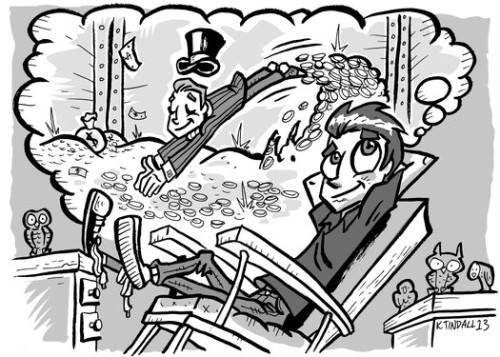
Originally published in New Escapologist Issue 9. Artwork by Kelly Tindall.

rsz_article_01

Between the ages of seven and ten, I loved to collect things. I collected postage stamps and cigarette cards like many children do, but some of my tastes verged on the absurd. I had, for example, a thing for ceramic owls and must have collected at least fifty different ones.

I collected jokey car decals. I’d fix them to the window, my bedroom becoming a shade gloomier with every trip to Kwik Fit. A particular decal pictured neat stacks of pound coins and the words, “Trainee Millionaire”.

From the psychic signals picked up from adults, I knew that money was important. The way my dad would try to preserve it and the way my mum tried to get rid of it as quickly as possible. Money never struck me as an end in itself but it was clearly a key to living well. You needed money to buy food and bicycles and cabinets for your ceramic owls.

Perhaps it was the signals from adult society or perhaps it was my existing tendency towards eccentric levels of accumulation, but the concept of a trainee millionaire was appealing to me. I understood that the decal should belong to a driver who was cynical about his financial prospects, but it was also totemic to this young man in his owl-crammed bedroom. I liked the idea of striving toward a million pounds.

If it were easy to extract a pound coin from someone (simply by asking “may I have a pound?”) then all you’d have to do to become a millionaire is to repeat the action one million times. The solution was purely mechanical. To become a millionaire, you must first become a kinetic sculpture capable of performing the same rotation one million times.

So I set out to become a child millionaire.

“Do you think we’ve ever had a million pounds?” I asked my mother one morning as she was cutting the battlements into my toast, a carbohydrate I’d apparently only eat if it were trimmed into the shape of castles.

“No,” she said, “I do not think we have.”

“Even if you count every penny that our family has ever seen? Even if we include all of our school lunch money and spare change inside the sofa and all those ten-pees we wasted in the machines on Blackpool pier?”

“No,” she said, “A million pounds is a lot of money.”

“Have you ever met anyone who had a million pounds?”

“Oh yes,” she said, “Barney was a millionaire”.

Barney was my mother’s boyfriend from before she met and married my dad and gave birth to an eccentric son and a cootie-infested daughter.

“How did he become a millionaire?”

“His father had a factory, which was worth a lot of money and he left it to Barney when he died. Barney runs the factory now and it continues to make him rich.”

This didn’t sound good to me. My dad was a part-time tour guide at the Black Country Living Museum. If he died, would I have to show tourists around the Newcomen steam engine every Wednesday, Saturday and Sunday? This didn’t sound like a fast way to millions. I’d never be able to fill a skyscraper with coins and swim around in it like Scrooge McDuck.

“Barney was also very frugal,” said mum.

This was true. Dad once told me that Barney had extracted a two-pence piece from a nightclub urinal. He willingly soiled his fingertips with the wee of drunk men so that he could add two pennies to his piggy bank, which must have been the size of Westminster Abbey. I loved this story partly because it was grotesque but also because it confirmed my idea that riches could be achieved through repetitive accumulation.

It was around this time that I saw the movie version of Richie Rich in which Macaulay Culkin plays the top-hat-wearing boy libertarian. In the movie, Richie had his own branch of McDonald’s in his garden. He was its only customer. This struck me as profoundly alienating and wasteful. It seemed that my brand of speculation had been established. I learned that I was more like Barney than Richie Rich. I was a pint-sized Puritan.

“Can I have a pound?” I asked my dad, who was in the mid-stages of building a scale model of the Clifton Suspension Bridge, the original of which had been designed and constructed by his boyfriend Isambard Kingdom Brunel.

“What for?” he asked.

I told him my plan. He sighed and told me it was time for a chat about how money worked.

Kablingy had, in his opinion, to be worked for. Just like Isambard Kingdom Brunel might work hard to build a bridge or a tunnel or even an aqueduct. An aqueduct was a bridge that carried water, and they didn’t just fall out of the clear blue sky without hard work.

I wasn’t entirely averse to work, I told him. The problem, however, was that I was eight and had no marketable skill that was worth even one pound let alone a million. I also had an addiction to acquiring decals and first-day covers and ceramic owls, which potentially left me in the hole. My first pound would almost certainly be squandered in celebratory owl acquisition.

“Hmm,” he said, “I see the problem. You know, Isambard Kingdom Brunel began by working for his father. Why don’t you work for me and I’ll pay you. I’ll pay you a pound today if you sweep the driveway.”

Elated, I ran downstairs, took a sweeping brush from the garden shed and started work.

It didn’t take long for my sister to appear to ask just what the sweet shit I was doing.

“I’m flying a helicopter!” I said with glee. This was the standard answer in our family when confronted with the question “what are you doing?”.

“No you’re not,” said Katy, “You’re sweeping the driveway and I want to know why.”

“It’s so I can save up for helicopter lessons,” I said, prancing elegantly in the minefield twixt sarcasm and fact.

“NO IT ISN’T,” she screamed in caps-lock. “TELL ME WHY YOU’RE DOING IT OR I’LL GET THE CHICKEN POO.”

The chicken poo was a hard black rubber ball that lived with the other toys in the garden shed.

It was different to the other balls — cricket balls, footballs — and as such garnered our scorn. I think it was probably an industrial thing salvaged by my dad from the inside of a water tank or an x-ray machine. It didn’t bounce very well and you couldn’t do much with it. It, a ball, was our enemy. Katy and I were also enemies but I now realise that only she had worked out that one’s enemy’s enemy can be one’s friend. Damn.

“Oh all right,” I said crumpling in the face of the chicken poo threat, “Dad’s paying me a pound to sweep the drive.”

“A pound!”

“Yes.”

“Do you think he’d pay me a pound if I also swept the drive?”

“Probably,” I shrugged, and before long she too had retrieved a broom from the shed and started sweeping.

Job done, we reported for our wages. “You got your little sister to help?” said Dad, “That is very enterprising”.

He pressed fifty pence into each of our outstretched palms.

“What’s this?” I raged. It was half of what I’d been promised and I was furious. He explained that I’d have to pay my employees. I protested. I was angry. I didn’t want to learn lessons. I wanted the first pound in my trainee millionaire project.

In protest, I gave my sister my share of the day’s wages. “Katy might as well have a whole pound,” I said, “Fifty pence is worth flip all to either of us.”

I stomped out.

This didn’t end the trainee millionaire project. There were several more frustrating incidents in which I was taught a lesson about money. One day, for example, I read in an encyclopaedia that the average human being lives for just 25,000 days. You’d have to convince forty people to part with a pound each day if you were to win your millionth pound upon your deathbed.

I wasn’t sure I had that kind of patience.

If you wanted to be a millionaire at fifty, you’d have to convince fifty-five people a day to give you a pound. If you wanted to retire at twenty-five, you’d need to convince 110 people. You’d also have expenses. You’d have to double that number of people if you wanted to eat. And then my dad told me about the 40% tax bracket for high earners, so I’d have to almost double that figure yet again. We’re up to 183 conversations a day now. You’d be better off showing people around a Newcomen steam engine at the Black Country Living Museum three days a week.

As with so many piano lessons, I went off the idea in the end.

💷

If you enjoyed this story, (a) shame on you, and (b) please consider buying my books A Loose Egg and Stern Plastic Owl for other get rich quick schemes.

Published
Categorised as Features

They have John Houblon on them

From the secret archives of Robert Wringham, this is a Glasgow-based diary entry about a frustrating day in 2009. Until today, it remained unpublished on grounds being too rubbish. But thanks to declining standards at this website and in life generally, it’s probably safe to air it now.

Cutting through the university quad, some animal rights protesters take me for a university employee (I’d be the Dean of Lint Studies) and one of them shouts at me through a megaphone:

“THIS UNIVERSITY IS RESPONSIBLE FOR ANIMAL CRUELTY!” he bawls across the quad.

“I DON’T EAT MEAT OR DRINK MILK!” I shout back through my cupped hands. “I’VE NEVER DRESSED UP A CAT FOR FUN AND I’VE NEVER BEEN ENTERTAINED BY A CHIMPANZEE SMOKING A PIPE,” I lied. “I’M ON YOUR SIDE!”

“WHAT ABOUT HONEY?!” he comes back.

“I EAT HONEY IN LARGE AND VISCOUS PROPORTIONS! I THINK WE SHOULD STIMULATE DEMAND FOR BEEKEEPING. GIVEN THAT WILD BEES ARE ALL BUT EXTINCT WE NEED APIARY BEES IN ORDER TO POLLINATE THE EARTH! I’M A VERY CONSCIENTIOUS CONSUMER!”

That got him.

“UM. OKAY THEN. CARRY ON.”

This is not the first time today I’ve been shouted at for things that are nothing to do with me. I can only assume that Messenger Shooting has been added to the list of unlikely sports at the forthcoming commonwealth games.

This morning, I am pilloried by a dental receptionist for trying to pay for treatment with a fifty.

It’s not my fault the bank produces unpopular currency. What’s wrong with fifties? They’re great. They have John Houblon on them, his serious face forbidding you to spend the note on anything too frivolous: a responsible gesture on behalf of the bank, especially in these harsh economic times.

I couldn’t imagine why the dental receptionist would have a problem with Houblon.

“I disapprove of his 1695 fiscal reform,” I imagine her saying, “Also, his wig lacks schnooze. See you in six weeks for a scale and polish”.

Later, a pharmacist lambasts me for my dentist’s handwriting on the prescription. He can’t make out whether I should be given a week’s worth of antibiotics or just five day’s worth. I suggest he level it out at six and he shouts at me. The dentist and I should take prescription drugs more seriously.

“Sorry,” I squeak.

On the way home, exhausted from so many arguments, I see a sign strapped to a lamp post which reads: “It’s your dog mess. Clean it up!”

I want to protest but cannot. The lamp post, being an inanimate object and all, would be unable to comprehend my predicament and I’m just a middle man in all of this anyway and didn’t really want to get involved. I doubted that the lamp post would have had any say in what went on the sign either, but was forced to wear it like a gaudy and lambasting medallion.

In that lamp post I had found an equal: someone else caught up in the argument of two sides and ambivalent about the causes of either. Neither of us owned dogs and neither of us had any strong feelings on poo disposal. Of course, he was accustomed to dogs peeing around his feet so he had a more informed stance than I.

This lamp post was the most rational individual I had met all day. We’re meeting for coffee next week.

You can’t get an app for that!

Fans of “But I need It!” will want to hear about the latest catchphrase to evolve in our house.

It is mainly used in moments that witness human ingenuity.

For example, instead of eating pistachios from the bag like some kind of hooligan, I’ve taken to eating them from a cup-and-saucer. I fill the saucer with the salty nuts and, as I eat them, flippantly discard the shells into the waiting cup.

This little system prevents me from eating too many pistachios and helps to perpetuate my reputation as an eccentric Englishman.

It’s also good if you enjoy slightly salty tea.

Amazed at my improvisational genius at inventing this neat little technique, I smugly announced: “You can’t get an app for that!”

It was met with much amusement. In my house, if nowhere else, I am the king of comedy.

Of course, the joke works even better when you use it for something for which there’s obviously an app. Scheduling, say, or goal motivation.

I like the new catchphrase. It’s a slight rebellion against iPad dominion and, at the same time, recognises the futility of rebelling against it.

I’m not very fond of iPads or other forms of jabscreen. They remind me of Fisher Price Activity Centres.

Another fine blog entry complete. You can’t get an app for that.

Richard Herring Book

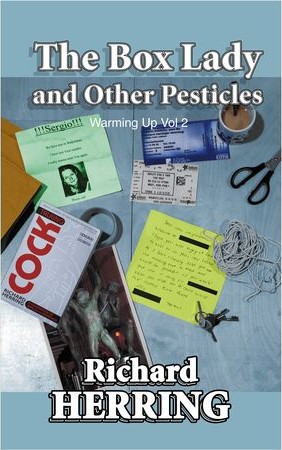
511Off the back of my own amazing book, Go Faster Stripe allowed me to edit Richard Herring’s second volume of funny diary writing.

It’s called The Box Lady and Other Pesticles and is out now.

I’ve been reading Warming Up since it began in 2003, so it was wonderful to revisit the early entries. Amazing how well I remembered some of them and also what I could recall about my own life at the time. I could sometimes remember precisely where I was when reading a given entry. The book is a real-life time machine.

There’s loads of new content too. And if you prefer a plastic pal to real books, you can get a Kindle version.

Whistle and I’ll Come to You, Belfast

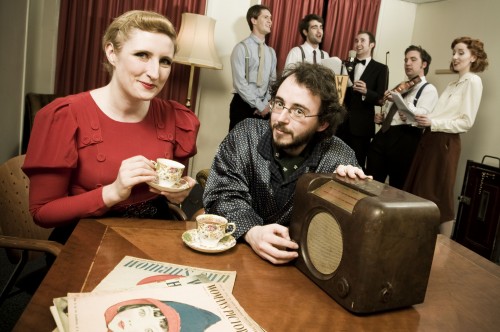
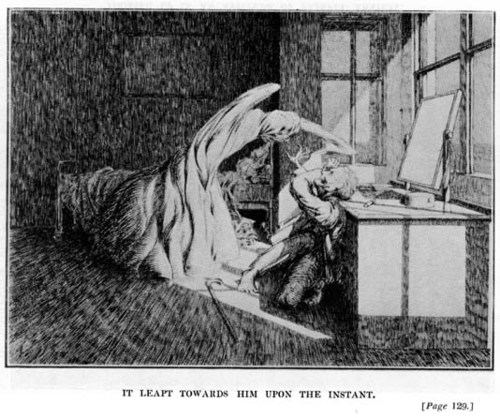
20th December 2012 will see the sensational Wireless Mystery Theatre perform my adaptation of the M. R. James ghost story, Whistle and I’ll Come to You at the Linen Hall Library, Belfast.

It’s part of a WMT evening of festive ghost stories (and mulled wine!) called Ghosts of Christmas Past.

Not familiar with the Wireless Mystery Theatre? Shame on you. Hear some snippets of their amazing work here.

And this is where to go for tickets.

I’m quietly proud of the script. Our version of Professor Parkin probably owes something to Johnathan Miller’s 1968 BBC television version, but he’s closer in spirit to the 1904 M. R. James original. I also added a scholarly extra touch concerning the Latin inscription on the whistle. As for our version of the ghost? Well, you’ll have to go along to find out.

Two new W&G podcasts

With a sense of profound embarrassment (and sexual arousal), we draw your attention to two brand new Wringham & Godsil podcasts.

This double whammy belatedly celebrates Halloween and Jesus Ween.

The sound quality is a bit crappier than usual, especially in the first half of Episode 30. Sorry about that. You can hear me very well but Dan sounds a bit quiet, which some might argue is an improvement. Hah!

Limited time? Listen to the first eight minutes and the last twenty minutes of the “deliberately foul” Jesus Ween episode. It’s properly, darkly funny. I got a bit carried away in the safe sex discussion and, listening back now, am genuinely shocked by some of the unsavory things I come up with (all of which are meaningless jokes of course). I also like a later bit about murderous milkmen in which Dan says, charmingly, “You could wipe out a whole community if you liked”. I love his comedy mind.

In Episode 30: Y is for Your Wife’s Vagina, we celebrate Dan’s recent wedding and the near-death experience at the reception; ruminate about Max Schreck’s smelly wee; make a long-awaited return to our Urinal Fly efficiency debate; consider the mechanics of The Rapture (as presented by Kilroy); debunk all garlic-based superstitions; and lament Dr. Beeching’s failure to close Highley railway station. This podcast also features gourmet tramps; indoor tramps; tramp restaurants; and spruced-up pissers.

In Episode 31: J is for Jesus Ween, things take a darker turn when Rob frightens Dan with his ideas for a death-based advent calendar; we educate the public about safe sex (at last!); market Dan’s new “splat mat” and Rob’s new “Jizzel”; wrongly predict that next week will see the first ever resuscitation of a cryogenically-frozen head; discuss living hams, psycho milkies, poisoned yakults, sliced bear faces, chapatti masks, murdered Josephs, nonchalant corpses; and family-sized telepathic bacteria dinners.

Happy Jesus Ween, everyone!

You Are Nothing: Extra Features

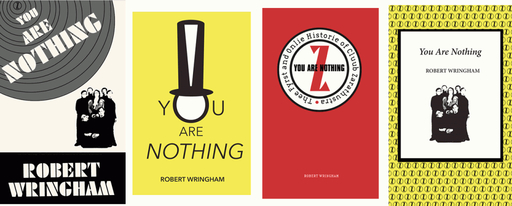
In 2012, I wrote a book called You Are Nothing about a comedy phenomenon of the mid-nineties called Cluub Zarathustra. Stewart Lee described my book variously as “Excellent,” “Interesting,” and “Important” and he sells it as part of his official tour merch.

It was published by the mighty Go Faster Stripe, who still make the book available to discerning people such as yourself.

This post collects some comments and cuttings about the book and about Cluub Zarathustra itself.

The Title

  1. For a while, the book didn’t have a title. It was known by its project code GFS42, about which Chris Evans rightly said “Sounds special doesn’t it?”

  2. I thought the confrontational title eventually arrived at would be brilliant, but I’m already tired of explaining it (and by extention, myself) to my girlfriend’s foreign family and people I sit next to on planes.

  3. The subtitle was originally “Or: a tonne of worms in an acre”. It’s a reference to Beckett and to The League Against Tedium’s infamous worm execution. In the end, it looked unwieldy, so like The League to a worm, I chopped it.

Shorter things I wrote about Cluub Zarathustra

“The club (or ‘Cluub’) saw some of the most exciting, experimental and downright weird comedy to ever grace the fringe. This is not hyperbole. Traditional stand-up was banned, and over the years it would feature sketches, opera, pyrotechnics, stunts, melting ice, and jelly in the shape of human faces.” — British Comedy Guide

“There’s a certain flavour of British comedy – perhaps epitomised by Munnery and Lee – that has never successfully exported to North America. Goodness knows we’ve tried. We’ve sent it to your comedy festivals. We’ve tried to get it on your telly. We’ve even had small victories by smuggling our writers into films like Borat and shows like Veep. But for all our efforts, the kind of comedy I’m talking about has never been taken to the American bosom, preferring to embrace, as you do, mechanical bulls and Toddlers in Tiaras instead. That’s what you like.” — Splitsider

Reviews and Praise

“Superb book” — Telegraph.

“Cluub Zarathustra was funny, fuddled, bonkers, lovingly curated. Thanks to Robert Wringham it has a likewise history.” — Ben Moor

“For many, Cluub Zarathrusta holds a unique, legendary status in the history of cult comedy. But then they probably never actually had to watch it.” — Steve Bennett on Chortle

“Normally, a book’s epigraph either gives us a sense of the diverse elements to its story or hints at something brilliant inside. With ‘Thee fyrst and onlie hystorie of Cluub Zarathustra’, Robert Wringham has opted to make the comedy outfit sound absolutely rubbish.” — The List

“Wringham unpacks the ideologies and inspirations for the cabaret/alt-alt comedy style of the Cluub with ease and a scholarly touch.” — Goodreads

You Are Nothing was an excellent read! Now annoyed that I was born in the wrong time and place. Anyone got a time machine?” — @Aino_K

“Our enduring ignorance concerning Cluub Zarathustra is sporadically alleviated by Wringham’s tentative delineation of the hauntology through which the Cluub excelled aesthetically. Accessed voices – both deliberately and accidentally accessed – abounded in the Cluub’s performances.” — HairyAppleFeed

The book was also mentioned favourably by Simon Munnery and Stewart Lee on Richard Herring’s Edinburgh Fringe and Leicester Square Theatre Podcasts.

And in Stewart Lee’s own newsletter.

“I’m only now realising that that book on Cluub Zarathustra is by the same person who does the New Escapologist magazine. Pleasing.” —@Lyeekha

Reposte

A reviewer for The List felt that a better book could have been written by someone who had seen actually the show. Well, maybe. Perhaps we should have given them another twenty years to step up.

My never having seen the show was part of the narrative thread of the book: an unreliable history pieced together by an enthusiastic outsider with only the blurry half-memories of the insiders for reference. We hinted at this on the back of the book.

Reposte II

Interviewed in The List in 2019, comedian Amelia Bayler mentions the book:

“my friend Gabriel Featherstone, who I perform with regularly at alt comedy nights Chunks and Project X, loaned me this book about a 90s experimental comedy night called Cluub Zarathustra. It’s called You Are Nothing by Robert Wringham. My fave bit is where he describes Stewart Lee mispronouncing Doritos as ‘Dorritoss’. Definitely worth a read!”

Legacy

“Cluub Zarathustra was shambolic, under-rehearsed, willfully obtuse, self-indulgent, amateurish and often in questionable taste” — New paragraphs from Paul Hamilton and The League Against Tedium in Kevin Eldon’s 2014 book.

“Cluub Zarathustra was a fringe comedy cabaret act and troupe active between 1994 and 1997.” — Cluub Zarathustra on Wikipedia.

Fun Facts

  1. To get the book started, I interviewed Simon Munnery in a Glasgow cafe called Cafe Rio. Sitting nearby were comedian Ian Macpherson and novelist Alan Bissett. Glasgow is a showbiz city.

  2. In Cafe Rio, Simon Munnery ordered soup and tea. Write that down, comedy fans. Soup and tea.

  3. Thanks to the rip-roaring success of this book, I got a gig proof-reading Richard Herring’s second volume of old blog entries, which was my evil capitalist plan all along. It’s about the long game, my friends.

Older Links about Cluub Zarathustra

“Let’s get one thing very clear: the only way that you can have ever seen anything like Cluub Zarathustra before is if you’ve seen Cluub Zarathustra before. This is one of the most obsessive, original and vicious shows at the Fringe. End of statement.” — A good fanzine review of the 1997 CZ Edinburgh show.

“I’ve always liked Simon as a person but it wasn’t until I saw Cluub Zarathustra at the Edinburgh Fringe in 1994 that I really started to appreciate his act. I thought the subsequent 2001 TV series Attention Scum! slightly watered-down the amazingly admirable nastiness of Cluub Zarathustra.” — John Fleming remembers Simon Munnery’s early work and the original CZ run.

“You also had an anti-heckling device” – An excerpt from Simon Munnery’s second appearance on Richard Herring’s Edinburgh Fringe Podcast, in which the two briefly mention my book and talk about Cluub Zarathustra’s ‘self-knowledge impregnator’.

Pilot – Watch the whole TV pilot on YouTube. For the full story of the pilot (and indeed the rest of it), read the book.

Cluub Zarathustra: British Comedy’s Weirdest Secret

Originally published at Splitsider

“I had no idea who he was,” says Marc Maron on WTF. “I had to do a cram course on him… I felt like an idiot because I don’t know much about British comedy.” He was referring to Stewart Lee: one of Britain’s most interesting and integral stand-ups, perhaps best known for his against-the-grain demeanour and deadpan delivery. In a later episode, Maron also meets Lee’s contemporary, Simon Munnery, described on the podcast, not unfairly, as “different”. For the duration of both interviews, Maron seems simultaneously baffled and delighted, like a baby coming to terms with a heron.

There’s a certain flavour of British comedy – perhaps epitomised by Munnery and Lee – that has never successfully exported to North America. Goodness knows we’ve tried. We’ve sent it to your comedy festivals. We’ve tried to get it on your telly. We’ve even had small victories by smuggling our writers into films like Borat and shows like Veep. But for all our efforts, the kind of comedy I’m talking about has never been taken to the American bosom, preferring to embrace, as you do, mechanical bulls and Toddlers in Tiaras instead. That’s what you like.

So what is this weird comedy? Well, we might call it ‘alternative’ if we’re being generous, but ‘alternative alternative’ would be more accurate: a secret comedy lineage of names like Richard Herring, Waen Shepherd, Dave Thompson, Tom Binns, and Sally Phillips. But it all started with Cluub Zarathustra.

Cluub Zarathustra was a midnight London cabaret show dedicated to atypical and experimental comedy. It was set up by Simon Munnery and his comedian friend Roger Mann. Stewart Lee joined the team a little later, along with a comic actor called Kevin Eldon. Simon hosted in-character as The League Against Tedium: a pantomimish Nietzschean dictator whose bizarre pronouncements (“A punch in the gob lets a fat man know his status!”) set the tone for the evenings. At the Cluub, straight stand-up was verboten and the performers were encouraged to branch out into avant-garde areas of performance. “We aim to fascinate, not entertain” was their backstage mantra.

Over the years, Cluub Zarathustra saw skits so outlandish that they’d have stumped even Monty Python. It would have been more at home in a pre-war Berlin cabaret bar, but even that doesn’t fully capture the tone. It was as wonky as a homemade spice rack, yet it was daring, experimental and ultra-modern. It saw opera, pyrotechnics, dangerous stunts, melting ice, weird short films, high-tech gadgets, and a selection of gelatin desserts shaped like human faces.

The audience were tormented en-masse by The League Against Tedium and his assorted minions. They were shouted at through bullhorns, insulted, drooled upon, physically carried around, graffitied with lipstick, and forced to wear demeaning hats. “You Are Nothing,” they were told. And, apparently, they loved it.

A genius thing about Cluub Zarathustra was the way they dealt with hecklers. One such method (still talked about by comedians today) was “The Cunt Ray”.

“It was known as the Cunt Ray,” says Simon Munnery, “but it was [actually] called the Self-Knowledge Impregnator. ‘Cunt Ray’ ruins the surprise of the joke.”

If someone heckled, a siren would sound, Munnery would shout “Activate the Self-Knowledge Impregnator!” and a large black box would be carried on stage. The device was equipped with a camera flash bulb behind a cleverly stencilled sheet of gauze. They’d point the device at the heckler and – boom! – it would burn the word “CUNT” onto their retina. “It’s probably illegal nowadays,” says Munnery, “Health and safety.”

Cluub Zarathustra started a chain reaction which lead to the development of much of the best British comedy of recent years, including the controversial Jerry Springer The Opera. Cluub Zarathustra is, quite simply, where it all began.

It’s a terrible injustice that nobody knows about it. Even though some of the biggest players in current British comedy were involved (Johnny Vegas, Harry Hill, and Graham ‘IT Crowd’ Linehan to name but a few), and thousands of people saw their shows in London and at the Edinburgh Fringe Festival between 1994 and 1997, hardly anyone can remember that Cluub Zarathustra ever happened. It never got filmed (aside from an unbroadcast pilot, which didn’t really work) and it was before the days of digital posterity. Thanks to a weird incident involving a PhD researcher being committed to a psychiatric hospital, even the original scripts and photography were lost. The only way you’d ever hear about the Cluub was if you were lucky enough to meet someone who saw the show or someone who was in it. So that’s what I did, thoroughly and systematically. I interviewed everyone I could find with a connection to the show – comedians, audience members, theatre critics, TV producers – and I wrote about it in a book.

So, yeah. If you’re interested in tragically obscure, outrageously experimental, and deeply influential British comedy, why not buy my book? Please buy my book. I need this. Sorry about the Toddlers in Tiaras thing.

You Are Nothing by Robert Wringham is out now. It is published by Go Faster Stripe, a Welsh media production company who specialise in DVDs, CDs, and books by comedians who tend to be overlooked by the mainstream. Robert Wringham is an English comedian, writer, and magazine editor currently living in Montreal.

Fizzy hand grenade

I’m three years older than my girlfriend. Occasionally we’ll alight upon a cultural phenomenon that I can remember but she cannot.

Nerf Blasters. Gina G. The Yorkshire Ripper. Things like that.

“Hey,” I said, “I bet you don’t remember detachable ring-pulls.”

“What are those?” she said, blinking naively in the morning light.

“There was a time,” I said, speaking grandly like wise man up a stick, “when the ring-pull of a drinks can was designed to come off in your hand.”

I may be imagining it now, but I fancy she may have gasped in youthful amazement. Like David Quantick on a Channel 4 clip show, I had put my hand on one golden recollection.

“It came off in your hand?” she said, nymphish eyes pinwheeling in fascination.

“Yes,” I said, nodding sagely, “But they banned them because they caused litter.”

I forget my girlfriend’s response but I expect it was something along the lines of a delighted “Wowee!”

“People would throw those ring-pulls everywhere, you see,” I said, “Even people who didn’t usually litter. As I’m sure you’ve observed, there’s an intoxicating sense of abandon when you open a can of 7Up.”

Ah, we were having fun scooping around in my adventurer’s memory like a couple of plongeurs groping around in a soupy basin of end-of-shift dishwater for an unaccounted-for teaspoon. Or whisk.

“You’d just tear that strip of metal right off the can,” I said with aplomb, “take a scrumptious swig of aspartame, and throw the damned ring-pull over your shoulder and into the face of Satan.”

“Those were the days,” I said, shaking my head nostalgically, tears beginning to well.

“Even as a four-year-old,” I whispered in a conspiratorial aside, “I preferred the detachable ring-pulls to the new ones. The new ones were far less satisfying. They didn’t allow you to pretend your can was a fizzy hand grenade. And when you take a drink from the can with a modern ring-pull, the damn thing can go straight up your conk. If you aren’t careful, a swig of Pepsi will claim an ever-so-fine layer of skin from inside your nostril”.

“That’s dangerous!” she definitely said.

“Right!” I said, laughing at the foolish design which has today become prevalent.

We both laughed at the drinks-can designers for about twenty minutes. Our breakfasts were going cold but that was okay.

“I wasn’t alone in feeling this way,” I said. “For years, people would tear off their so-called fixed ring-pulls, rip them from the lids of their drinks cans like a corybantic dentist excising a blackened incisor.”

Agog she was at my enthusiasm. And at my casual use of the word ‘corybantic’.

“Over the years, people lost their passion. Ring-pulls remained attached to cans and the numbers of discarded ring-pulls you’d see glistening in the gutters of the nation slowly declined. Many a pigeon remains unchoked.”

My girlfriend mulled over the story.

“When I was little,” she said, “My school would have recycling drives. We’d have to save the lids from drinks cans, which would be recycled into wheelchairs.”

“You see,” resting a case I didn’t have, “Everyone has a ring-pull story”.

Pants on fire: eleven crises witnessed by Momus

Originally published in CACTUS

“Every lie creates a parallel world. The world in which it is true”.

So begins the The Book of Scotlands: a novel of speculative vignettes, each chapter introducing a different version of Scotland. Among their number is the Scotland in which money is abolished, the Scotland in which ten or more children per family is compulsory, and the Scotland in which a giant goose roosts upon the country before eventually flying away, leaving a sense of loss in its wake. Some of these worlds are satires of our own, while others are whimsical and Rabelaisian flights of fancy. We are left to imagine the crises faced by these worlds when branching off from our own so spectacularly.

The writer of The Book of Scotlands is Nick Currie, better known as Momus: a monocular Scottish pop musician, performance artist, kulturkritik, futurist, and author. He has lived in Montreal, New York City, Berlin, Paris, Toyko and has recently made Osaka his home.

Momus is nothing if not prolific. To know his work is to know him. At the time of writing, he has twenty-two studio albums to his name, has written three well-received novels and published hundreds of insightful essays both in the mainstream media and on his blog. In addition to news and retrospectives on Momus’ career, the blog (Click Opera, 2004-2010) explored such subjects as our slow and steady adoption of alternative energy resources, the differences between an American- and an Asian-dominated world, and whether his pet rabbit’s personality remained intact after his unavoidable spaying.

A tag cloud for Momus would look something like this: identity, authority, perversion, time travel, fetishism, philosophy, Japan, internationalism, Berlin, Bowie, the avant-garde. He is known for his unorthodox fashion sense: baggy pants, aprons, a wig, Cold War-era eyeglasses and—most immediately striking—a patch over his right eye. His most-frequently cited remark perverts Warhol and anticipates the mass adoption of web-based social media: “in the future, everyone will be famous for fifteen people”.

Momus has been, if not a pioneer, then certainly an early-adopter and hearty embracer of social media and information technology in general. He produced a wave of synth-folk music in the 90s and his live music performances aren’t so much concerts as multimedia events. Online, Momus is seldom dumbstruck: even after the conclusion of Click Opera, he has maintained a regularly-updated Tumblr blog, packed with his own digital photographs and streaming video clips; and his Facebook and Twitter feeds are forever ablaze with ideas. He is certainly a futurist and, through his books, has become a cartographer of parallel universes. He has also unleashed a new performance creation upon the world in the form of the Unreliable Tour Guide. In this guise, Momus drags tourists and art lovers around museums and galleries, telling them satires, half-truths and lies about the venue and exhibits. Above all, Momus considers himself a storytelling enterprise and is a devil for asking ‘what if?’

I chatted with Momus (by high-tech and transpacific means, naturally) and asked him about eleven different flavours of crisis.

Mid-Life Crisis: How are you liking your sixth decade on the Earth? Have you endured/enjoyed a mid-life crisis? If so, how have you used it?

Martin Amis said that after 50 there’s a “thickening out” of life: “There is now an enormous and unsuspected presence within your being”. He didn’t say what that presence is, but I guess he meant death. That’s definitely coming through as a presence in my new songs, but death has always been a presence in my songs. My midlife crises (I’ve had a few) tend to come in the form of affairs with women much younger than me. They generally turn out badly, but the resulting songs are good. That’s the thing about being a songwriter: even when you lose, you win.

Identity Crisis. Did Momus come fully-formed into the world or did you develop your artist identity gradually? What moment do you consider to be Momus’ birthday?

Momus was born in 1985. I needed an identity to use on Mike Alway’s newly-formed él Records. Momus did already have a ready-formed identity, in the sense that he was a minor Greek god of cynicism and mockery who was kicked off Mount Olympus. I’ve kept fairly faithful to the obscurity, astringency and outsiderdom of the original Momus, I think.

Existential Crisis. You have lived in different cities in different countries. Do you change personally with your surroundings or do they help to confirm your identity?

Taking on a new city is like taking on a new romantic partner: you’re attracted because of affinities, but there’s definitely going to be some negotiation and some alteration if you want to get on. It’s a nice feeling to know that you’re going to be changed in ways that you trust, ways that are limited and pre-approved. But you never quite know what the result will be. Who knew that moving to Paris would get me obsessed with America, and with computers? Or that my New York idyll would be cut short by a Saudi Arabian called Osama? Here in Osaka I’m surprised to find myself haunting the slums and dressing like the dossers there. I suppose what these things tell you is that place is only one factor: time is pretty important too, in the form of your own age and in the form of history.

Fashion Crisis: When will people stop wearing jeans? What are you wearing in the alternative reality where aprons and baggy hose are in vogue?

Jeans are clothes that make sense in the context of American 20th century dominance. If the 21st century becomes predominantly Asian, as seems likely, that signifier will get fuzzy. American hard power will linger on a few decades as American soft power (nostalgia, cultural influence) but fizzle by mid-century, I think. So I’d be looking to see different trousers taking over by about 2050. I’ll be 90. As for your parallel universe question, in that parallel universe I’m wearing an apron with a trompe l’oeil pair of jeans printed on it.

Artistic Crisis. What do you feel most contributed to your transition from pop music to literature?

Well, I haven’t transitioned. I’m still making music — I’m making a new album right now — but I now publish books as well. I use the Momus name for both my books and my records because I see it all as part of the same storytelling enterprise. I was always a “singing author” (literal translation of the Italian term cantautore, songwriter).

Energy Crisis. Are you optimistic about our gradual move towards sustainable energy resources? Moreover, do you think the west will ever embrace kuruma banare and, like Japan, become a post-car society?

It’s all there in the word “sustainable”. This is not really a matter of choice. The only variable is whether we embrace sustainable energy through wise foresight or after a series of crises. Right now, here in Japan, we’re in the middle of exactly such a crisis, with Fukushima. Let’s see how it turns out. As for cars, my feeling is that cars will turn into train carriages. Computers are doing more and more in cars; eventually they’ll take over all the driving functions. Increasing car numbers will lead to congestion, but computer control will allow cars to travel bumper-to-bumper, even at high speed. Eventually the cars will link up, and sliding doors and corridors will be installed. This will allow services (snacks, meals, drinks, batteries, massage) to enter cars, which are currently woefully bereft of them. The trainization of cars will come more quickly in societies (like Japan) where citizens trust each other.

Industrial Crisis. What are the current challenges facing the worlds of pop music and print?

I’m totally bored by the technicalities of this question — how copyrights and payments are administered in a rapidly-changing world, blah blah blah. What interests me is the kind of music and writing people make even if they aren’t going to be paid a dime for it. Especially in the incredible world where these people have a device which gives them instant worldwide publication, which is our world right now. Of course, it may be that the answer is that a de-professionalized media is one that produces mostly inconsequential work. In which case we’re back to square one: how to keep professionals in the picture by making sure they get paid. I actually think Apple is quite clever, and that the Apple Store is a good model if we want to keep copyright alive. But I also rather like the cowboy world of Piratebay. I’m happy for both those things to exist.

Global Financial Crisis. As a sort of futurist and a cartographer of alternative worlds, do you think we will come out of this recession differently to how we went into it?

I think way too much is made of really tiny incremental changes. Is there growth in the growth, is there shrinkage in the growth? Who cares. What matters more is stuff like Gini — the rate of overall equality in a society. A lot more attention should be paid to distribution of existing wealth, rather than percentile changes in growth rates. Overall, I think the scenario for nations like the US, UK, Germany and Japan is what I’ve called “aftergold”: how to control shrinkage — and expectations — in such a way that happiness and fulfillment take over from growth and wealth as the dominant values. At a certain basic income level (about $20,000) our basic material needs are taken care of. Income increases beyond that don’t really increase happiness significantly. It’s up to us to decide what’s important to us, and find the optimal point between work and fulfillment. This requires quite a bit of self-knowledge and self-control, though.

Crisis in Japan. Japan sometimes seems defined by terrible events: the bombs, the earthquakes and the 1995 gas attacks. You may even refer to this in your upcoming book, The Book of Japans. What do you anticipate will be the lasting effect of recent events (the natural disasters but also the way they have been dealt with by the authorities) upon the Japanese popular consciousness?

Japan has been having earthquakes and tsunamis for thousands of years: this stuff is already built into the cultural DNA. It’s led to a certain detachment from material things; nobody has a venerable old family house here, they rebuild totally every twenty or thirty years. It’s led to the outlandish scenarios in manga and monster movies. It dovetails with the detachment built into Buddhism. The Japanese are incredibly stoical. I was amazed by videos of the March quake, how calm the Japanese were as it happened, just holding onto valuables and waiting for the shaking to stop. It was the foreigners who fled: they call them “flyjin” — the gaijin who flew.

Crisis in objectivity. What is a crisis for the unreliable tour guide?

Well, being an unreliable tour guide has made me very aware of the power of spin. Even the word “crisis” is spin. I could give you a tour of a crisis and show how it was a totally benign natural evolution, planned for in every detail.

What crises would you most like to see in the world? What needs shaking up?

We need to move from American modes to Asian modes, and from capitalist modes to communist modes. And we need to stop using fossil fuels, and fighting wars because of them.

Published
Categorised as Interviews

Renaissance Man: in conversation with Paul Bourgault

Originally published in Side Street Review

Paul Bourgault is a visual artist in Montreal. He usually works in collage and paints. Among his most recurring themes are those of Catholic and Renaissance iconography, and he often uses vibrant colour and sensuous imagery on his large canvases.

It is a privilege to visit Paul’s studio. Seven months previously, I’d been present at the opening of his exhibition Grande Consecration des Utopies Approximatives at Montreal’s Maison de la culture Frontenac and I’d seen a further collection of his works at the Toronto International Art Fair. On both occasions, his work had struck a chord with me, perhaps because of its imposing presence but perhaps because it reminds me of the closest thing I’ve ever had to a spiritual experience, absorbed in the splendor of Renaissance art in Vatican City. I have a lot of respect for the works of Paul Bourgault and so being in his studio and paying witness to so many works in progress is both an honor and disconcerting. The dozen or so canvases propped up around the room are incomplete but each is unmistakably a Bourgault. Seeing them, I think, is like bearing witness to half-formed stars in the depths of a nebula.

The studio is a small space on the upper floor of a tall building. There’s a city law preventing architecture from exceeding the height of Mount Royal, so the view from Paul’s window is a rare opportunity. The island’s snow-covered east side stretches out before us: the domes and spires of Mile End and Roger Tallibert’s organic-modernist Olympic Stadium on the horizon. A wall of Paul’s studio displays a quote from a motivational speaker called Les Brown: “Shoot for the moon. Even if you miss, you’ll land among the stars”. I suspect this was left behind by the studio’s previous occupant. Paul doesn’t strike me as aggressively ambitious: the act of creation is the important thing to Bourgault.

Paul welcomes me into the studio. After a tour of the canvases closest to completion (and one wholly incomplete, untitled piece that marks his pending transition from mixed media to pure painting), we crack open a couple of beers and our conversation begins.

I understand you were originally trained in film. Was it a challenging transition to go from film to painting?

When I started college in the mid-eighties, the art scene in Montreal—at least the art scene I knew—was not very open to certain types of painting or draftsmanship. It was more conceptual and installation[-driven]. I’m not saying it was the right decision, but it doesn’t take much when you’re young to intimidate you. Maybe I would go into studying art if I were to do it all over again but, you know, that’s impossible. I loved film but I was always more of a draftsman or a painter than a film expert or a film maker, so film was like an escape route. Also, I had very little interest in school, so film was interesting. It was one of those decisions of picking something that you’d like to do instead of making a smart decision with a specific goal.

Film brought me into working in sets. I was a scenic artist; a set painter in film, opera sets, television and television advertising. One thing I learned here was how to be efficient. When I do my own paintings—like any artist—a lot of my emotions and my vision of the world goes into it. When you’re a set painter, you’re almost like a painting machine, so while you have to reflect on the task, you don’t have to reflect on whatever the film maker is trying to convey. You only see pieces of it. You’re told ‘paint this barn’. You’re stuck with how to do it so there’s a lot of problem solving but you’re not asked to make decisions per se. So that was extremely useful. I did that for about ten or fifteen years at least.

So film gave you a kind of work ethic.

Yes! If you go on a film set, we agree that film is a true art form. As is painting, architecture, dance: there’s no doubt about it – that film is a true art form. Of course, there’s a lot of preparation that goes into it, but when the film crew is working, no one stops to look at their belly button. This is costing us ten-thousand dollars a minute, guys, let’s go! So I did learn that. I’m not always as good as I should be or as disciplined, but I do have a strong work ethic. I think that film might have given me the attitude that you can be a creator and be on the ball. Creating doesn’t mean sitting down and waiting for stuff to happen.

To what extent is your work autobiography? Do you bring much from your heritage or your family background or your own emotional landscape?

It’s mostly autobiographical. Mostly in an emotional, spiritual and philosophical way. I’m quite sure that we have old memories stored into us. I don’t know how it works. I’m not a neurosurgeon or an expert but my gut feeling is that we have some sort of very long-term memories stored away somewhere in our brains: cultural memories. Because we’re all mixed, it comes from everywhere. Most of my heritage is French, but the French were conquered by the Norsemen by the Germanic tribes and so on.

And we all go back to Africa ultimately.

Yeah, that’s it. I do believe that. Another thing is being here in Québec where the Catholic religion had quite a strong presence. My mother was probably of the first generation, as an adult, to get rid of it as an overbearing presence. I don’t think that the church in itself is that awful but I think there is a problem when it’s overbearing. There’s a lot of reference to Renaissance painting in my work. I think the main reason is that I simply love those paintings and the work that went into making them, but also there’s a link in there to the Catholic church in Québec. So there’s this dual interest. Some of those [Renaissance] paintings are just so stunning. They still shock me when I go to museums. To complement your question, I think all of my paintings are to a large extent autobiographical. I don’t know that it shows or that it should show, but they’re all based on ideas or doubts or fears or experiences or points of view that are personal. Why is there so much information flying all over my paintings? Our minds are always at work, always stimulating and being stimulated, buzzing. Life never stops, the atoms and the planets turn. Physics and mathematics were one of the few things I liked at school. We don’t think about it because it would be burdensome to do so, but right now there are five billion people thinking, moving, talking, fighting, being born, dying. The cosmos is spinning in every which direction. Everything is in constant motion. I like that idea, that everything is alive, that there’s a force in everything and that it’s always moving.

Something I get from some of your paintings is this idea about excess and abstinence simultaneously. I’m thinking of your exhibition, ‘Carnival at Lent’ specifically.

One thing that Chinese painting has taught me is that the empty space in a painting is just as important as the rest of it. When Chinese painters do their work, they look at the lines [but also] the space between the lines. Life is all about oppositions. In that sense, my work [contains] what I believe about life. You live, you die, there’s space between things and there are oppositions between desires, like carnival and lent. What would be one without the other? If you’re doing carnival three-hundred-and-sixty-five days a year, it would lose its meaning. Getting pissed and dancing all night would become just a normal day. I don’t think it would be interesting or possible to do it six hundred days in a row.

So the whole universe is vibrating with opposites.

Yes, absolutely. And that’s an important part of what motivates my work; the idea of—the way your phrased it—that vibration, the emptiness. The universe is kind of participating in my creation. It applies to everyone but I think some people are more conscious of it or have accepted it.

You are bilingual and spent a long time in Ontario as well as Québec. I don’t know, but I imagine, there might be Francophone and Anglophone cultures of art in Québec. Is that true? And if it is true, do you feel that you exist between them or that you have one foot in both worlds or do you feel like a true third thing?

To a certain extent, every artist is out of it [and] working on his own. As far as the language goes, because it’s a super-touchy question, I’m going to answer like a politician. But real seriously, with globalisation and the Internet, we’re all connected. You can see in real-time, the paintings at an opening in Saigon. I’m not saying there are no differences but there are so many crossover practices now. If there’s a difference between a French scene and an English scene, it might be more in relation to human friendship. If you go to an English school, you have those friends and most of those friends will speak English. I’m not sure that it affects the art. We’re all mixed. It’s not like there’s a big wall between us with the French world here and the English world there. I think it’s more of a social networking difference more than an art difference.

I’m not a big part of any crowd. I mean, I go to openings and I have artist friends but I’m not really into some specific theme. It’s not, like, a scene.

Do you have any thoughts about government funding of the arts? It’s obviously good in that arts have to happen and we shouldn’t be starving as artists, but also, do you feel there’s a problem with being sanctioned?

Out of principle, I think that financing for the arts is a very good thing. We live in a social democracy and taxes should be invested in a general manner. Of course, education and health is Number One, but we all pay taxes and I think its good that artists can get a little pat on the back. Receiving a grant is good for you because it gives you time to work, time to stop worrying for a few months. It gives you a form of recognition, which is great, but making art is like a quest; you should never wait for someone to sanction you as an important motivation. I apply for grants and I think it’s smart to do so, but what wakes me up in the morning and what brings me [to the studio] every day has nothing to do with being sanctioned.

Tell me a little about your ‘Chasse-démons’ painting. It’s a personal favourite.

It’s a talisman. Everyone has demons: personal hurts and broken parts from adapting to society, from childhood, from disappointments we have about life. We all have some open scars. Maybe some people are more sensitive about these, so I had this idea of painting something that could help you chase away these demons. But I also painted it for myself. I figured maybe some day a man or a woman could say ‘yeah, I could use one of those talismans’.

I was reading a lot about the Bohemians recently. About Nineteenth Century Bohemians. They’d often keep a skull around the place, and it was like a talisman against becoming bourgeois. It’s like a constant reminder of death, that one day you’re going to be a skull in the Earth.

That’s very interesting. It’s a Memento-Mori. I collect art a bit. I only have small works, but usually, the work that I buy are Memento-Mori. For me, and this is strictly personal, art has to do important things for you. There’s no reason it can’t be beautiful but if all art were beautiful it would be useless. In my own work, there are often little details of skulls, bones, trash and stuff that looks like dead animals, and there are dead birds. I don’t want anyone to be ‘oh wow, dead birds’ because I like my work to be beautiful, colourful, sensuous, vibrant, but I like that in almost every piece there’s a little Memento-Mori: just a little something to remind you that you’re passing through. You’re just passing through. I think that life is beautiful. To have a little reminder of death is very important but only if you enjoy life. Dancing is great, food is great, sex is great, friendships are great, the sunset is beautiful. I enjoy life, but as you were saying about the Bohemians, to always keep a little something, like a little wink that says ‘don’t forget’.

Well, it’s what encourages you to live vigorously. Knowing that this is it.

Yeah! And it’s like the opposites of the universe, as we were saying earlier on. If we had eternal life and we know it, boy, we’d be fucking bored. We’d only be playing cards or something like that, you know.

Are there other artists whose work you draw from?

Many. And I’ve noticed as the years go by that I’m more and more open-minded. I was not as open-minded when I was a young adult. Of course there are many strong influences, like painters of the Renaissance, Rubens, Rembrandt , the use of colour in Vincent van Gogh’s work has inspired me a lot. Colour has a hell of a lot of importance in my work. For me, colour is like an emotion, it’s like energy, it’s like life. I don’t mean ‘red is this, yellow is that’, but the interaction of colour is a really magical aspect of painting.

But yes, Rembrandt especially. I’m not nostalgic, but I like old painting because it’s kind of out of time. I like to think that my work might also be somewhat out of time. I mean, you can’t truly become out of one’s own time, but I like not to voluntarily push it into it. You know what I mean by that? This might be a bad example, but I use a computer and I find lots of things about it useful so I’m living in my time. But I’ve never had a Twitter account and I never will have Facebook. It’s going too far. I can understand why some people want to use those tools, but for me, I like to keep a safe distance. You can tell that my paintings are being painted ‘now’, but I like to think they are happening out of time a bit as well. The references are hopefully a little timeless.

As a self-taught painter, I learnt what I know about art history and art by reading and going to museums. I go to the library a lot. When you’ve absorbed so much information, you’re in a sense influenced by all of that. You have favourites but it all just becomes part of you over time.

I saw a documentary recently at the [Musée des beaux-arts de Montréal] about Warhol’s protegee, Jean-Michel Basquiat and, in it, he said a lovely thing. He was asked how he is influenced by other people and he said “it’s someone else’s idea going through my new mind”. Going through my new mind. Isn’t that perfect?

Painters have always had affiliation: ideas that are inherited from father to son. If you look at the history of art, I think everything has been done through affiliation because every artist is inspired by and inspires his contemporaries and his friends. The Basquiat thing is very interesting and true because painters nourish other painters. You look at Bosch and Picasso and you mix and match and something weird comes out and you sprinkle something else onto it. I’m inspired by many, many painters so it’s hard to pinpoint now.

[One of your art dealers] told me that you now want to do more painting without using collage?

It’s a shift. Every work leads you to another work, like communicating vessels. Sometimes you make drastic decisions but generally you carry stuff with you. You bring maybe ninety percent of the last work into the new work. I’m trying to paint myself out of collage and I’m finding it a gradual process. A thing about art is that I have to avoid being comfortable. If I’m too comfortable and safe in what I’m doing, it doesn’t stimulate me. You can’t cut all the bridges: you can’t one day say ‘I’ll never paint like this again’ and paint like someone else. You can’t run away from yourself. A singer doesn’t change his voice in five minutes. It is done over years. But collage helped me feel a certain danger, a certain risk, to do things I wasn’t comfortable with. But now it’s turning into a comfort zone. I’m starting, with painting, to get myself out of that zone.

*

We talk for another hour or two about work ethics, stand-up comedy, long-distance walking, Canada, physics and space, while the unfinished pieces around us – the embryonic stars in the nebula – vibrate with potential energy. Paul Bourgault’s channeling of primal, atomic, and universal forces is the very reason for these paintings’ existing ‘out of time’. While human beings may benefit from a Memento Mori, these ideas remain eternally untouched by the currents of time.
Published
Categorised as Interviews

Cluub Zarathustra

I’m researching a book about Simon Munnery’s Cluub Zarathustra (1993-1997).

If you performed at the Cluub or were in the audience for one of the shows, you’d be doing me a tremendous favour by getting in touch. Your account could sit alongside those of Stewart Lee, Richard Thomas, Simon Munnery, Kevin Eldon and many others.

I’m also eager to see any photographs, brochures, ticket stubs or promotional material relating to the show. A bootleg recording would have Holy Grail status. Cheers!

MAY 2012 UPDATE: The book is finished and available to buy. So do so! Though the book is done, I’m still very interested in receiving any new anecdotes or media relating to the Cluub, so always feel free to email.

Upcoming Performance: ‘The Salon’

On 10th October 2011, I’ll take part in The Salon for Untitled Projects at the Traverse Theatre, Edinburgh. The theme for the evening is ‘The Future’ and will involve my dressing up in Nineteenth-Century garb and performing my piece, The Escapological Eutopia: Five Dodgy Prophecies. There will be other speakers too, and even the audience will be invited to dress up!
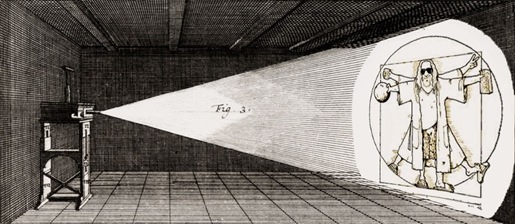
Film appearance! The Way of the Dude

There’s not been much posted about the movie online yet, but I recorded a segment last month for Thomas Fazi and Oliver Benjamin’s documentary, The Way of the Dude.

The film is the latest creation in the Dudeism ouvre, a very cheeky religion based upon the ‘teachings’ of the Cohen Brothers’ movie, The Big Lebowski.

I’ll be in good company too. The crew also interviewed Tom Hodgkinson, John Naish, Mark Vernon, Mark Townsend, The Barefoot Doctor and others.

The Rebel Dollar: Joseph Heath

Originally published in Side Street Review

As an artist, if I find myself thinking about economics, it is usually disparagingly. I’m not alone. For years, artists have rebelled against economics through parody in paintings, music, stand-up comedy and Turner Prize-nominated installation pieces.

Unfortunately, if we want to comment upon economics intelligently in our work, we have to know something about it. We can’t simply hate Capitalism because we sometimes have trouble paying the rent or because we have a vague idea that it’s bad for people in Africa. To hate something intelligently, we need better data than that.

An excellent guide for artists—and people who dislike finance generally—are the books of Joseph Heath. Joseph is a philosophy professor at the University of Toronto and writes popular publications on the subject of money. His most recent book is called Filthy Lucre: economics for people who hate capitalism. I meet Joseph to discuss the complex relationship between artists and money.

“The latest book,” he tells me, “is remedial economics for people on the left. Like me, many people got turned off by their first-year economics class and decided that the whole thing was right-wing ideology and didn’t have to pay attention to it. It happens disproportionately on the left, so we’re often weaker in economics than the right. In the first half of the book, there’s a lot of economic theory that actually undermines classic right-wing positions. In the second half, I show there are things said on the left that don’t make sense from an economic perspective.”

Like many academics now writing for popular consumption, Joseph strikes me as a highly accessible fellow: a man steeped in theory but able to discuss it with the layperson. What took Joseph from academic philosophy to accessible consumerism and economics?

“Consumerism is already a topic in philosophy. Philosophy has some elaborate ideas about consumerism. Sadly, a lot of these are based on fallacies about economics, such as the over-production fallacy: the idea that mass-production has generated an overwhelming surplus of goods and so we resort to marketing. Alas, it’s a fallacy because ultimately in Capitalism—despite the illusion created by money— goods are exchanged for other goods. It’s possible for there to be too many shoes or shares but impossible to be too many goods in general. Based on this fallacy, philosophers have thrown up elaborate theories on how the advertising industry manipulates people’s desires, makes them consume more and generates an homogeneity of desires. Lots of theories but it’s all based on an ignorance of economics.”

Another of Joseph’s books, The Rebel Sell concludes that counter-cultural movements have failed and that there’s no real friction between the counter-culture and the accepted mainstream. The rebellious fringes may actually feed Capitalism:

“Rebellion was advertised in the late fifties and early sixties as having revolutionary consequences with respect to the political and economic system. The book points out that [the counter-culture] didn’t deliver on any of those problems. Rather than being a revolutionary transformation of consciousness, it was just consumerism. Take the sexual revolution: people thought it was going to undermine Capitalism because, in the post-Freudian view, instinctive repression was required to get workers to show up at the factory and this was incompatible with sexual freedom. The sexual revolution was going to lead to a wild freedom in society that would make factories and the tyranny of the clock impossible. If you look at [the psychoanalyst,] Wilhelm Reich, you can see this theme prominently: that the sexual revolution was supposed to undermine the entire political and economic system. Looking back with forty years of hindsight and wisdom, the major consequence of the sexual revolution was [the feeding of] the pornography industry. It’s a classic example of counter-cultural rebellion failing to result in the collapse of the system and in fact feeding into the desire to consume more and more. People thought ‘sex, drugs and rock ‘n’ roll’ was was going to be revolutionary in the way that, say, Marxism was revolutionary. They thought that it was going to emancipate people and fundamentally change things, that war would become impossible. To point out the obvious, it didn’t pan out that way. What’s striking is that everybody has recognised the total failure of these ideals but we’ve not rejected the underlying theory: that the political-economic system is a big machine and culture is the software, so by reprogramming the software you could fundamentally change the way the whole machine functioned. You still see it in contemporary cultural politics and art theory. It’s just that nobody has the radical pretensions for it that people had in the sixties.”

This strikes me as devastatingly defeatist but I’ve always been a dreamer. If the sexual revolution and rock ‘n’ roll—genuinely radical cultural forces—had resulted in the opposite of what was intended, what chance do small-time artists have in a world jaded by artistic rebellion? Should we hand in our pallets and brushes for white collars? Is there anywhere left for artists to rebel against money?

“A journalist recently wanted to interview me about Lady Gaga. Basically, he wanted to know whether the violent imagery in the Alejandro video meant the collapse of Western civilisation. I was like, ‘Jesus Christ, were you born yesterday?’ We live in a society that survived the Rolling Stones! The Stones were drug-using Satanists. The Stones and The Doors were the real deal, right? People thought it was mind-blowingly radical, that music industry would never be the same, that it was going to be Earth-shattering. But it didn’t quite work out. When I came along in the seventies, the Rolling Stones were already neutered. Already they were a joke in terms of rebellion. When punk came along people thought ‘Oh my God, this is the real deal now’, and its gone on and on. By now rebellion is such an empty gesture and so obviously a marketing gimmick, it’s astounding that anyone could think any kind of cultural event could have any significance on anything political or economic.”

At this point in the conversation, I remember a 2002 Adam Curtis documentary called Century of the Self. It mentioned something called the ‘torches of liberty contingent’: a 1929 women’s liberation movement in which hundreds of women marched on New York, brandishing cigarettes. There had been a perception in America that women shouldn’t smoke and so this was a hugely equalising demonstration. Equalising? Certainly. But the real effect was the doubling of cigarette sales. Tobacco companies got richer in the name of personal liberation. Are there other cases in which the corporation has exploited our senses of justice and rebellion?

“Sure. There’s the idea that Capitalism has to increase consumer desire to get rid of a surplus of mass-produced goods. Everyone is somehow threatened into wanting the same house, the same car, the same clothes and so forth. So the idea arose that by rebelling against mainstream tastes, you’re throwing a cog in the works of the industrial system. By refusing to live in the classic suburban home, by cutting your hair a certain way—all the standard counter-cultural gestures—you are exacerbating the crisis in Capitalism. This is the idea of the rebel consumer: that by smoking or getting tattoos or colouring your hair purple, you were striking a blow against the system. The consequence, however, is quite the opposite because rebellion becomes a positional good. The latest rebel style is extremely cool and attracts imitators. The people who want to rebel have to constantly search for the newest, latest thing. This generates competitive consumption and the quest for cool or the quest for rebellion winds up generating consumer desire. Rather than striking a blow against the system it actually ends up promoting consumerism. There’s the idea that rebel styles get co-opted by the system. But the co-option is completely an illusion. All that happens is once-exclusive things become popular. Once people start finding out and jumping on the band-waggon, it generates a snob effect whereby everyone has to get off the band-waggon. What looks like co-option is actually competitive consumption among individuals. But remember: none of this matters at all from an economic or political standpoint. Think of the fifty years of revolutionary rock ‘n’ roll, crap pop or whatever: it’s amazing that the system never collapses, but its because all this stuff is totally irrelevant.”

So what can counter-culture can hope for? Is there any point to being a part of a counter-cultural movement now? “No. I don’t think so. By now, the rebel gesture is so empty and so vacuous. Younger people don’t actually believe any of that. It’s just all been done so many times and the radicality got pushed to the point where there’s nowhere further to go. By the end of the twentieth century, radical music was politically exhausted. The most radical gestures are made already. I think best example is Lou Reed’s Metal Machine Music: the band started out revolutionary and underground, but when a bunch of frat boys started listening to it, the band immediately became mainstream. To maintain their underground credibility, they make another album of less-accessible music in order to lose fans and maintain cachet. You make your music more unlistenable as a way of restoring its exclusivity: you sell people an album of screeching noise. Like, that’s as revolutionary as it gets! And some people actually listen to it! It’s all a matter of exclusivity. I’ve sat through contemporary dance performances that were absolutely inaccessible and when people start to walk out, you can see the look of absolute satisfaction on everybody else. It’s just straight-up snobbery, right? It’s like distancing yourself from the great unwashed, from the people with mainstream tastes who lack true aesthetic judgement”.

Guilty, I explain that my favourite record is Captain Beefheart’s highly-inaccessible Trout Mask Replica: an album recorded under cult-like conditions with highly avant-garde results. I also remember how pleased I was when The Simpsons creator, Matt Groening announced it was also his favourite album. Me and Groening: two pretentious peas in a radical pod.

“When The Rebel Sell came out, a lot of old hippies were extremely upset by it, a lot of people our age—Generation X—reacted to it with ‘Oh, that’s really helpful. It’s something I kinda thought but never articulated,’ but anyone younger was like ‘Dude, tell me something I don’t know’. For anyone post-Internet, this is totally obvious. Stuff on the Internet gets co-opted overnight. It used to be that information moved very slowly. You could have a six-month lead before other found out [about the hip, new thing]. Growing up, a girl I knew would visit New York to check out [the nightclub,] CBGB. She would come back with a band t-shirt and she’d have the [scoop] on what was going on. This allowed us young punks to be cool for about a year because of the long lag. There was no MTV, radio stations didn’t play this stuff and albums were hauled around in trucks. Nobody could find out what was going on at CBGB, so if you got someone with inside intel, you were cool for ages before the ordinary folks found out about it. I used to feel that I was a member of an alternative culture and there was an essential difference between us and the mainstream. I realised later on that it was just a consequence of time lag: the delay in transmission of cultural information. Now, if someone puts something on YouTube, ten-thousand people are imitating it the next day. That’s why no young person was surprised by [the message of The Rebel Sell]. They’ve already realised it: there’s no such thing as alternative music. It took me a long time to figure out! I bought the whole thing, hook, line and sinker.”

So the standard rebel arguments are often just garden-variety inherited wisdom, which doesn’t need to be proliferated through art.

One point that I believe to be important, however, before we give up on rebellion, is that life without it is somehow hollow. Artists—whether musicians, film makers, performers or visual artists—have always gone against the grain or at least held up rebellion as a pretense for getting our blood pumping. There was never a song written about how the government have our best interests at heart and how the bankers do a great job. Without rebellion, sincere or otherwise, we’d never have seen The Wild Ones or Easy Rider or One Flew Over the Cuckoo’s Nest. We’d never have felt the love of John Lennon and Yoko Ono’s ‘Bed In’. We’d have never experienced the punk phenomena of the Sex Pistols or Patti Smith or The Clash or The Fall; or felt the surge of naive adrenaline when absorbing the crimson ink of comic books by torchlight under the covers. Exposure to rebellious art will often leave the feeling of new neural pathways being cut, often painfully, through the brain and of new mental muscles being flexed. Something that disconcerts (the grotesque pornography of Jake and Dinos Chapman), challenges the way you perceive the world (Douglas Gordon’s ’24-hour psycho’ video installation) or rocks the boat of social norms (Mark Quinn’s ‘Alison Lapper Pregnant’, the sculpture of a pregnant quadriplegic, which stood beautiful on Trafalgar Square’s fourth plinth in London) has surely more value than a work that simply confirms what you know (stand-up comedy by Michael McIntyre) or agrees with the status quo. If rebellion in art is an empty gesture and is ineffective against Capitalism, it is still the best way I know for art to feel like the result of independent thought and in favour of a beautiful, vigorous life, which goes against the grain.

It’s also important to remember that artistic rebellion doesn’t only go against Capitalism. Artists can rebel against unethical government policies, animal cruelty, environmental collapse, racism, poor public amenities and infringements upon our human rights: things that bring shame upon every one of us if they go unaddressed. It is not direct action but through rebellious art, we can generate a discourse around these things and heighten public awareness. Art can be the conscience required to temper the crimes of governments and individuals and the corporation. If an artist intelligently and opaquely rails against (for example) the war in Dafur or low standards of living closer to home in the US and Canada, it can be the spark required to ignite mass comprehension and ultimately mass action.

Personally, I wonder if the counterculture’s failure to derail or temper Capitalism is not a failing of rebellion intrinsically but that the counterculture has simply been rebelling in an unproductive fashion. Thanks to Joseph Heath’s observations, we now know that rebellion has backfired and lead to the stimulation of rebel desires and the identification of a rebel market. With this knowledge, perhaps artists should strive to create a non-marketable, non-profitable commodity and promote, through this, a form of anti-consumption. If art could successfully manufacture an anti-product: something which could neither be bought or sold with money and didn’t rely on further extraction of materials from the Earth, could we not exploit the rebel desire without the rebel dollar? Could we not appeal to people’s rebel instincts and desires for a better world without selling them the t-shirt? Can we not create a kind of ‘outwardly projected hunger strike’ to discourage the unnecessary consumption of material products? When will the truly minimalist home (ascetic as opposed to designer) become fashionable? When will empty space be perceived as the next luxury good? I think, if any rebellious artistic movement can affect Capitalism, it lies here. We now know that the acquisition of haircuts and records and magazines—what Heath described to me as “the standard rebel gestures”—only serves to fuel the system. If we want to properly throw a spanner into the works of Capitalism, we’ve got to pull our funding and stop consuming these empty symbols of a fake revolution. That is the message of this rebellious artist. Now, where’s my commission?

Published
Categorised as Interviews

My essay in Idler 44

I have a useful essay in the upcoming Idler 44: Mind Your Business. My piece is called ‘The Business of Escape’ and pulls together some of the economic and entrepreneurial ideas covered in New Escapologist 1-5 and learned through my own experience of being professionally on the lam.

As is now traditional (after three years in its current format) the new Idler edition looks utterly stunning with its fine typography and hardback cloth binding. My essay is in good company too, sitting alongside works from Penny Rimbaud and Bill Drummond et al. The Idler is an astonishing annual event. Copies now available to pre-order at their shop.

Real Fucking Magic: My Edinburgh 2011 Report

“Asking a stand-up to improvise an entire set is like asking a magician to do real fucking magic.” —Paul Provenza.

On 24th, 25th, 26th and 27th of August 2011, Dan and I staged four live versions of our famous podcast as part of PBH’s Free Fringe at the Edinburgh Festival.

It was the first time we had tried anything of the sort. I think we had planned to do some trial runs in Glasgow and the Midlands before the big fest but, as is so often the case, time got the better of us and we took a plunge into the deep end.

Thankfully, our audiences were warm and generally appreciative, and I think we can consider the live podcasts a success by most criteria.

Podcast 1 remains our favourite and is surely the most memorable. When “The Human Centipede” was selected as a conversation topic, I casually asked Dan “So, have you ever been in a human centipede?” which got a good laugh. I was able to wax lyrical on the movie monster’s lack of ambition (“Three people? That’s not a human centipede!”) and about how I felt motivated to go the extra mile and get an easy entry into the Guinness Book of Records. A young woman in the middle of the audience was laughing uncontrollably at this section and covering her face in hilarious shock. Seeing this girl’s watery eyes peeking at me through her fingers will always stand out in my Edinburgh memories and, to me, was the absolute high point of this year’s Fringe.

We had friends in the audience for Podcast 1 who were familiar with our stuff. I was very glad when my friend Neil shouted “Do Derek Gray!” to prompt an appearance from our occasional character. Character comedy, I think, can be a bit contrived and I didn’t want to go onto the stage saying “Here’s a little character I’ve been working on” because I haven’t been working on him! He’s just a thing I do off-the-cuff on the podcast, meaning that Derek is only about twenty-minutes old. Luckily, I can ‘become the character’ pretty much on-command because he exists in me so utterly. He is my anal-retentive, obsessive-compulsive side with a strong desire for order, hygiene and symmetry. It was terrific fun to talk in-character about Derek’s involvement in the London riots (“I flew into a fury”). Derek confessed to being responsible for breaking precisely half of the windows in London town (“Plus: new shoes”). The Derek section ended with Dan losing control and corpsing, much to the audience’s pleasure. I think this little section of the show, as Derek would say, was “perfectly acceptable”.

There were some Maltese men in the room for Podcast 1. I had some existing comedy observations in the bank about Malta, the “miracle bomb” at the Mosta Dome, and the clapped-out Maltese public transport. I think this looked very fast-witted and showed unexpected knowledge of an unusual location. I suppose I was lucky that these punters had come from a place I knew, but it did feel like a good pay-off for years of deliberate harvesting small things with a comedic eye.

Daniel James Godsil was brilliant throughout the run, but perhaps especially in Podcast 1. I had always known he would be good at the live podcasts, but not this good. I suppose I may have had a kernel of worry that his nerves would betray us at the last second and he’d clam up. But he didn’t. His early observation about strippers being “reluctant to barter” went a long way to boosting our confidence and our winning the audience’s trust that day.

Flyering for Podcast 2 outside the venue, I spotted comedy hero and “Edinburgh institution” Arthur Smith walking down the Royal Mile in a kilt and some strange white-framed designer glasses. At first I wasn’t certain it was him: he looks a lot older than he does on telly (sorry, Arfur) and he was, after all, wearing a disguise. What really put me off thinking it was him though, was the fact that I’d been reading his autobiography on the train just moments previously. What are the chances? Alas, it was almost certainly the Hamlet actor and Leonard Cohen impersonator himself because Dan had independently identified him too. I’m annoyed at myself for not speaking to him because he had the potential to answer an important question regarding Cluub Zarathustra (about which I’m writing a book), but seeing him did at least inspire some material about celebrity-spotting for the podcast. I was able to say that “Ricky Gervais [who I once spotted in Glasgow Central Station] hires expensive bodyguards but Arthur Smith just wears a cunning disguise”.

Podcast 2 turned out to be the most disappointing of the run. We had a decent turn-out in terms of audience numbers but there wasn’t much love in the room and we never managed to get the crowd properly on our side. When our ad-libbing skills ground, if not to a halt then to a sluggish little chug-along, we resorted to using some of the winning material from the previous day – The Human Centipede, strippers, and a few cheerful mouth-jingles – but they weren’t having it. I don’t know if some audiences simply aren’t up for it (because it seems unlikely to me – anyone who has the drive to come to the same show must have something in common we could appeal to) or if we failed to win their trust in the first two minutes but it just didn’t work.

After the show, we had to hot-foot it down to the Buff’s Club for my stand-up spot at Al Cowie’s LLAUGH Comedy Club. I was surprised at how confident I felt even after the sub-par podcast and I think I gave a decent performance for Al’s delightful audience. There were two small children in the room (the son and daughter of some of Dan’s friends), which seemed to make the other comedians a bit nervous about swearing. Since my current stand-up material is about penguins and harmless pun-driven jokes, I didn’t have to reign anything in at all. My only regret is that I rattled through the material too quickly. I don’t want my on-stage manner to be that of the hyperactive comedian, so I resolve to put the breaks on next time. The three other comedians who performed at LLAUGH were extremely competent, if a little “G-Star Raw” in manner and material. As arrogant as it sounds, I genuinely feel I was the most interesting act on the bill, albeit not the most competent. If I can get up to their level of professional-sounding delivery, I think I can do okay at this.

After the stand-up and a short break, I went to the Voodoo Rooms to MC The Sulking Ape and Other Stories, which was a smash. I wrote a dedicated report about it here.

Podcast 3 was a step up from Podcast 2 but still didn’t recapture the magic of the first performance. I think the material generated was pretty decent but today’s audience (perhaps put off the truly unreasonable rain) was very small. The six or so people who came were very much up for it, but I think there’s only so much you can achieve with such a small crowd. The proprietor of the venue was visibly annoyed by our inability to draw a crowd today, but I don’t think he appreciated that it was Dan and I who suffered for it the most.

Also suffering today’s tiny audience was Al Cowie. My appearance at his club last night was twinned with a guest spot from him at today’s podcast. Big thanks to Al for coming down to play such a small and rain-soaked audience. I don’t think the guest-spot format was very successful (though this is no reflection on Al who was brilliant). A guest spot was one of the things we had suggested in our pitch to Peter Buckley-Hill to convince him to take a chance on our ad-libbed show. I think he had been worried that we would run out of things to talk about or that we generally owed an audience more than improvised banter, so he’d asked us to refine the format to include some safety nets. A surprising thing about the live podcast is that we’re definitely best when there’s no safety net: we need to be free to riff, and it felt that the show lost an all-important frisson when we fell back on old material or a structured format. In the case of the guest spot, it just felt like we had to stop-and-start and so never got into a proper flow.

Podcast 4 was, thankfully, a very good one, so we were able to finish our run on a high note. I started the show with a slightly refined version of the stand-up I performed at Al Cowie’s club. This time, mindful of my decision not to race through it too quickly, I gave a slower and more dead-pan delivery, somewhat channeling my heroes Arnold Brown and Stewart Lee, though very consciously avoiding any of their specific mannerisms or turns of phrase. By slowing it down, I was able to savour the experience more and properly enjoy it. It gave my slow brain extra chance to think of new ideas off-the-cuff too, and I think the slower style lent itself well to the pedantic analysis of a snowman joke. I had a better opening gambit this time and also reanimated my joke about storks, which I have not thought about for a long time, so it felt like a decent little step towards the longer show I eventually want this material to form.

There were some interesting audience members in for Podcast 4, which always helps. A man on the front row was especially game. He contributed some useful material that I was able to use as a springboard. His knowledge of military munitions gave me the chance to lambast him for being a bit of a weirdo: “Who ARE you?! You sit there on the front row, casually talking to the acts, and you know all about weaponry. You’re like one of those lunatics who sits at the back of the bus talking to strangers about nun-chucks!” The nun-chucks line is actually courtesy of my girlfriend who is not a comedian and therefore doesn’t need it. Annoyingly though, the line works better for her because you can imagine a young girl being cornered by this kind of loon and sympathise, but you can’t really imagine it being a problem for me. If I ever use the line again, I’ll be sure to put the young female character into it as the object of the nutter’s polemic.

The man on the front row wasn’t really a nutter, of course. He was lovely, and I’m grateful for his contribution. There were some younger girls in the middle of the audience (who very tellingly related to the nun-chucks character, clearly through experience) to whom I was able to direct some material about Buffy the Vampire Slayer. I mentioned Buffy’s boyfriend Angel “wanking and crying at the same time” in the tree outside her bedroom window, which is my favourite thing to talk about in comedy. “wanking and crying at the same time” or “laughing and wanking at the same time” in a variety of contexts is my special comedy idea and I don’t tire of using it. It is my baby and I love it.

There was some weird talk of firing various chocolate bars out of my bum-hole (the curly-wurly being the audience’s favourite chocolate projectile) and when the psycho on the front row revealed his occupation as an accountant, I was able to segue into a request for the audience to put some money into the bucket on the way out. Between them they gave us £1.30.

So where are the podcast recordings? We fucked up royally in recording the podcasts. Podcast 1 (the best one) did not record because my cheapo batteries went immediately flat in the recorder. The same thing happened halfway through Podcast 3. We did, however, manage to tape Podcast 2 and 4, but I’m reluctant to put them online because Podcast 2 was so poor and Podcast 4 contains my precious new stand-up material. What we will do is use all of the material recorded to edit together a ‘best of the live shows’ podcast, perhaps punctuated with new commentary about the Fringe 2011 experience from me and Dan. This will take a little while to sort out, but stay tuned because it’ll be excellent.

Something else we fucked up on was ensuring that the donations bucket was present at the end of the show. If you were in our audience and would still like to contribute (or if you enjoy the regular, non-live podcasts and want to do the same) send us a bit of money. If you send us £1.30, you will double our entire Fringe 2011 gross revenue, making you a massive patron of the arts.

Thanks for having us, Edinburgh. It was ace.

Thom Tuck Goes Straight to DVD

Originally published at The British Comedy Guide

Walt Disney’s Lion King 3, Thom Tuck explains, is a straight-to-video ‘parallelquel’ alternately known as Lion King 1½. That is, it’s a non-cinematic entry into the Lion King movie franchise, the events of which, unlike those of a sequel or a prequel, take place alongside the timeline of the original. Got it? To make matters even more confusing for the film’s presumably pre-teen intended audience, there is a fourth-wall-breaking storyline in which Lion King characters watch The Lion King in a cinema and are eventually joined by Mickey Mouse, Snow White and a parade of other popular characters in a universe-crossing meltdown of all natural laws.

I listen to Thom’s review with slack-jawed incredulity. How can a production from a studio as prestigious as Disney be so staggeringly and weirdly bad? I struggle to believe it and vow to check Wikipedia for verification. But, of course, it is all too real, and so are the other fifty-three cash-in productions covered by Thom in the show. Like a comedy Joseph Smith, it is very much to his credit that he discovered this plethora of non-canonical oddness and saw fit to bring it along for analysis.

These reports from the strange world of the Disney spin-off are tremendously entertaining, especially when performed with such cartoonish charisma, but there’s an unfortunate expectation that we have intimate knowledge of the more iconic Disney films. There’s even a Little Mermaid singalong, to which I think we’re genuinely expected to know the lyrics. To be fair, the show’s marketing has attracted a number of Disney fans to the room but many of us (including a woman lambasted for not knowing what The Return of Jafar might be) are left a little alienated.

The Disney analysis is complemented by seemingly real stories from Thom’s past, each about how a girl “broke his heart”. The two narrative strands dovetail nicely without explicitly crossing over and so form a nicely opaque storytelling device. Unfortunately, his romantic gestures leave us a tad cold: we would gladly have been entertained by his neediness if he’d demonstrated more awareness of it, but it appears we’re supposed to sympathise. Through this miscalculation, these sections end up feeling a bit creepy.

An excellent one-man show, albeit compromised by the unnecessary opening of a romantic Ark of the Covenant. Instead, I could have stood to hear more about the parallelquel world of Tarzan II, which apparently takes place not just alongside the original movie but inside one of its songs: an extraordinarily clever thing to drag into the comedy arena.

Markus Birdman: Dreaming

Originally published at The British Comedy Guide

It is an almost exclusively female crowd at Markus Birdman‘s penultimate Fringe 2011 performance. Most of the room has been booked by a single hen party and they are in high spirits. As we file into the venue, their ringleader says something about “hiding the weed”, and the ticket collector sighs the sigh of a man getting ready to bounce his one-hundredth drunk of the month. But the Festival is almost over and we can all go home soon.

Fortunately, the tipsy audience and the arse-end-of-the-fringe-effect are not problems for Rockabilly dad Markus Birdman, who is an extraordinarily likable and energetic performer. Something that sets him apart from many other comics is that his act is not built on vitriol but on a kind of spiritual generosity. He’s willing to let things go. Even when he talks about existential disappointments or feigns frustration with his mid-life lot, he doesn’t seem particularly bitter. It is refreshing to spend time in the company of an act who is neither fizzingly excited about an issue or on a mission to set everything right. He discusses various sources of urban dissatisfaction, but it doesn’t seem to compromise the gleeful pleasure he takes in so many of the world’s good things.

Structurally, the show is a tad wonky. I’m not sure whether the kernel is supposed to be a personal life reassessment after his fortieth birthday and coincident life-threatening stroke or whether it was a lecture about following your dreams. Did one inform the other? I wasn’t sure. This doesn’t particularly matter: the show is less of a concept album than a gentle romp through the events that have characterised Birdman’s year.

Particularly pleasing is a routine about how he mistook his stroke for a hangover. He says there is something wrong about our British urban lifestyle when waking up partially-sighted is conceivably the result of a night on the piss. Tonight’s swigged-up audience are evidence of this problem, contributing non-sequiturs and making weird remarks, but Markus handles the squiffy women with a gentlemanly charm and ease.

Each chapter of the show is introduced by a pre-recorded jingle, each of which is low-fi and clownish and very funny. An impressive outing for the Birdman.

Asher Treleaven: Matador

Originally published at The British Comedy Guide

Clown Prince Asher Treleaven doesn’t like racism. But, ever the pedant, what really angers him is inaccurate racism. When someone wishes him luck “eating dog meat and hanging out with Chinks” in Vietnam, Asher is too shocked and afraid of confrontation to point out that the correct slur is actually “Gooks”. There’s little worse in life than erroneous bigotry.

This is why Asher created The Matador: a superhero capable of challenging surprise encounters with racists. Alas, The Matador’s faux-Spanish accent and impressively bulging crotch implicate the character as a stereotype, signalling that even the most well-meaning of us can be, unexpectedly, a tiny bit racist.

Asher is the ambassador of a delightfully homemade world. His circus-schooled prancing and precision preening takes place on a set made from greengrocer grass, plastic roses, a garden gnome and a lawn flamingo. In a story about being lost in the Vietnamese jungle while wearing nothing but a pair of swimming trunks, he reports that scooching along the floor of such a jungle results in “crud and ants and biscuit crumbs” being collected in the trunks. Somehow, it is perfectly reasonable to expect biscuit crumbs on the jungle floor of Asher’s mind.

For all his lampooning of traditional comedy stylings (“Hey shit head. Hey dick leg. Where do you work? Fuckin’ shit place?” he says to nobody in particular on the front row) he is a surprising dab-hand with observational comedy. He points out in a very throwaway fashion that sheep have human teeth. If you think about it, sheep really do have human teeth. But how did he notice that? And how do we recognise it?

Perhaps the show’s stand-out set-piece is a song about rednecks to the famous show tune, My Favourite Things. Not only is the unexpected musical number a comprehensively-researched list of slurs, it is a fairly breathtaking feat of memory.

Matador tackles the important issues of racism and tolerance head-on, but surrounds them entertainingly with a surreal hedge maze of playful stories and one-liners. A well-handled and enjoyable fourth solo show.

Josie Long: The Future is Another Place

Originally published at The British Comedy Guide

For a few years, hand-knitted Josie Long has been tickling our fancies with her brand of fluttery whimsy. Today’s audience of hipsters and their mums perch upon their seat edges in delighted anticipation as Josie coasts through an unusual live pre-set: an ad-libbed commentary on the progress of the pre-set itself and a “sodcast” of naff hip-hop music played through a phone. It is disorientating good fun to enter a show on time but for the performance to have already begun.

For this year’s show, Josie weaves sincere political discourse into the fancy. The Future is Another Place is about her ongoing attempt to engage with politics, especially left-wing activism, and what this means to her as a comedian. She worries that her new-found political rage has compromised her style as a stand-up, but there’s nothing trite about her anger and it adds an interesting edge to an otherwise optimistic persona. It feels like watching a bright-eyed Richard Scarry character chance across a rusting machine from a forgotten war.

Her time spent investigating Tory policy, she tells us, was a waste of time. “I used to think that the Tories were cunts,” she says, and her research only confirmed her suspicions. “Why are you cutting funding to the libraries? Isn’t that just about children reading?!”

She reports on her experiences at UK Uncut protests; on her anger at the coalition government’s ongoing attempts to destroy all that is decent and reasonable (“Don’t take away children’s wheelchairs! That’s like what a Bond villain would do!”); and on her inspiring correspondence with one of the Black Panthers. She fondly quotes a Black Panther press conference: “We say to pigs: Daddy, we will not be held to ransom. The people’s law is lovelier than lovely”.

Perhaps the most memorable segment, however, is not political at all, but a startling account of her near-death motorway accident earlier in the year. The accident involved logs falling from the back of a moving lorry and an off-road skid through an old woman’s greenhouse. That she’s able to wring humour and useful narrative out of such a harrowing personal event is testament to her skills as a performer. When she later notices that her shoes have come off and the police officers aren’t talking to her, she worries that it’s a Sixth Sense-style ghost bluff: “This is classic dead-and-don’t-realise-it”, she says.

Charming, life-affirming and frequently devastating, Josie’s new show is essential Fringe viewing.

Simon Munnery: Hats Off to the 101ers (And Other Material)

Originally published at The British Comedy Guide

“Jesus!” gasps the woman sitting next to me as Simon Munnery‘s home-made canopy-like structure leans perilously toward the audience. It is all perfectly safe, of course, and Munnery points out that his expensive insurance policy means he can take out five of us and still have change. It’s all going to be fine.

There’s a frisson in the room as Munnery begins his performance not on stage but behind us, strumming an electric guitar and singing about the 101ers: the ambitious but doomed crew of a 1929 experimental airship. The titular segment doesn’t last long, but it’s a riotous start to the show.

Next, Simon erects the above-mentioned canopy over the stage. Seemingly made of kitchen wine racks, the whole thing concertinas spectacularly over and around him. At first, it seems impressively erected with a simple motion; but then there’s some fumbling and muttering as Simon tries to attach the safety guy-wire to the ceiling. The canopy flops around and, for a while, we’re all genuinely unsure if it’s going to collapse into our astonished faces. After being teased by the theatrical prospect of a pop-up set, this engineered anticlimax is hilarious and a perfect view into Simon’s messy but beautiful mind. “It took months to make,” he says, “Now I’ve just got to figure out what it’s for”.

The rest of the show is a boneshaker ride through some of Simon’s best recent work: a seedy lecture from a seemingly unaccredited and misogynistic professor of women’s studies is a standout moment; and a puppet show about Jesus’ neighbours at the Crucifixion is truly an evergreen.

The entire is a patchwork of eccentric ideas, flights of fancy, and bogglingly brilliant aphorisms. There are funny props including another of his trademark mechanical hats, though he’s anything but a prop comic: while wearing the outlandish topper, he delivers one-liners and short stories that leave you in puzzled awe over the train of thought that could possibly have lead to them. “My dad is a speaking edition of the Daily Mail. Only extracts though, or we’d rent him out to the blind.”

Beautiful, ramshackle and odd, Munnery’s new show is a chance window into a rare mind. Go along to see the best of a performer at the top of his game and learn what rhymes with “zeppelins”.

Psychic air traffic control for flies

It’s been a while since I wrote in my diary, dear reader, but I’ve been thoroughly occupied with my new hobby: psychic air traffic control for flies.

When a fly comes in through the window, I use my mind to take control of him. Nothing malicious. I simply extend my mind out to catch the fly and whiz him around the room a couple of times before slingshotting him safely out of the window.

Sometimes, if it strikes me to do so, I take him right up to the window but just before letting him leave, I’ll whiz him back into the room at an unpredictably bizarre angle, give him a lap of the bathroom or something and finally pop him out into the garden.

Sometimes I might make him pause on the skin of an apple. Sometimes on the toe of my slippers. Other times, I might let him rest upon the spine of a book about Norman Lamont. But every time, I make sure he leaves unharmed through the window.

I do not mean to suggest that bluebottles or other airborne creatures – gnats or bumble bees, for instance – need an air traffic control system. I do not maintain pretensions of public service or anything like that. Our winged pals are capable of flying around in the garden with minimal assistance and their flight paths do not impact upon the correct rotation of the Earth. It is just a little hobby I have. It is a way to idly pass the hours while exercising the psychic parts of my brain.

“He’s gone bananas,” you’re thinking. But don’t worry. What I do isn’t telekinesis or anything like that. Hahaha. The very thought. What I do is more like persuasion.

The bluebottle comes in through the window. I put my book to one side, get inside his mind and when he takes an unpredictable turn, I know it is through my subtle, psychic gestures that he does so.

When I return to my own mind, all is as normal. Except that I sometimes have a craving for some turds.

At the end of our little dance, the bluebottle is returned to the garden none the wiser.

I do wonder though, if somewhere down the line, the bluebottle will wake in the dead of night after a repressed memory dream. He will have a hankering for cheese on toast, the sweet memory of holding hands with Hannah Fellows near the teeter-tots in the school playground, and the vague recollection that he may once have missed the 18:26 train to Luton after falling asleep in the station.

And then he’ll go buzzing off into the world, to fill a discarded dog turd with thousands of tiny eggs, each egg spawning a tiny baby bluebottle WITH THE FACE OF YOUR HUMBLE NARRATOR.

🪰

If you enjoyed this story, (a) shame on you, and (b) please consider buying my books A Loose Egg and Stern Plastic Owl for countless other flights of fancy.