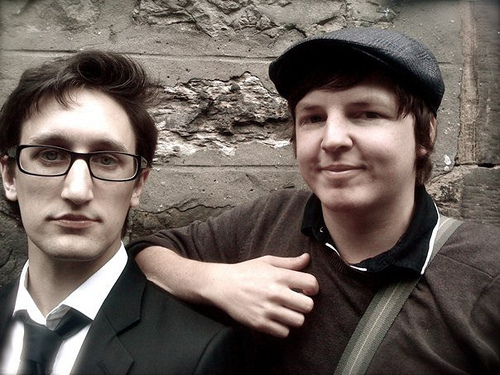
It’s a Wringham & Godsil Edinburgh Festival show.

Here it is! The inevitable live version of The Wringham & Godsil Podcast: part of Peter Buckley Hill’s much celebrated Free Fringe.

We’re doing FOUR live podcast recordings, on 24, 25, 26 and 27 August 2011.

The name of the show? We’ve gone with THE WRINGHAM & GODSIL PODCAST LIVE! to keep things simple. Here are some of the show titles we rejected:

– Aaaaaargh! It’s a Wringham & Godsil Edinburgh Festival show.
– Quick, Hide, It’s Wringham & Godsil.
– The two faces of Wringham & Godsil.
– Ben Elton Presents: Wringham & Godsil.
– Wringham & Godsil get the munchies.
– The Isambard Kingdom Brunel Story.

It’ll be the usual shambles, but presented in front of a live audience and moved along with the assistance of a pomodoro tomato timer. There will also be celebrity guests, some audience-inspired japery, and a sneak-beak of Rob’s future show Penguin Joke. As a wise man almost certainly once said, “Come!”

Wringham & Godsil Podcast 29

Episode 29, “R is for Ripping”, is online now!

This time, we podcast from a mini cooper parked outside Dan’s house in Shropshire. Among other things, we discuss what Jack the Ripper might use for pillow cases; weigh up the merits of invisibility and flight; and consider how Beyonce Knowles ascertains whether things are Bootilicious or not. Deceased turkey farmer Bernard Matthews, of course, is not Bootilicious: he’s merely Bootiful.

Upon learning that some listeners use our podcast as an alarm clock, we also provide a helpful “Wake up!” soundbite for precisely this function.

New Escapologist Issue Five launch event

That there’s a New Escapologist gathering in Glasgow on 10th May 2011. If you fancy coming along, we’ll be at The Arches (beneath Central Station) between 6pm and 9pm.

>Facebook event page.

>Event page at The Arches.

All are welcome. Bring friends. Meet the creative team behind the magazine, mingle with other readers and buy a copy of the mag. Free entry, naturally.

“Foppish, irresponsible, and very needed” – Pat Kane, ThoughtLand

“Excellent publications which deserve a wide readership” – Tom Hodgkinson, The Idler

New Escapologist Issue Five available now

Issue Five of New Escapologist is out now! My journalistic contributions include an interview with Alain de Botton, an account of my time living in a Glaswegian attic, and a new editorial called ‘Behind the scenes of New Escapologist’.

Also in this issue are Dickon Edwards on bedsits and Quentin Crisp; Tom Mellors on Bohemian love; and Reggie C. King on Erik Satie. Loads more too. Probably our best (and certainly fullest) issue to date.

Purchase your copy at the NE shop today.

Poly Styrene

Originally published at Verbicide

Legendary punk front woman Poly Styrene has cancer and is reportedly too weak for chemotherapy. Three months after diagnosis, however, she is promoting her new studio album, Generation Indigo, from a hospital bed while nurses administer a miracle drug called Herceptin. It is from this bed in a British coastal town (very near to Hastings pier, where she first saw the Sex Pistols perform and famously said, “I could do that”) that Ms. Styrene grants us a short but upbeat interview.

Alongside Laura Logic, Poly Styrene came to popular consciousness while fronting the iconic punk rock band X-Ray Spex. The only criticism that can be leveled upon this amazing group (important in the history of New Wave as well as pure punk) is that they didn’t produce enough work. Two archetypal studio albums and two live recordings have left fans desperate for more. Parallel to her work with the Spex, Poly has enjoyed a solo career, starting in 1980 with her album Translucence. Putting aside the heavy and grubby punk guitar of the Spex, her solo work tends to be gentler, jazzy, and inspired by her spiritual outlook — Poly was initiated into the Hare Krishna movement in 1983 and lived as a devotee in their temple for several years.

The latest installment to the Styrene canon is Generation Indigo and its first single, “Virtual Boyfriend.” “I just wanted to do something that was very current and that was about modern relationships,” Poly tells me in regards to the single. “There wasn’t a lot of thought. It channeled through me and just happened.” The narrative of the new single concerns technology and our relationship to it: “Human contact is necessary, and we need to be careful we don’t lose this and its importance.”

The new album is produced by Martin Glover, perhaps most famous as “Youth” from post-punk kings, Killing Joke. “It was a pleasant experience [working with him] and we got on. He works pretty fast and so do I, so the pace was familiar.” Poly Styrene is often cited as the original feminist punk icon. What are the challenges for feminism today?

“I don’t think there are any challenges anymore. Just the over-sexualization of women, but that’s quite small in reality. I’m in a hospital at the moment and all the nurses are women and they’re lovely. In the media they’re portrayed in a different way, but just like the nurses I’m talking about, the majority of women are out there being themselves. Women are quite caring and nurturing and that’s good. If that’s feminism then there should be more of it.”

I ask the question to which we’re all nonchalantly hoping for an affirmative. Will there be a future excursion for the X-Ray Spex or perhaps a release of older, unheard material? “I’m not sure at the moment, as I’m concentrating on this album and also on getting better. There are some early recordings that haven’t been out there yet… maybe one day in the future it will be released.”

I think Verbicide speaks on behalf of all the fans when we wish Poly a speedy recovery.

Published
Categorised as Interviews

Wringham & Godsil Podcast 28

Episode 28 is online now! This time we podcast live from a motorway service station in the North of England.

Rob has sushi. Dan has fajitas. The hand-held recording device has some 69p zinc-based batteries. We’re ready to go!

From Dan’s car, we discuss public toilet politics; Dan’s misinterpretation of the Jesus resurrection story; promote a new kidney stone-giving soft drink; prematurely leak news of our possible Edinburgh Fringe show; and Rob reminisces about the time he rode upon the ant from Honey I shrunk the Kids.

This episode also features the introduction of our new catchphrase, “You can’t throw that away. It’s a piece of foam”. This will soon be chanted ad-nauseum by school children and office workers across the world.

Wringham & Godsil Podcast: Series 2

Our rambling, shambling, deliciously-dangling podcast makes a triumphant return with Episode 27: “A is for Beginnings”.

This slice of podcast pie is also known as “Series 2, Episode 1”. Yes, we’ve decided to complicate the future of our once-simple numbering scheme. Needless to say, we anticipate a tsunami of frustrated fan backlash.

But wait! In addition to the main podcast, we also recorded TWO pre-podcast chats. The first (26a) takes place in my mum’s house; and the second (26b) is a Robert Llewellyn-style mini-podcast recorded in Dan’s car en-route to the studio. Never has so much W&G been unleashed on a single day; probably with good reason.

As usual, the main episode is available at the above link and on iTunes. The bonus easter eggs, however, are only available at the above links.

Series 2 will continue in earnest on Sunday 27th March. Enjoy!

Status Anxiety and Bohemia: Alain de Botton

This is a very short excerpt from my interview with Alain de Botton. The interview can be read in its entirety in Issue Five of New Escapologist.

Employment often seems at odds with the happiness and internal values of the individual. Must it always be this way?

There are broadly speaking two philosophies of work out there. The first you could call the working-class view of work, which sees the point of work as being primarily financial. You work to feed yourself and your loved ones. You don’t live for your work. You work for the sake of the weekend and spare time – and your colleagues are not your friends necessarily. The other view of work, very different, is the middle class view, which sees work as absolutely essential to a fulfilled life and lying at the heart of our self-creation and self-fulfilment. These two philosophies always co-exist but in a recession, the working class view is getting a new lease of life. More and more one hears the refrain, ‘it’s not perfect, but at least it’s a job…’

The strangest thing about the world of work isn’t the long hours we put in or the fancy machines we use to get it done; take a step back and perhaps the most extraordinary aspect of the work scene is in the end psychological rather than economic or industrial. It has to do with our attitudes to work, more specifically the widespread expectation that our work should make us happy, that it should be at the centre of our lives and our expectations of fulfilment. The first question we tend to ask of new acquaintances is not where they come from or who their parents were, but what they do. Here is the key to someone’s identity and esteem. It seems hard to imagine being able to feel good about yourself or knowing who you were without having work to get on with.

It wasn’t always like this. For thousands of years, work was viewed as an unavoidable drudge and nothing more, something to be done with as rapidly as possible and escaped in the imagination through alcohol or religious intoxication. Aristotle was only the first of many philosophers to state that no one could be both free and obliged to earn a living. Holding down a job, any job, was akin to slavery and denied one any chance of greatness. Christianity added to this analysis the yet grimmer conclusion that the misery of work was an unavoidable consequence of the sins of Adam and Eve. The idea that work could be fun, as opposed to simply useful and necessary, had to wait until the Renaissance to get any traction. It was then, in contemporary biographies of geniuses like Raphael or Leonardo da Vinci, that one gets the first glimmers of the idea that doing extraordinary work might be better than lying around as an idle aristocrat, indeed, that work might be the highest of blessings. A more optimistic assessment of work as a whole had to wait until the eighteenth century, the age of the great bourgeois philosophers, men like Jean-Jacques Rousseau and Denis Diderot, who for the first time argued that one’s working life could be at the centre of any ambition for happiness. It was during this century that our modern ideas about work were formed – incidentally, at the very same time as our modern ideas about love and marriage took shape.

In fact, there were remarkable similarities between the two realms of love and work. In the pre-modern age, it had widely been assumed that no one could try to be in love and married: marriage was something one did for purely commercial reasons, to hand down the family farm or ensure a dynastic continuity. Things were going well if you maintained a tepid friendship with your spouse. Meanwhile, love was something you did with your mistress, on the side, with pleasure untied to the responsibilities of child-rearing. Yet the new philosophers of love now argued that one might actually aim to marry the person one was in love with rather than just have an affair. To this unusual idea was added the even more peculiar notion that one might work both for money and to realise one’s dreams, an idea that replaced the previous assumption that the day job took care of the rent and anything more ambitious had to happen in one’s spare time, once the money had been hauled in.

We are the heirs of these two very ambitious beliefs: that you can be in love and married ­- and in a job and having a good time. It has become as impossible for us to think that you could be out of work and happy as it had once seemed impossible for Aristotle to think that you could be employed and human.

Published
Categorised as Interviews

9th March-25th May 2011: Robert Wringham and the Chrono-Synclastic Infundibulum

As a piece of performance art, I am making myself available to the public, every Wednesday noontime for the next three months.

As if at the whim of a chrono-synclastic infundibulum, I will appear at Glasgow’s Kibble Palace between 12:00 and 13:00 every Wednesday until the end of May.

You’ll find me sitting near the statue of “King Robert and his Monkey” (pictured above).

According to the plaque at the foot of the statue, “[Robert] was an arrogant king who was deposed by an angel, stripped of his robes, and forced to assume the role of a jester, with only a monkey for a friend.”

Come and meet me. The words “Hello, Robert” will activate me and, I’ll do one of three things:

1. I’ll casually talk with you until 13:00 (or until you leave);

2. I’ll read a single random passage from Private Memoirs and Confessions of a Justified Sinner by James Hogg (the book from which I take my name);

3. I’ll tell you a short anecdote about my monkey, whose name is Daniel Godsil;

4. I’ll walk you around the main circle of the Kibble Palace, telling a made-up lie about the history of each statue.

I’ll also have copies of New Escapologist with me if you’d like to buy one.

This supernatural occurrence is unsanctioned, and has nothing to do with Glasgow Botanic Gardens or Glasgow City Council. Tell your friends.

9th February 2011: It’s all talk with Asaf Gerchak

On February 9th, I’ll be one of three guests at Asaf Gerchak’s new on-stage talk show, It’s All Talk.

The gig is held at Montreal’s most satisfying microbrew, Brutopia. Come along if you’re in the area or hop on a plane if you’re not. It’ll be ace.

Not sure what Asaf and I will talk about yet (it’s improvised, you silly goose), but we’ll probably cover New Escapologist and Alphabites and non-self-promotional avenues too. If a reading is demanded, I’ll probably do psychic air traffic control for flies. Boogle!

Wringham & Godsil’s Alphabites

I co-produce an improvised podcast with my friend, Mr. Daniel James Godsil. It’s a pretty shambolic affair and almost certainly our Derek-and-Clive moment. It’s probably not suitable for the faint-hearted or easily offended.

Rob is aloof and likes jazz. Dan is friendly and likes pineapples. Together they are Wringham & Godsil, best of friends, worst of enemies, and presenters of the Alphabites podcast.

Recorded live at Dan’s studio in Dudley, England (and later in a specially-constucted podcast igloo in Montreal, Québec), the ongoing series is available to download via iTunes or via the direct download links below.

Wringham & Godsil’s Alphabites: Series 2

Episode 27: A is for Beginnings
Episode 28: M is for Motorway
Episode 29: R is for Ripping

Wringham & Godsil’s Alphabites: Complete Series 1

Episode 1: G is for Ghosts
Episode 2: P is for Paperclips
Episode 3: M is for Money
Episode 4: L is for Local
Episode 5: T is for Trailer
Episode 6: E is for Etterick
Episode 7: F is for Fish
Episode 8: D is for Derek
Episode 9: H is for Halfords
Episode 10: X is for Ten
Episode 11: S is for Science
Episode 12: N is for Neige
Episode 13: C is for Crisps
Episode 14: B is for Bagel
Episode 15: I is for Imran the Inuit
Episode 16: A is for Adam
Episode 17: K is for Kilroy’s Ilk
Episode 18: O is for Oreos
Episode 19: U is for Urinal Fly
Episode 20: W is for Warm and Wobbly
Episode 21: J is for Jacko
Episode 22: Y is for Yes, it’s a pumpkin!
Episode 23: R is for the Robert Wringham Show
Episode 24: V is for Vegetarian
Episode 25: Q is for Quint (Halloween Special)
Episode 26: Z is for Honesty, Honestly

If you enjoy our audio drivel, express your appreciation by joining our Facebook army.

Published
Categorised as Podcast

5th February 2011: Confabulation

On February 5th, I’ll be doing a stint at Matt Goldberg’s storytelling night, Confabulation. It’s at a venue called Shaika in Montreal and is sure to be a hoot.

The theme of this month’s performance is ‘neighbourhoods’ so I’ll be squirting out some anecdotal curds about Dudley, England.

Squirrel Seeks Chipmunk by David Sedaris

Originally published at Verbicide

Following in the footsteps of Me Talk Pretty One Day and Dress Your Family in Corduroy and Denim, the latest addition to the David Sedaris library has hallmarks of his classics: the dysfunctional family values, the well-observed minutiae of human behaviour. Unlike in his classic tomes, however, the characters of this book aren’t human.

Squirrel Seeks Chipmunk is a collection of animal fables, absurd enough to remind you of Edward Lear and wise enough to evoke Aesop, especially when they have titles like “The Vigilant Rabbit” and “The Sick Rat and the Healthy Rat.” Where Aesop’s fables are cautionary or moral, those of Sedaris are rich comedic performances: satires of common human behaviour and rituals. He documents a slice of life in which mothers and fathers trade parenting tips in the schoolyard, but puts a spin on it by making those parents into chattering storks. He writes an hilarious dialogue between a housewife and her stylist, but the two women are actually a cat and a baboon. There’s something very pleasing about a society in which the skills and traits of a baboon will guarantee a career in the beauty industry.

There’s a certain kind of misanthropy in the stories and a whiff of nihilism: for all our pretenses as humans, are we not really a hoard of pooping, gossiping, socially-awkward, baby-producing animals? Like so many Richard Scarry characters, we are a mammalian society of naively evolved carbon-heads, muddling along and doing what we can. It’s not until you embed the common behaviors observed by Sedaris into his feathered and furry characters (sweetly illustrated by Ian Faulkner) that you get the anthropological distance required to make this observation without feeling weird.

Sedaris is known as an excellent public speaker (cutting his teeth at National Public Radio), so it feels appropriate to mention his excellent reading at the Librairie Paragraphe Bookstore in Montreal as part of his ongoing book tour. The hour-long reading added fantastic value to the book. In addition to a deadpan and adorably maudlin reading from the book’s titular tale (the sad story of sciuridae struggling to make dinner conversation and understand jazz), he read from a story excised from the final book on grounds of taste. It is called “The Shit- and Vomit-eating Flies” and depicts a conversation between a pair of foodie bluebottles: which parts of town have the most delicious vomit and feces. It’s a shame the story was cut from the book, but it made a very meaty bonus for those who made it to the event. He also read from a condensed work in progress: highlights from his personal tour diary, which will presumably be different depending on which leg of the tour you catch him. Continuing with the animal theme, one of these tour diary excerpts concerns a girl whose t-shirt had allegedly been “painted by a dolphin with scoliosis.” How and why a dolphin could be cajoled into painting a t-shirt boggles the mind. The detail of the scoliosis, much like the observational details salt-and-peppered throughout Squirrel Seeks Chipunk, can only further baffle and delight.

Side Street Review article. December 2010.

The December issue of Side Street Review features a lengthy interview I did with philosopher Joseph Heath on the idea that rebellion against Capitalism actually helps the system. It makes for chilling reading but hopefully ends on a positive note.

The Great Escape: Tom Hodgkinson (with Neil Scott)

This is a very short excerpt from our on-stage conversation with Tom Hodgkinson.

The interview can be read in its entirety in Issue Three of New Escapologist.

Tom: I’ll go back to when I started the Idler magazine, which was in 1993. The reason I started was because I left university and I was beginning a career. I had had one year working in a record shop called Rough Trade in London. I’d met a whole different crowd of people; these people were skateboarders. It impressed me as a very creative scene, full of autonomously functioning individuals. There were people running their own club nights and tprinting T-shirts and running fanzines and magazines and playing in bands and there were DJs. No one actually had any money, but no one seemed to have a job. And it was great to meet such people here, who were coming from a completely different and a less academic background, but who seemed to be much more free and more spirited and were grabbing their life with both hands — much more than I was — because I was sitting in the shop all day.

So that was one thing that began to open out: the fact there might be work outside of the conventional. I think I had the idea for the magazine a couple of years later, when I was working on the Sunday Mirror magazine. I had got the job kind of by accident — fifty pounds a day as a researcher for three days a week. I thought this would be good; I could do my own stuff at the same time. I found myself being made thoroughly miserable by the culture of the office, which was later well portrayed in The Office. I was too young and new to get involved in the politics, but there was something about these offices: the boss was made into a petty tyrant and we were humiliated daily and one day I’d be asked to, sort of, write a short article, which, itself, was actually rubbish, as it was a terrible magazine. One of the editors would come by and go “coffee run, coffee run, coffee run, Tom, Tom, coffee”. So, we had to go and get the editors their different kinds of coffees. I didn’t have any money. I couldn’t stand the commute every day.

I was always late; I was probably a very bad employee. And I was also very bored for long periods of the day. I had been bored at the shop, but it was a little different, because people came in and we were able to hang out. But if you started, sort of, chatting to your neighbor in this office, then the editor would tell you, “I want to see heads down, heads down,” and just enjoy, sort of, putting people down. It’s really very humiliating; I felt so depressed.

Neil: Okay, Rob. The latest issue of your magazine is about the practicalities of escape. I was wondering if you could tell us how you got to be producing this magazine and to be expressing these ideas and what you think are the practical ways that people here tonight can take to get to where they want to be.

Robert: Well, the practicalities edition is not actually released yet. The War Against Cliché Issues is on sale tonight. The practicalities one will be a little bit different, but, yeah, we can talk about that for a bit. I think, as Tom was saying, the 9-5 work system does not work. It doesn’t make anybody happy and it also fails in terms of production as well. I mean, do a lot of people here have officy kinds of jobs?

The audience responds with an unenthusiastic ‘Yeah’.

Robert: (Laughs). See, you cannot muster the energy to be enthusiastic – even ironically – at working in an office 9-5. The bottom line is: if you work in the office, probably about 80% of your time is spent doing not very much. So, even from the employer’s or the bureaucrat’s perspective, it’s probably a very inefficient system. It fails on both sides. It doesn’t make the worker happy, we don’t make enough money, we are not respected, and, frankly, it doesn’t work. We produce inferior products and inferior services that probably don’t really matter, especially if you work in something like marketing.

I worked as a librarian for a long time, but I ended up working in an office again. Librarianship is one of those careers that was, perhaps, a trade, once upon a time, but it is becoming kind of deskilled. They outsource a lot of the skilled work, so now librarians end up in offices, either at the back of an actual library or there is no physical library at all and they offer electronic services. And that’s basically where I ended up: it was somewhat dissatisfying, not because I fetishise books or the ideas of a library to a huge degree, but I just felt that the cornerstone principles of librarianship aren’t being met anymore.

So, to answer the question about the project’s history, it came about when I was reading two books simultaneously: one about the life of Houdini and also one about the rise of Bohemianism around the nineteenth and early twentieth century.

Buy New Escapologist Issue Three for the complete conversation (and other issues) here.

Published
Categorised as Interviews

For the advanced minimalist: Leo Babauta

Originally published at New Escapologist

Leo Babauta is the founder of the Zen Habits website and books and (more pertinently to this post) the website, Mnmlist. His sites have thousands of readers. I caught up with Leo by email and asked him a few questions for the advanced minimalist:

Q: After minimalism, do you find yourself treasuring the things still in your possession or do they weigh upon you as stubborn things that wouldn’t wash away?

Leo: I don’t think about them much. The things in my possessions are just things. They are there because I need them, not because I love them. I have a T-shirt because otherwise I’d be cold, not because it’s beautiful and gives me joy. Going outside and playing with my kids gives me joy. Minimalism is a way for me to let go of thinking about things so much.

Q: Do you feel that digital entities (mp3s, eBooks etc) constitute clutter in the same way that physical objects do? Should we try to save virtual real estate as well as physical space?

Leo: A few years ago I moved from organizing all my files into folders, to forgetting about them and using search to find what I need — this includes mp3s, documents, emails. Search eliminates the need to organize, though you can purge if you’re using up too much space.

More important than worrying about digital files is being aware of digital buying. If you buy things mindlessly because it’s easy — apps, music, movies, ebooks — that’s mindless consumerism. That’s something you should become aware of.

Q: I converted to minimalism as a personal preference but I find myself thinking more and more about the green benefits of reduction. How relevant is the environmental issue to you?

Leo: It’s at the heart of minimalism. Environmental problems have become so overpowering because we have let corporate consumerism become more important than how we treat each other, how we live with nature … than living in general. Minimalism is striking back against that. When you let go of corporate consumerism, you let go of the need to overconsume, to buy horrible amounts of things and waste so many natural resources.

Published
Categorised as Interviews

New Escapologist breakfast party @ The School of Life, London

8:30am, 13th August 2010 sees the New Escapologist breakfast party at the School of Life in London.

Founded by Alain de Botton and friends, the School is the perfect venue to mark the launch of our philosophy-inspired fourth issue. The School is officially closed for the duration of August, but they’re opening especially for us. Special thanks to The School for this.

The event will feature a talk by New Escapologist Editor, Robert Wringham and a unique ‘conversation breakfast’ run by Mark Vernon. It’ll also be a great opportunity to meet some of the New Escapologist staff and writers as well as other New Escapologist readers.

We’ll have advance copies of the magazine for sale (or for free collection to subscribers).

For those who fancy it, the event will informally continue at the nearby St. George’s Gardens and/or local Camden drinkery.

The event is limited to twenty places and costs £20. Tickets will be on sale until July 30th (or until they sell out, whichever comes first). Come along! It’s going to be great.


Stuffing it ceremonially into the milk jug

“Minimalism”, I once wrote in these very pages, “is anorexia projected outwards”. This suspicion that my ongoing dedication to asceticism might be a mental illness was further demonstrated this week.

“It’s pathological!” my girlfriend teases me after I decline a carrier bag at the pharmacy. As a result of doing so, I had been forced to walk around the rest of the shops with a box of condoms and a roll-on deodorant, repeatedly showing the receipt to security guards to demonstrate that I’d bought the goods elsewhere.

“Don’t you see? When your minimalism interferes with day-to-day activities, you’ve got a problem,” she said.

I refuted this because, to me, the mild inconvenience of walking around with a box of johnnies and a niff stick™ was preferable to the burden of being responsible for another fucking carrier bag. But was this the skewed perspective of a mentally unstable individual?

Later in the week, we went for dinner with our friend Shanti. Somehow we’d gotten onto the subject of whether or not you’re supposed to jam your wallet into the mouth of someone suffering an epileptic fit.

“That’s not for fits,” someone pointed out, “You’re thinking of spoons. You have to put a spoon in their mouth to stop them from swallowing their tongue. You do the wallet trick if you need to snap a broken bone back into position. They bight down on it to distract from the pain.”

I love discussing the strange idea that shoving a spoon into the mouth of an epileptic is supposed to be useful. Imagine recovering from a horrible fit only to find that someone had placed a spoon in your mouth. “What’s this?” you’d ask. “Oh, you know, it’s a spoon,” a well-meaning stranger would reply. And you’d say, “Right.”

I also like the idea that you might have to do the wallet trick one day only to enrage the patient who, a lifelong vegan, becomes offended that you’d forced a piece of cowhide into their gob.

On this occasion, however, I didn’t wax lyrical on the epileptic/spoon myth or the sudden idea of snapping the bone back into place in an angry vegan. Instead, I got my wallet out.

“My wallet wouldn’t be much use there!” I bragged, “It’s about as thick as a beermat.”

I never miss an opportunity to brag about the slenderness of my wallet. To the dedicated minimalist, a slim wallet acts as a sort of talisman: a symbol of minimalism carried around at all times. So proud am I of my super-slim wallet, I actually like to get it out and demonstrate the contents at dinner parties, much as I was doing now, oblivious to the fact that nobody is really interested. The way I see it though, is that since I’ll never have children, I should be able to use the time normally allotted to showing photographs of my children in any way I like. People at dinner parties have no choice but to listen.

“Look, here are my cash cards, a health insurance card, a few bank notes, my casino membership card, my press ID card AND THAT’S ALL,” I conclude proudly. “No receipts, no business cards, no loyalty cards, no photographs of my mewling spawn. Just the essentials.”

Our friend, to her credit, seemed genuinely impressed.

Upon demonstrating the handful of essential plastic cards, I saw that my library card from Glasgow was still in there. I have no plans to go back to a Glaswegian public library and by the time I’m in one again the card would have surely expired. I had a rare opportunity to permanently remove something from my wallet.

Naturally, I made a big show of this by removing the card and stuffing it ceremonially into the milk jug.

My girlfriend, presumably recognising the signs of my “pathological” malaise, extracted the from the milk jug, cleaned it off and popped it into her handbag.

At first I shrugged this off. If she wanted to harbour this burden out of the extreme off-chance that we’ll want to borrow something from a Glaswegian library, she was welcome to do so. But now it’s slightly starting to bother me that the card continues to exist in my material sphere. I don’t want it any more! The fact that it exists outside of a garbage can is starting to pull at my attention. Even though my girlfriend has ostensibly taken responsibility for it, I still know that it’s there and still mentally account for it.

The worst thing about all this is that I can’t possibly tell my girlfriend about this and ask her to throw it away because then she’ll have the final confirmation that I’m mental.

Suicide is the only way out of this.

The damning evidence of a further level of preparation

On our way to sunbathe in the park, my girlfriend and I chanced across three uniformed policemen enthusiastically singing ‘Jingle Bells’ by the roadside.

One of the officers was even keeping their rhythm with a set of sleigh bells, adding quite the festive vibe to an already merry scene. I’m not sure which was the biggest juxtaposition: singing policemen or the sound of ‘Jingle Bells’ in the 30°C Montreal sunshine.

My first thought was that the carolers weren’t real policemen but surely some sort of performance art troupe. Such would be typical in the public spaces of Montreal, so this would explain the strange out-of-season caroling to which we were bearing witness.

I then noticed that the uniforms of the cops – complete with night sticks and firearms – were pretty authentic. What was going on?

My girlfriend pointed out that the nearest car to the trio of festive policemen contained a woman seemingly sleeping in the passenger seat. Ah, now it was clear. The cops, perhaps concerned that she might suffer heat stroke behind the car’s windscreen, were in the process of waking her up through the medium of Christmas songs. They were being civil-minded but also playing a joke: when the woman woke up, she would disorientatedly think she had slept until December.

Even to a curmudgeon like me who hates all acts of merriment or human happiness, this was pretty funny. I watched on for a while and enjoyed seeing the expression on the dozing passenger’s face as she awoke to this slightly bizarre spectacle.

I wondered for half a second where the cops could possibly have found sleigh bells at such short notice. The park is always full of creative buskers though so maybe the cops had formed an alliance with one of these musicians and borrowed the sleigh bells to complete the charade.

It was a quite brilliant and lovely scene. The policemen of England might be savage and humourless meat-heads but it became clear to me that their Canadian counterparts were not so bad.

We set down our beach towel and settled down for an afternoon in the sunshine. No more than ten minutes had passed when the chorus of Jingle Bells once again picked up from the location of the three policemen. Strange.

Ten minutes later it happened again. And again. And again. What the fuck was going on?

It soon became apparent that my impression of cops waking a sleeping woman in a jovial fashion was to overestimate the value of their joke. They hadn’t been trying to wake the woman in the car.

This had not been a spontaneous or well-meaning prank. The cops had been in the park all afternoon on some slack duty and had decided somewhere along the way that Christmas caroling in the 30°C sunshine would be amusing enough a joke to perform repeatedly in public. Drunk from the attention that the public (sadly including myself) had been giving them, this would continue ad-nauseum until the sun went down.

Or possibly until it went Nova and destroyed all life on the Earth.

But what about the sleigh bells with which one of the officers had been keeping festive rhythm? God, the bells were the damning evidence of a further level of preparation. They hadn’t quick-wittedly borrowed them from a busker at all. One of the cops must have planned this in advance and brought the bloody things along with him from home.

Not only was this not a spontaneous act of impromptu wit, it wasn’t even something they’d connived suddenly by way of passing the time. It had been planned at least a day previously. Perhaps it is an annual tradition they have. Perhaps they do this every day.

Comedy should really be left in the hands of experts. It’s a dangerous commodity and shouldn’t be tossed around by just anyone. In fact, I’d be willing to volunteer for some sort of comedy police force who go around arresting people who dare to make poor, dim-witted or laboured jokes in public.

The Plain People of Cyberspace: “Ah, but don’t you see that by being a humourist dabbling in the policing business, you’re committing the same sin as the cops were but the other way around?”

Quiet you.

Typographic bounty hunters

Reading a library copy of Haruki Murakami’s South of the border, West of the sun today, I noticed that someone had fixed a typographic error in the book by penciling an ‘r’ into the misprinted word, ‘unb oken’.

The manual correction of typos in library books strikes me as a slightly odd thing to do but is something we’ve probably all seen before. Oddly enough, the last one I can remember seeing was in a copy of The Wind-Up Bird Chronicle: also an Haruki Murakami novel. Maybe there is specifically something about Murakami readers that leaves them so inclined.

If we were to ask them about this behaviour, I’d like to think that they’d have an appropriately mindful Murakami-esque response: “I just can’t stand to see an incomplete or misspelled word. I don’t know why. I just can’t. It is what it is”, and then maybe they’d go and talk to a stray cat for a while.

It strikes me that you’d have to be a very singular person to do correct a typo in a mass-market paperback. What is the motivation? When I see a typo in a book, it may momentarily derail my reading but once I’ve acknowledged the typo, I just ignore it and move on.

By correcting the typo with a pen, all you’re doing is correcting the typo in one copy of a book, of which there are thousands, even millions, of other copies. There’s presumably no motivation on behalf of the corrector to fix all of the copies of the book. (Unless, of course, there is. Perhaps there’s a subculture of typographic bounty hunters travelling the libraries and bookshops of the world, patiently waiting to be discovered and interviewed by Louis Theroux).

Maybe this is the difference between typo correctors and people like me. If ever I find myself correcting typos, it’s as a professional editor and always in the master or proof copy of a book which has not yet been mass-printed.

This being said, I think the typo correctors should be praised for making this tiny difference in the world. I’ll miss this sort of thing when everything is digital and correctable at the source.

Where Delhi Belly comes from

“Suppose you chomp down on an abscess and shatter your jaw,” says my dad in the cautionary tone of someone who knows about life or has at least been told a lot about it.

“Or suppose you get completely paralysed from the neck down. A proper superman job. How are you going to get home then?”

We are having a conversation about travel insurance. All I have asked for are the names of a few reputable brokers. Instead, my dad has opened my eyes to a seemingly endless score of terrifying “what ifs” that can happen around the globe.

“What if you put your foot down a rabbit hole and trip, cracking your head off a rock?”

I never knew this man had such a cool imagination. He lives in a world of “indemnity policies” and “negative equities” and “shadow cabinets”: things I had always assumed to be mind-picklingly officious. It turns out I might have been wrong. The field of insurance is as entertainingly grisly as a trip to the London Dungeon.

Come to think of it, the shadow cabinet sounds pretty spooky as well. Like something Lord Voldemort might be involved in.

“You hear about these kids,” he says, “who step on a jellyfish in Crete and spend the next forty years in a grubby Greek hospital, wriggling their eyebrows at nurses – once for yes, twice for no.”

After some more blood-curdling tales of potential holiday woe, my dad explains that my policy should include something called “repatriation”. Apparently, it is best to have a sort of escape plan built into your insurance policy: so that the company will charter a flight back to Old Blighty if you end up in a coma or a head in a jar.

“LastMinute.com isn’t much use if you’re in an Iron Lung in Baghdad with organ leggers asking suspicious questions about your teeth”, he warns me sagely.

I’m not going to Baghdad though. I’m going to nice places like Montreal, where there’s a really good socialist health service in place. A nice Canadian hospital is probably a good place to be in such an event. At least I wouldn’t have orange-skinned British nurses sponging me down with MRSA.

“And China? You don’t want to think about what you can catch in China. They invented SARS. And India? That’s where Delhi Belly comes from. And Poland? Whoa, Poland. Try pronouncing allergic to penicillin in that language.”

All this talk of jellyfish and eyebrows is putting me off going anywhere ever again. Who needs beaches and bad wax museums anyway? I might just stay at home.

“Home? Do you have any idea how many accidents happen in your own home? You’re scared of terrorism but you’ll twice as likely suffocate in your own bed.”

That’s it then. I’ll take one middleclass life of living in fear, sustantivo.