Kubrick Box

This was written for New Escapologist‘s now-defunct Patreon situation in 2020. It was part of a show-and-tell series called Hypocrite Minimalist.

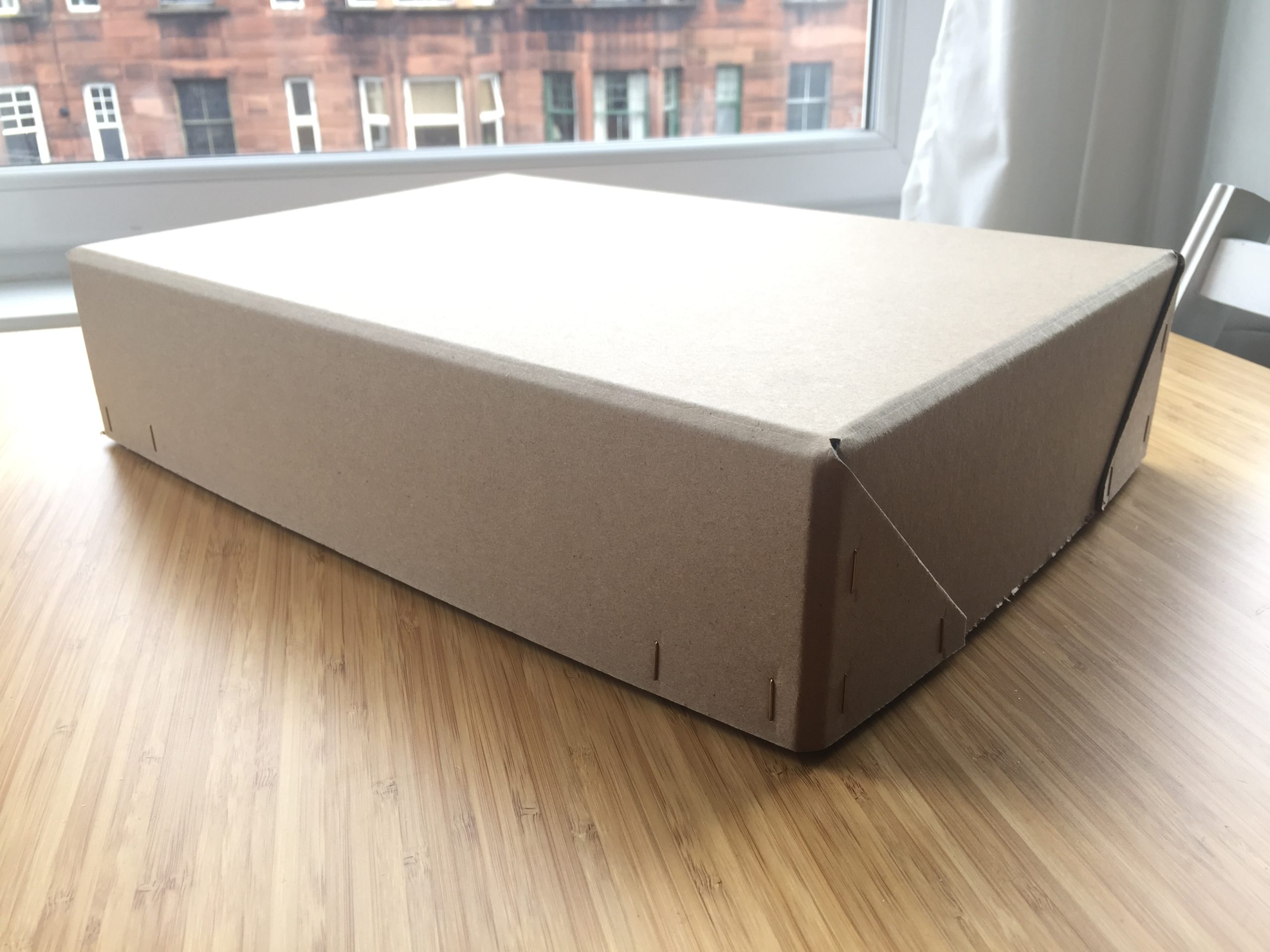
Object Number 3 in our inventory is my Kubrick Box. All will be explained. I have written a thousand words here about a cardboard box. No, it’s you who is weird.
Sixteen years ago, I sat in an office canteen on my lunch break and read a story by Jon Ronson in the Guardian. Pre- smartphone ubiquity, the paper was in print and my eyes were on stalks.

Ronson told the story of how he’d visited the English estate of Stanley Kubrick after his death and been confronted by boxes and boxes and boxes.

“There are boxes everywhere,” wrote Jon Ronson, “shelves of boxes in the stable block, rooms full of boxes in the main house. In the fields, where racehorses once stood and grazed, are half a dozen portable cabins, each packed with boxes.”

Kubrick, famously obsessive, had kept almost everything from his life in film.

As well as being a Kubrick fan, I also had a slightly complicated relationship with stuff. By 2003, I already had a tendency towards Minimalism but this had come after an early life of collecting things. I still liked material objects, especially when they were archived or organised in some fussy and logical way. I loved (and still love) libraries, museums, storehouses and collections, so long as I don’t have to own them myself, and I admired Kubrick’s demented, almost religious, maximalism.

A few years passed and I escaped office life. In a bookshop in New York, I picked up a collection of Jon Ronson’s journalism. I wondered if the Kubrick article had made the cut. It had. So I read it again. I bought the book and took to reading the Kubrick piece every so often. I found it soothing. All that nicely-organised cardboard. Ah, lovely.

When I told someone this, they looked at me askance and said, “do you mean the film about Stanley Kubrick’s boxes?” A film? Well, no it was in the newspaper ages ago. But it turned out Ronson had made a film about it in the meantime.
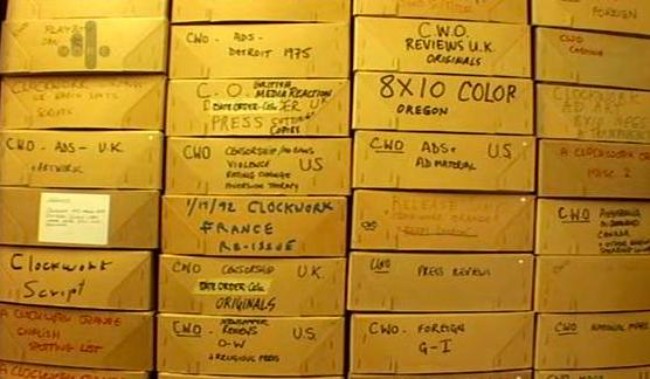
In the film, there’s picture after picture of the boxes. Some of them are opened in what is essentially a really good unboxing video. At the end, the boxes are shown being taken away to the University of the Arts London. I was a bit sad to see this, preferring to think of the boxes in their original home, but at least you can go and look at the boxes now if you want to, without even having to be Jon Ronson.

A filmmaker friend AJ (Hi, AJ!) went to see the archive a few years ago and there’s a Taschen book about it too, full of photographs.

Ronson says in his film that he’d been looking for a “rosebud” in the boxes but that, actually, the boxes themselves were the key to Kubrick’s character. Apparently, Kubrick hadn’t been willing to settle for the standard archive box you can buy from stationery stores (though it’s on record that he loved commercial stationery from his local Rymans) and went to the lengths of commissioning the perfect archive box from a box manufacturer.

There’s a memo from the box maker in the archive with a note about the “fussy customer” who wants the lid to slide off without a struggle but not to fall off by chance. Also on that memo was the name of the box company: G. Ryder and Co.

I wonder if they’re still in business, I thought one day. I Googled. They are. I called them, a man picked up the phone, and I asked if he could make me a box exactly to Stanley Kubrick’s specifications. He laughed at me.

“I’m researching a book about Stanley Kubrick,” I lied.

“Well,” he said, we don’t normally take orders for a single box. We have to make a whole run of them.” And if they did that, he explained, it would cost thousands of pounds for loads of unwanted boxes.

“But since you’re working on a book,” he said, “I’ll do you a box for forty pounds.”

Forty pounds. After embracing and selling off all my CDs one by one, was I really going to spend forty actual quid on a cardboard box?

“Okay,” I said.

A couple of weeks later, the boxes arrived. Two of them! A steal at twenty quid apiece.

I now use them as, well, archive boxes. The box maker, meanwhile, now sells them as a featured product with a clip from Ronson’s film.

Showing my boxes off to Landis one night, (Landis being easily as fussy as Stanley Kubrick and didn’t think it was strange that I wanted to show him a cardboard box) we wondered if one day “a Kubrick” could be a standard measure of stuff.

People could say “yeah, I’ve got 736 Kubricks at home” or “did you know Bill Gates has an estimated three-million Kubricks spread over six different homes?” or “I have whittled my life down to three eminently-portable Kubricks.” It’s a lovely dream.

Inside a Kubrick:
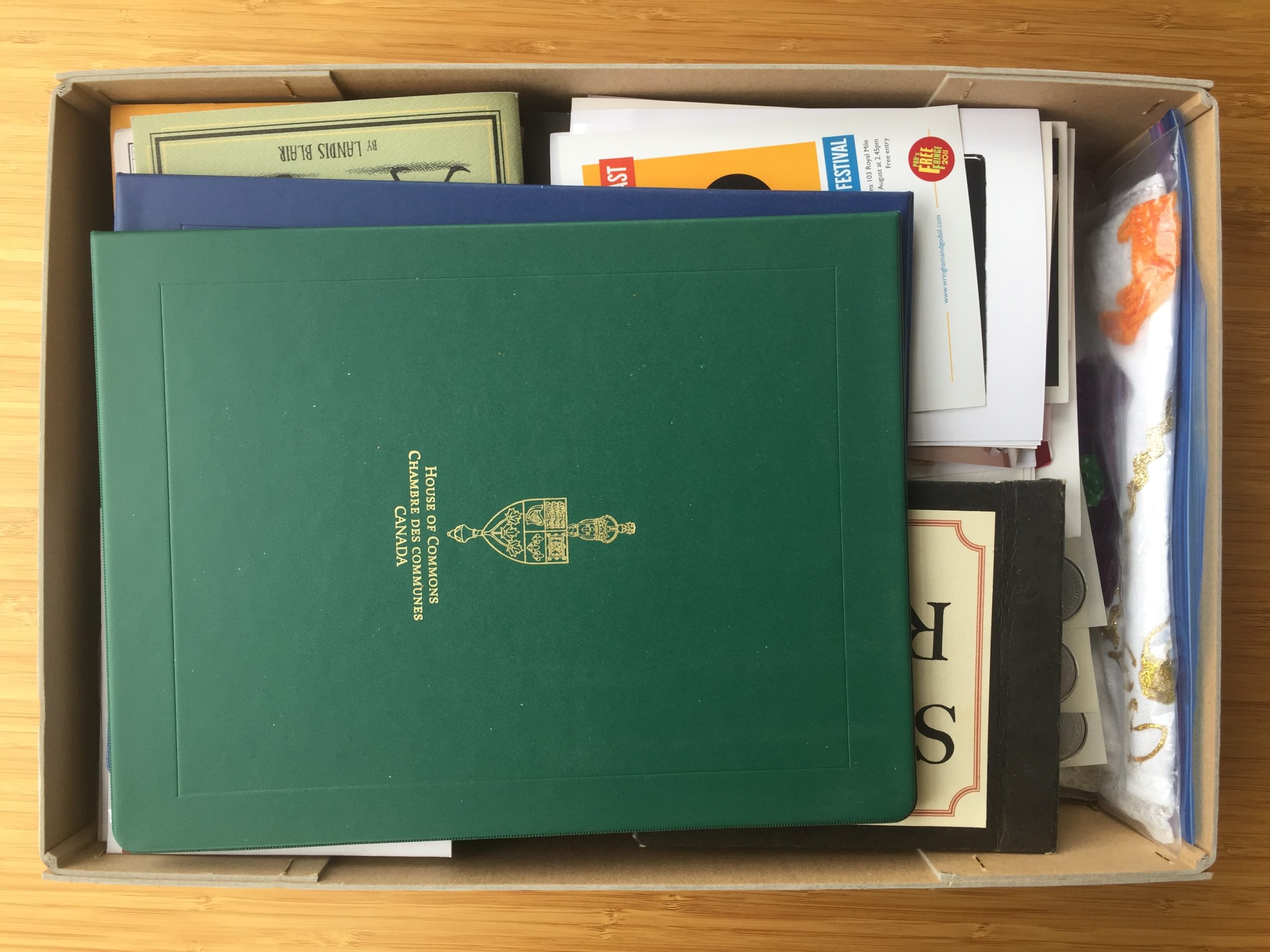
Nowness: May 2024

It’s May 2024. I’m a writer. I live in Glasgow. I’m married to Samara. This is all exactly as it should be.

Work

I run a small press magazine called New Escapologist and I’m currently putting Issue 16 together. It’s a thing of beauty and will be shipping very soon, so why not pre-order a copy?

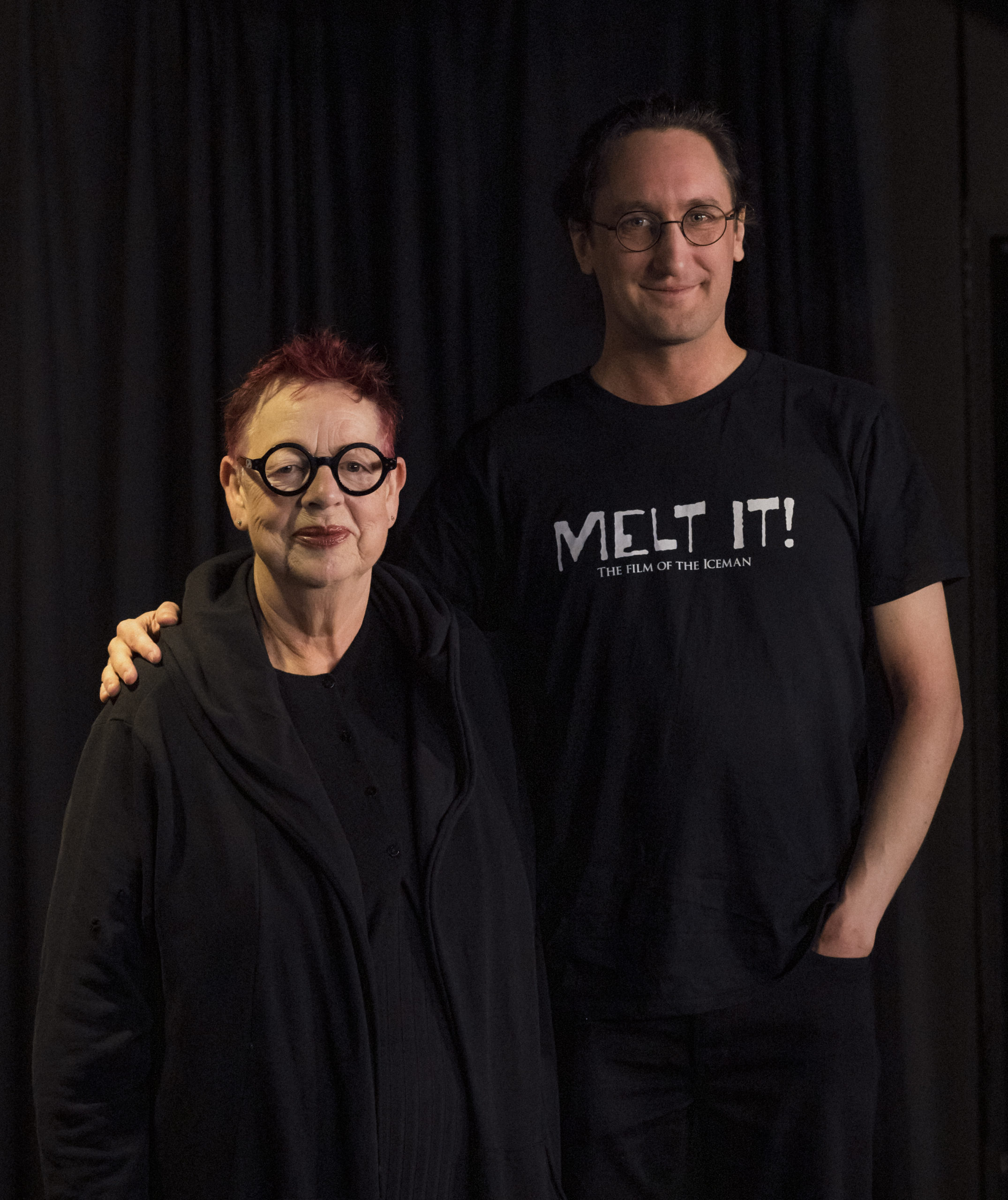
Work continues on the film I’m making with Mark Cartwright and Anthony Irvine. We’re basically turning my book about the Iceman into a documentary and it’s been tremendous creative fun so far.

I’m editing a new memoir called Before I Go for “the archaeopteryx of alternative comedy,” (Alan Moore’s words, not mine) John Dowie.

You might remember me mentioning Dowie’s other excellent book The Freewheeling John Dowie in my previous Nowness message. I’d enjoyed it greatly and was irritated that it was no longer in print. Well, I pulled some levers and strings and it’s now available again as an e-book at least. Hooray!

The month of June, if I can mop up these few projects in the meantime and since I’m not needed on any film shoots, will be devoted to something completely new. Ooooh, yes.

Reading

I’m 300 pages into a thousand-page biography of Portuguese poet Ferdinand Pessoa by Richard Zenith. It’s very, very good so it’s hard to begrudge the absurd length. I want to tell the world about Pessoa, but there would be no point: Zenith is your man for that.

Travel

I just got back from London where I was filming at the Comedy Store with Mark Cartwright and our little team. We met some incredible people and I’m particularly grateful to the Obi-Wan of improv Neil Mullarkey for all he did for us. Thank you Neil.

Culture Devourment

I’m writing this in a quiet moment at Tectonics, a weekend city festival of experimental music. It’s always one of my cultural highlights of the year. Today I’m all about Koichi Makigami.

For TV, I’ve been watching Werner Herzog’s filmmaking Master Class, chunk by 15-minute chunk. It’s more about spending time with Herzog than actually learning any practical skills for me. But as the Bavarian man himself says, you don’t become a poet by learning to type.

Some films I enjoyed recently were The Delinquents (2023) and Wim Wenders’ Perfect Days (2023). I review both in Issue 16 of New Escapologist since they’re about, in different ways, escapes from work. I saw these films at the GFT. Support your local art cinemas, you sods.

Physical Form

Here’s my picture of the “month” so you can continue to monitor my ongoing decay, this time taken at the Comedy Store in London:

Old Now pages (Then pages?) are squirreled pointlessly into the Now Page Archive

Published
Categorised as Nowness

Crossmylaff

One must drink on Purim until that person cannot distinguish between cursing Haman and blessing Mordechai (Megillah 7b)

The show was a smash, obviously.

Next up: a 7-minute version of the same sort of thing for Fergus Mitchell’s fantastic South Side comedy night, Crossmylaff. It’s at Glad Cafe on 24th March.

Unfortunately the 24th is also Purim, the Jewish festival of getting blotto. So I’ll be coming from that. Get yer tickets here.

Alt text: the whitest kids you know.

Our Tiggy

I try not to be prejudiced against the posh, but there’s an article in Home & Garden magazine by someone called Tiggy Hatley-Dent.

Tiggy Hatley-Dent.

I mean, come on. It’s almost cruel.

Gray Day 2024

Happy Gray Day, one and all. To cocky chaps, wise old owls, urban foxes, queer fishes, merry devils, and back green puddocks.

Today’s the day chosen by Sorcha Dallas, his representative on Earth, to honour and remember the writer and artist Alasdair Gray.

Alasdair’s been gone five years now and I still miss him. I didn’t know him personally because I was too starstruck to introduce myself on any one of the countless times we passed on West End streets, but his physical presence was important to me. When I pass his old Hillhead flat, which I do all the time, I feel a sense of bereavement. I want to see his paint brushes on the windowsill, to know the wizard is in residence.

At 85 he was probably an old enough man to go: he’d had his fill of earthly pleasure despite being famously shy and he’d done more than his share of great work. But he gave to Glasgow an imaginary carapace, a glamour that lives on but, I fear, is dimming in his absence.

With Alasdair around, Glasgow didn’t look like a poorly-financed motorway city. It looked like this:

When his third-finest novel Poor Things was adapted for cinema by Yorgos Lanthimos and released early this year I was surprised to find myself frustrated that the London scenes in the film were not set in Glasgow as per the novel. I hadn’t expected to be troubled by this. Sorcha Dallas had written a generous statement about the film being something other than the book, that it could put forward its own vision of a world. I agreed. But as I sat in the Glasgow Film Theatre, supping from my plastic pint pot of Alloa ale, I changed my mind. Those scenes should have been set in Glasgow. For all intents and purposes, most of those scenes could have been Glasgow–Willem Dafoe had studied Gray’s accent and mannerisms after all and his housekeeper appeared to be Scottish too–but when Bella returns from her travels the word LONDON appears on the screen to make it good and clear. But why not elevate something (as Alasdair would have done, routinely positioning Glasgow as every bit as good as other European cities and his literary friends Agnes Owen and Edwin Morgan as equal to Jane Austen and Jonathan Swift) in your so-called art film instead of showing the usual images of a well-known capital now all but lost to oligarchs and Pret a Manger? Imagine how much more beautiful and intriguing those steampunkish rooftop vistas would have been had they consisted of the glotted spires, Grecian pillars, and Victorian mausolea of Glasgow instead of the usual metropolitan landmarks everyone’s seen a thousand times before. I think Alasdair would have preferred Poor Things to be set in Glasgow. But as I say, I never got to know him. I regret this.

Ah, never mind the film adaptations. His legacy is everywhere, in words and in pictures and in the deeds of the people he moved.

Here’s a reading I recorded for Sorcha a few years ago, on the first Gray Day. For my reading I chose a chapter of his undisputed best novel, Lanark.

Nowness: February 2024

It’s February 2024 and all is well.

Samara and I still live in Glasgow as the baby Jesus intended. I’m a writer. Never mind what she does, nosey.

Work

I run a small press magazine called New Escapologist. Issues 14 and 15 are sold out at the official website but we recently expanded into the real world with these cool shops.

I’m making a film with Mark Cartwright and Anthony Irvine about the Iceman. We’re basically turning my book into a documentary. I was down in Bournemouth this week, filming away.

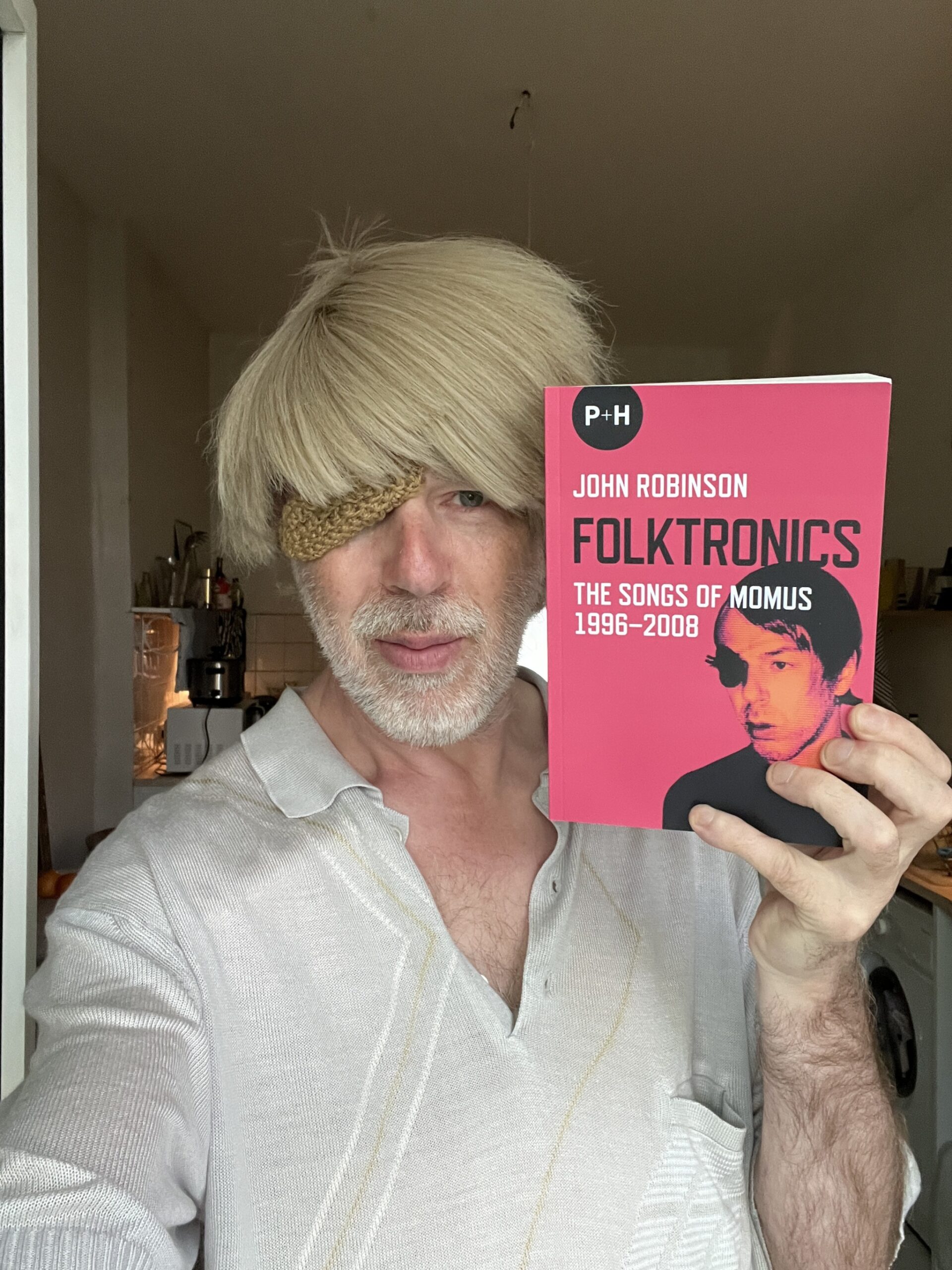
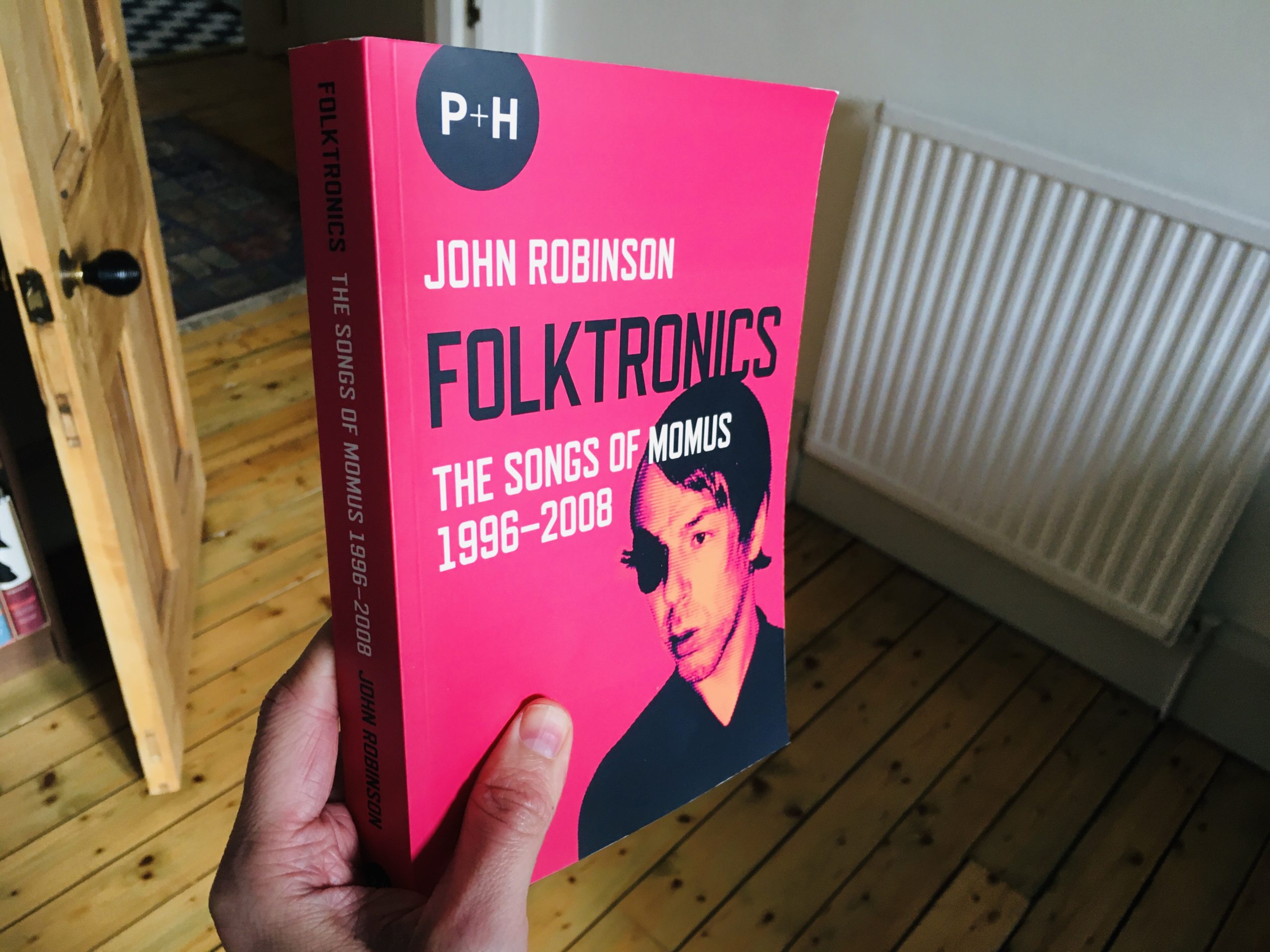
I’ve finished editing John Robinson’s second book about Momus. It was published this month and it’s a physically very beautiful book.

I’m writing a piece about my relationship with Richard Herring’s blog for the next issue of From the Sublime… magazine. The working title is “My Pet Man: 22 Years of Warming Up.”

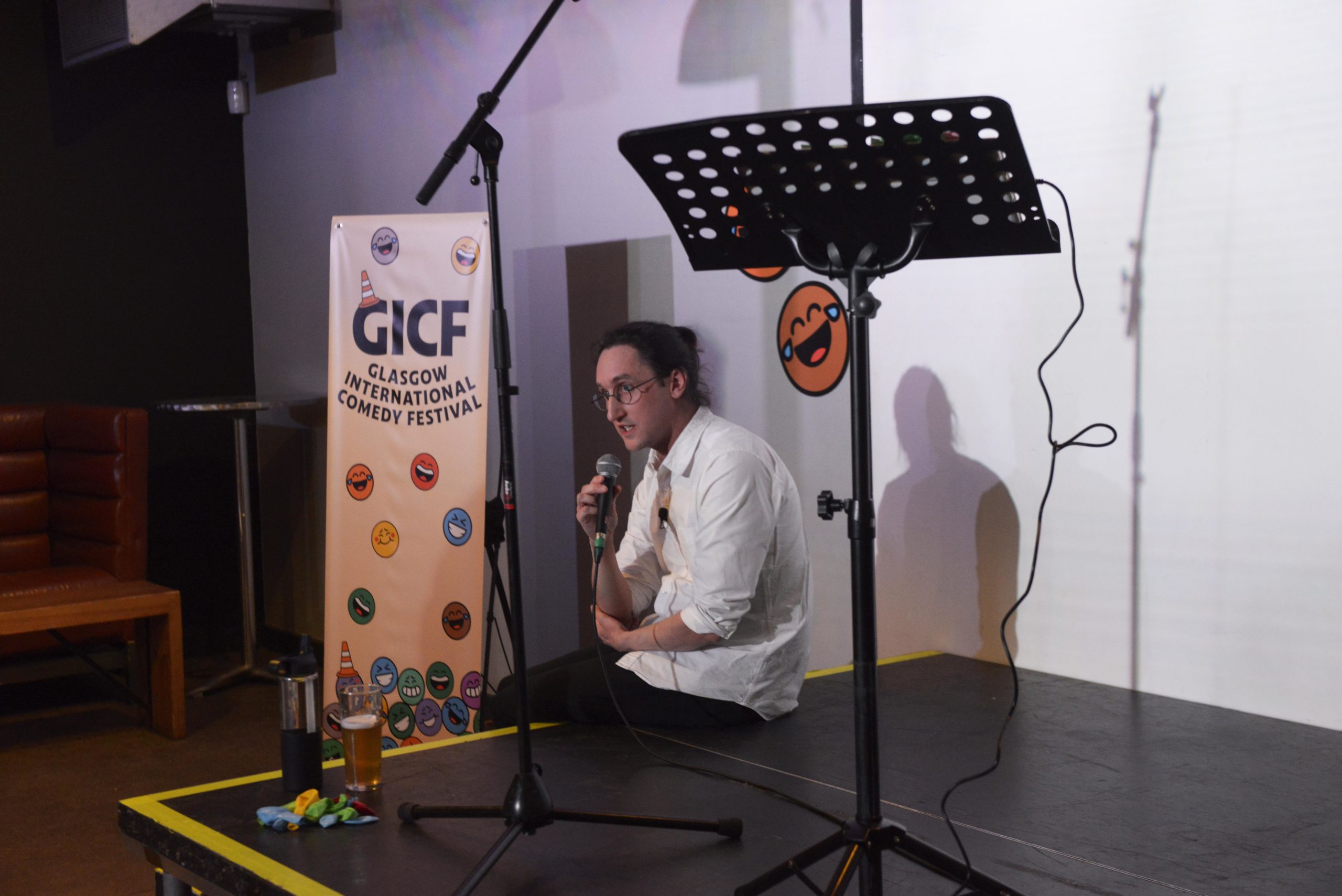
I’m preparing for my live show in March. My posters are all over town, though the one at the Sparkle Horse pub keeps getting taken down and I keep putting it back up again.

I heard yesterday that I’m Out is being discontinued (all 1,300 remaining copies to be pulped) by Unbound who aren’t happy with sales despite their stupid cover and title change (that I advised against) and not lifting a finger to market it. I’ve got seven books under my belt now, but the stiff letter I sent to Unbound is one of the most satisfying things I’ve ever written.

Reading

I’m halfway through The Freewheeling John Dowie by, well, John Dowie. Dowie (I’ll stop saying Dowie in a minute) was a great alternative comic in the ’80s who quit the business when it became a business. He’s great. Stewart Lee mentioned him in the interview he gave us for the Iceman film a couple of weeks ago and I suddenly remembered “of course, I must read that book!” Unfortunately, it was published by Unbound (see above) who made an arse of things and is now out of print. You can buy it expensively second hand. Mine was free because it was damaged in the post and I demanded a refund. The book is at least brilliant: a grumpy memoir about cycling in Europe. It’s like Dervla Murphy but properly funny and realistically miserable. I love it so much.

I also recently read Werner Herzog’s excellently-titled memoir, Every Man for Himself and God Against All (which everyone should read but only if they’ve already read his more interesting Guide for the Perplexed) and Bonjour Tristesse by Françoise Sagan. The latter turned out to be translated by Heather Lloyd, my old friend Helen’s mum. I didn’t realise until I read her translator’s note and saw that it was signed off “Glasgow, 2013.” I enjoyed the unexpected sense of connection.

Travel

I was on the English south coast this week, filming with Mark Cartwright and Anthony Irvine and our little team. I’ve already said that. Pay attention.

We’re going to Lisbon next week. Like Lanark, all I need is some sunshine.

Time Wasting

Most weeks, we attend a particular Monday night pub quiz. It’s a waste of time, money, and health but we continue to attend for reasons I can’t quite put my finger on. Maybe it’s because we keep WINNING. Oh yeah.

For TV, my partner and I have been watching old episodes of Jeopardy! after we enjoyed the recent UK version despite it being hosted by an awkward old taxidermied bear. On my own, I’ve been watching Inside Number 9, which I gave up around the fourth season but am enjoying catching up with. “Merrily Merrily” is my favourite story so far.

Some films I enjoyed recently were that Scala!! documentary, The Holdovers (which was so surprisingly good that I can’t stretch my imagination in a direction capable of criticising it – it’s a proper film like The Graduate or something, which I’m told is “mid budget”), and Poor Things (which was good but I found myself annoyed by the London bits not being set in Glasgow instead; why resist the call to elevate something instead of doing the same old expected shit?). I saw all of these films at the GFT. Support your local art cinemas, you sods.

Here’s my picture of the “month” so you can continue to monitor my ongoing decay, this time taken in Meadow Road Coffee, Glasgow, where I stopped to recaffeinate and to get a pebble out of my shoe:

Published
Categorised as Nowness

Pun

If I ever commit adultery, I’ll say to them “where have you been all my wife?”

Samara’s not so sure about that one.

Poster Boy

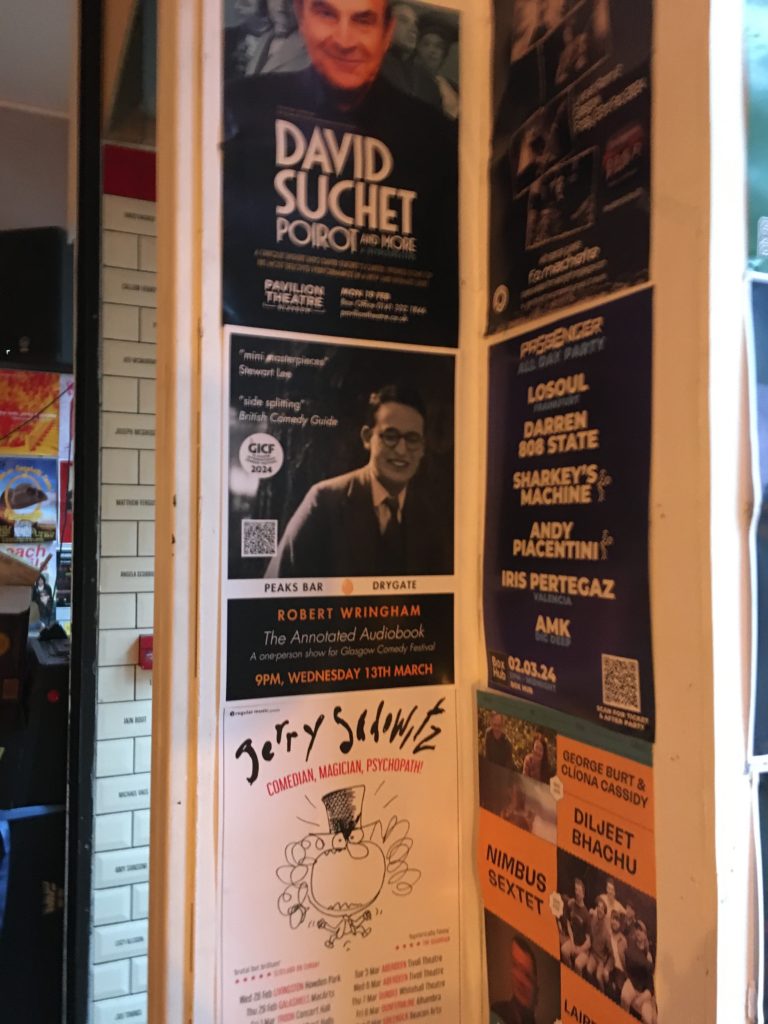
My Glasgow show poster for Glasgow Comedy Festival is all over town and it looks great.

I especially like this one at the Super Barrio retrogaming joint in the City Centre. I’m squished in between posters for David Suchet and Jerry Sadowitz. What a lineup!

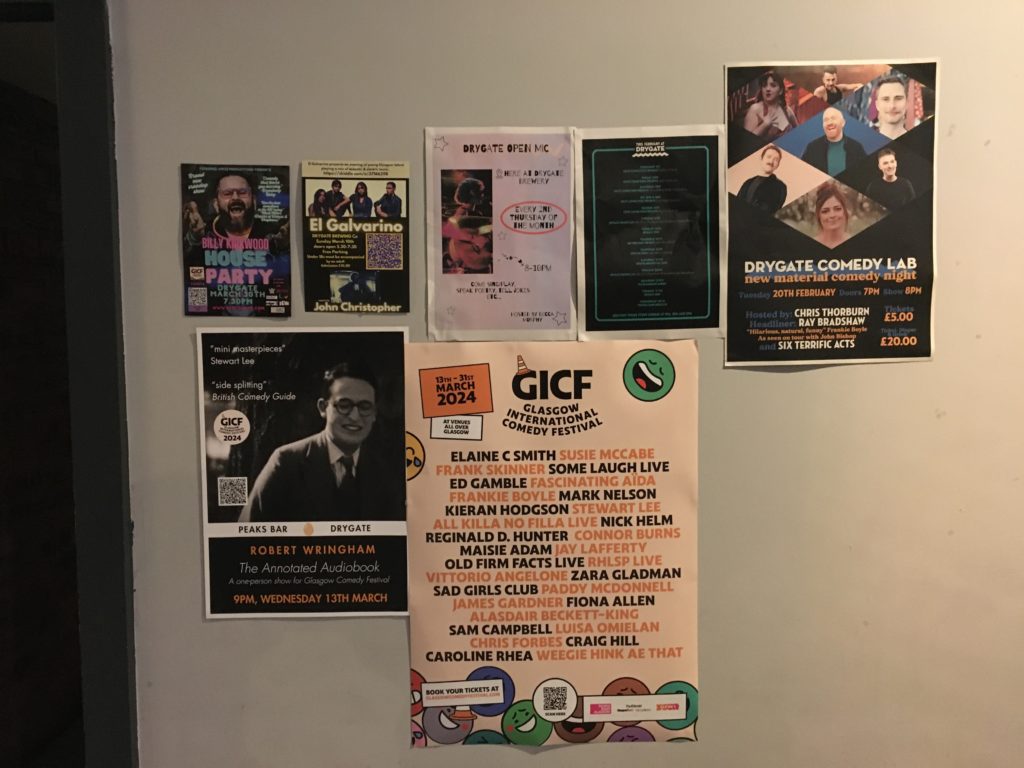
Meanwhile, in the venue itself (Drygate Brewery, East End) you can see my poster on this respectable notice board in the brasserie:

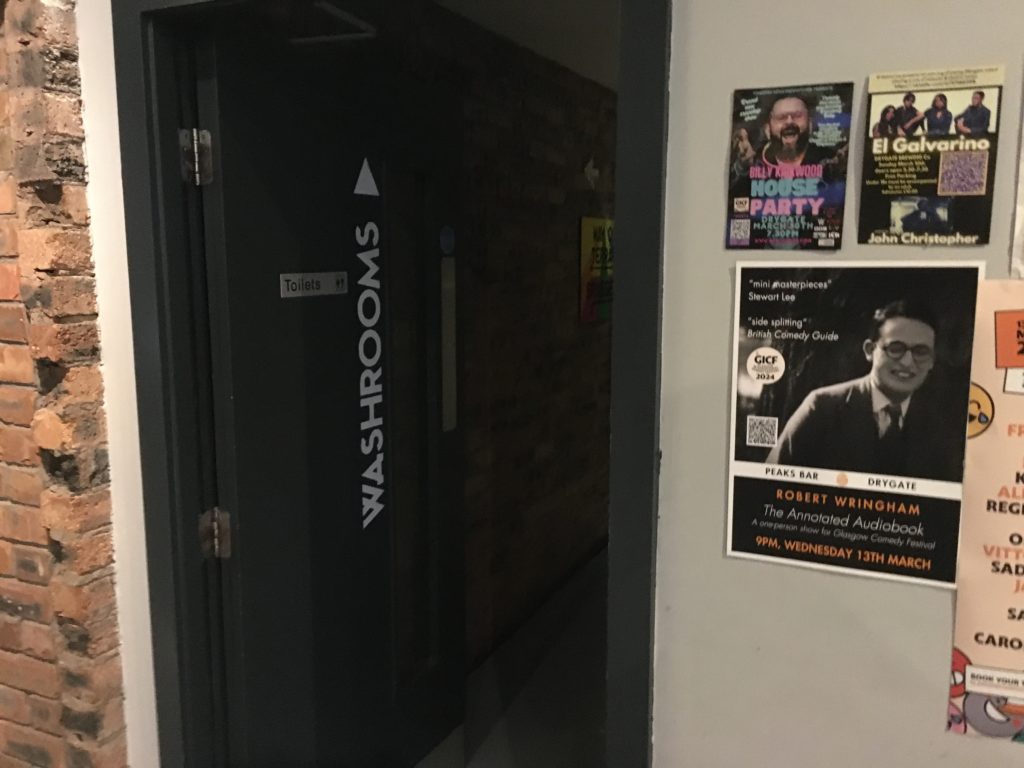
As well as upstairs by the bogs:

There’s a nice leaflet version here and there:

And this one is at the Sparkle Horse pub in the West End:

There’s also one in our kitchen, to scare myself when I’m getting a snack:

Nutcrackerish

This photograph is from maybe 2018, sent to us just now by Alan.

Ever since mother snapped me from the side while horsing a Swiss roll, I’ve been a bit self-conscious of my nutcrackerish profile.

But look at it. Bottom right. I’m beautiful!

RIP, those glasses btw. The hat is Dimmick’s.

The Chicken

I called my parents on Christmas Day.

Mum and I don’t celebrate Christmas but Dad does, so I wanted to wish a Merry Christmas to Dad. Besides, we spent twenty happy Christmases together before I moved out, so this is a time when, one would hope, we’re all thinking of each other.

My first mistake went like this: “Did Dad enjoy his Christmas dinner… um, lunch? No, sorry, dinner?”

Growing up in the Midlands, the midday meal was called “dinner” and the evening meal was called, inexplicably, “tea.” Now that I live in the world, I say “lunch” and “dinner” like everyone else. This seems to annoy my parents. Maybe it’s my imagination, but I think they think I’m being pretentious when I say “lunch” and “dinner” when really I just want to be understood by as many people as possible. It’s the same reason I use Greenwich Meantime and the Gregorian Calendar.

But out of respect for the house, I usually code-switch to the dinner/tea system when I talk to my folks. Only this time, I’d panicked and tripped over my own feet. I was like a cheating spouse who’d accidentally called his wife “Frank” and then tried to cover it up. It was a disaster.

“I don’t know why people make so much fuss over Christmas Dinner,” griped my mother.

“Well,” I said, “because it’s a special day, I suppose. People look forward to it.”

And here was my second mistake. I thought I was representing the views of “people” but she saw “representing the views of” to mean “siding with” and heard not the word “people” but the word “Dad” whose special meal she’d had to cook.

“So what did he have?” I asked, digging my grave ever deeper into cold winter soil.

“Pork, sprouts, potatoes, parsnips…”

“Parsnips!” I said. “Hah! Listen to this…”

And I told the story of my wife’s office party. There’d been a row, apparently, over the importance or otherwise of parsnips to Christmas Dinner.

“Isn’t that silly?” I said to Mum, “Who gets their knickers in a twist over parsnips? I’ve never heard of a Christmas parsnip.”

“Yes,” she said, “it’s like sprouts.”

“What? No,” I said, “It’s not like sprouts at all.”

“How is it not like sprouts?”

“Because brussels sprouts are a load-bearing Christmas tradition. Aren’t they? Everyone jokes about how nobody likes sprouts but you have to eat them because it’s Christmas. And then they eat curried turkey and turkey sandwiches and turkey crumble through to Easter.”

“Turkey’s not for Christmas Dinner,” said my mum, “that’s American. People only started going on about turkey twenty years ago. In England we have chicken.”

Office bods bickering about parsnips was nothing on this. I’d never heard such shit in all my life.

“I’ve never heard such shit in all my life,” I said.

“The English thing to have for Christmas,” she insisted, “is a roast chicken. A capon.”

“Maybe a duck?” I offered. “Or a goose?”

“A chicken!”

“Chicken,” I said, “is the most boring, everyday meat imaginable. Why would anyone have chicken on Christmas Day?”

“Because they like it,” she said firmly.

“Because they… because they like it?” I found myself stop-starting in the incredulous tone of Harold Steptoe. “Mum, Christmas isn’t about what you like. It’s about tradition. People like bubble gum but it’s not generally seen as essential to Christmas Dinner.”

“Move on,” my Dad was saying in the background, “Move on.” He had the tone of a level-headed Jerry Springer referee calmly positioning his body between warring whitetrash.

I’d been doing some simple observational comedy about taxonomies but Dad was right. It had become an argument. About Christmas Dinner. Between two vegetarian non-observers who neither eat it nor care about it.

How had we drifted into such a toboggan crash? Maybe it was the obvious wrongness of the chicken comment: my mother was essentially pointing to a cat and saying “dog” with complete confidence while simultaneously being allowed to vote in elections. But there was a body of dark matter in the conversation, which my telescopes could only detect the edges of, something that made me more uncomfortable and confused than a simple mistake should.

But of course, it was the “fuss.” We’d begun with Mum’s objection to the “fuss” of Christmas Dinner. But if a traditional Christmas Dinner, as she said, consists of a roast chicken with potatoes, parsnips and entirely optional brussels sprouts, it wouldn’t be a fuss at all. It would be one step up from a bag of chips.

So the conversation was complete gibberish, probably all because I’d clumsily barged into the room and used the word “dinner,” inadvertently exposing myself as a woke class traitor.

I excused myself because It’s a Wonderful Life was on, a film that probably strikes my mother as eccentric when, really, festive TV schedules should be largely devoted to Spring Watch.

A Muppet Misquote

I got the Muppet Show theme lyrics wrong towards the end of that little essay.

I said, “It’s time to put on makeup, it’s time to light the lights!”

But the actual lyrics are:

It’s time to play the music, it’s time to light the lights.

and later:

It’s time to put on makeup, it’s time to dress up right.

So I conflated two verses.

I should correct it but I don’t wanna. The conflation suits my purposes.

Making Fun, or, The Front Foot.

What is the point in writing light or funny stuff when the world is so darn horrid? And not just funny stuff, why write anything? Or create anything? Or do anything not germane to The Struggle.

Well, here’s the thing. There’s always a struggle. We have two major wars raging right now, affecting everyone’s mood and sanity and the lives and deaths of thousands. We have the climate crisis. We have a cost of living crisis. We have a totalitarian attack on trans people and other increasingly at-threat minorities, the fallout of which impacts every last one of us, not merely the targets of the fascists’ ire. We have deep attacks on quality of life. Already the media eye has glumly moved on from the crises of Brexit and the Trump years, few of which are satisfactorily resolved and remain smouldering like that Springfield tyre fire. Permacrisis Naomi Klein and others have called it since last year. Or to quote what Stewart Lee believes is the first joke, “the poor will always be with us.” Jesus, the lad himself, was ordering one last fling to celebrate his pending crucifixion when a do-gooder apostle suggested they donate the shindig money instead to the poor. “The poor,” Jesus quipped, “will always be with us.” As well as being an early joke, it’s an early identification of permacrisis.

The trouble, as the King of Kings apparently had the foresight to know, of acting against permacrisis is that you’re always on the back foot. I salute the work of those in Greenpeace who go out in dinghies to jimmy the system. I applaud the work of angels who, also afloat, pluck refugees from the soup. I’m grateful for those in Israel who devote their privilege to the tireless campaign for peace and an end to the madness. They’re doing what they have to do and they’re doing the right thing. They’re heroes. But they’re also in a state of unending triage. They’re a kind of casualty themselves. Imagine what those people could do if there was no malevolent pollutant to protest, no desperate to save, no bombs and rape in the war zone. Imagine what could be done with that energy and goodwill and brainpower in a time of lasting peace. Imagine what could be done if, instead of having to take out the Space Invaders one by one, we could find a space behind one of those oh-so-fragile little bunkers to create. Imagine what we could do if those noble jimmiers and campaigners and rescuers could afford to be on the front foot instead of the back. Think of the pleasures they could enjoy for themselves and create for others. Think of what they might build.

“But I get tremendous satisfaction from my job as a nurse,” you might protest. Yes, yes. And I’m grateful. Thank you, thank you, thank you. But I don’t think you’re saying that viruses and injury and abuse and infirmity are good things because they allow you to Do Good. Are you? Of course you’re not. I’m just asking that we don’t stop thinking of a world beyond chaos and death and hunger. And that we–some of us, those who are free and able to do so–get on with making that world.

When I see injustice, I’m always tempted to write about it. That’s honestly my first instinct. I want to write a column, fire off a tweet, write a letter to my MP. The idea is to appeal for sanity in the world, to join the chorus instead of vanish into silence, to help prevent further mistakes, to draw attention to systemic injustice instead of personal vendetta. Sometimes the lure is so hard to resist that I actually do these things. But imagine if I didn’t have to. Imagine if I could put that mental energy and time and finger wrigglings into writing a novel instead or a funny column or a sitcom or a film. Something of less consequence. Something about nothing. That’s what we should all be free to do. The world would be better off for it, not in the “we stopped a bad thing” way but in a “we created a good thing” way. The real victory in Europe wasn’t in wrestling Germany to its knees but in creating the post-War welfare state and the wave of midcentury art that would result from it all. This should be the aim of any socialism: not to pick up after totalitarianism or capitalism or even to stop them per se, but to create and live out the alternatives in real time. It should also be the aim of any society: not to wage exhausting battle with our idiot governments but to build the alternatives, right now, in the streets, in the fields, in workshops, in homes, in art, in people.

At the risk of sounding paranoid, I suspect (though I do not know) that our leaders are aware of this. While we’re picking up after their corrupt and incompetent mess making, we’re not doing anything outrageous that might lead to–or, better, is an example of–true emancipation. When we’re not making art–a good thing to do inherently but also in terms of exponential increase of joy it can bring in the long term–we’re not a problem to them. It’s better in their view to keep us struggling, better to keep us grappling with impossible paperwork and asking for medicine for a third time and demanding that the libraries we paid for aren’t shuttered and closed. While we’re talking about Brexit, we’re not campaigning for socialism. (Brexit killed Corbyn. Admittedly, it killed a bunch of their guys too, but they have veritable factories devoted to the production their guys while we only had the ball for a brief and shining moment.) And we’re not beautifying our world instead of working for them.

So that’s what permacrisis is. Or at least what it has done. Whether by design or by happenstance, it has gubbed up the channels. It has a way of making sure We The People never accomplish anything worthwhile. It’s all about the back foot.

The only way to combat this–in my opinion and don’t mind me–is to stay on the front foot for as long as you can. Instead of despairing and reducing your lot in life to picking up after the malevolent cretins in industry and in our governments (now practically one and the same) by dwelling on what seems immediately “relevant,” create art. Create, if you must, through despair and guilt and shellshock, art that strikes at the heart of these crises. But the greatest thing to do (IMHO!) is to create art that is nothing to do with crisis at all.

Create witty, funny, joyful, pretty, beautiful, happy art. Instead of reacting eternally to the Bad, push onwards into the Good. So few people are doing it, fewer still with the knowledge of its importance. Push on, on, on. Wear bright colours in times of darkness. Make sweet music, paint the ceiling. Truly, it’s time to put on makeup, it’s time to light the lights. To create something other than a response to crisis is not to support crisis or to ignore it. There’s no contradiction in hating the Bad while putting your energy into creating the Good. Why piss around with pawns and defence when you can get your bishops and knights out into the endgame? The endgame, it’s easy to forget, is a world of peace and freedom and flourishing. Make it.

Soan

I often find myself thinking of Martin Soan. I think of him when I hear the phrase “my giddy aunt” or see some meerkats in a zoo.

Most often though, I think of him when I clean the gunk out of the hair trap in our shower drain.

Martin has a bit where he comes on stage to Serge Gainsbourg’s Je t’aime, while “erotically” tugging some grotty-looking wool out of a section of drain pipe.

The music scratches to a halt and he says “Cor, I love doing that.”

I probably think of that every single morning.