What, in your opinion, dear reader, makes a good blog? Bloggery is such a freewheeling medium, it’s difficult to say, isn’t it? This blog, The Occasional Papers hasn’t really come into its own yet, mainly because I’ve been chimping around with the sorts of entry I write in it. I think I used to want to be Richard Herring and used my old blog to report comically upon the stacks of daily ennui and neurotic detritus that so plague the urban layabout. These days, however, I think the hight of blog perfection has been reached by Momus who uses his blog as a mixing tray for ideas and as a sort of well-informed online gonzo journalism.

 Assuming that the number of comments a LiveJournal entry receives is a fair indicator of an entry’s ‘goodness’, I find that the best sorts of entry are the ones that relate to an issue that the majority of the blog’s readers know a bit about already. Trouble is: I hate writing about the news. I’m not in politics and anything I have to say about the news is bound to be a half-baked load of claptrap. If only some other bloggers realised that then the blogosophere could be a better, less littered cyberplace.
I try to write these days about art (visual, televisual, literary, musical, comedic) and the train of thoughts I experience as a result of it. To me, this is what an integral, considered blog should be like. But are other people interested in this? I met Stewart Lee recently who advised me not to go into standup comedy with an agenda (such as to be subversive) but just to talk about what interests me and let the ‘agenda’ be a byproduct. I’m not sure how I feel about this: if a comedian just wanted to talk about things of interest to him, why would he do it on a stage in front of thirty to three thousand people? If I wanted to write a diary of personal memoranda or things that interest me exclusively, then I wouldn’t publish it online but instead write it in one of my many notebooks. If it’s not going to entertain or interest other people then it shouldn’t be on the web.
I recall Dickon Edwards writing on a few occasions about what he thinks makes a good blog (or ‘diary’ in his case). He said that entries are best received when short and frequent. I think he’s probably right. The problem is though, that the reason they are so successful is that people (I strongly suspect) often treat their friends’ blogs like pieces of online daily admin: little chores that they have to get though, akin to checking email or their ebay stock. I know that I’m guilty of this. But there are blogs that I really enjoy (namely the aforementioned journals of Momus, Dickon and Herring and perhaps those of
Lots of people use their blogs to critique or respond to what a proper critic (in a newspaper/magazine/popular blog) has said about a TV show/film/album/gig. I don’t realy understand the motivation for doing this. The person being written about will never read the opinions recorded here (unless they play the google-my-own-name game and the blog is popular enough or covered with enough metadata to be picked up by Google). So why not write to the critic in question (they are usually quite accessible) or else take part in a discussion on Comment is Free? I realise as I write these words that I have bitched about a columnist in these electronic pages in the past. I guess there is a certain ‘psychological escape valve’ aspect to blogging: our blogs can serve as safe and soudproofed padded cells despite their being on a huge electronic stage for all to see. I wonder what we did to satisfy our desires for a soapbox before we had our webblogs? And what do the vast numbers of the blogless do?
Perhaps a good blog simply depends upon who’s writing it and what they do. Herring and Momus are constantly travelling and attend interesting events frequently enough to always have something interesting to report upon.
So, what makes a good blog? Why do you genuinely enjoy reading some of the blogs in your livejournal friends list and skip past others? What makes you leave a comment?

 “A good many great men have lived in attics and some have died there. Attics, says the dictionary, are “places where lumber is stored,” and the world has used them to store a good deal of its lumber in at one time or another. Its preachers and painters and poets, its deep-browed men who will find out things, its fire-eyed men who will tell truths that no one wants to hear–these are the lumber that the world hides away in its attics. Haydn grew up in an attic and Chatterton starved in one. Addison and Goldsmith wrote in garrets. Faraday and De Quincey knew them well. Dr. Johnson camped cheerfully in them, sleeping soundly–too soundly sometimes–upon their trundle-beds, like the sturdy old soldier of fortune that he was, inured to hardship and all careless of himself. Dickens spent his youth among them, Morland his old age–alas! a drunken, premature old age. Hans Andersen, the fairy king, dreamed his sweet fancies beneath their sloping roofs. Poor, wayward-hearted Collins leaned his head upon their crazy tables; priggish Benjamin Franklin; Savage, the wrong-headed, much troubled when he could afford any softer bed than a doorstep; young Bloomfield, “Bobby” Burns, Hogarth, Watts the engineer–the roll is endless. Ever since the habitations of men were reared two stories high has the garret been the nursery of genius. […] Huddle them up in your lumber-rooms, oh, world! Shut them fast in and turn the key of poverty upon them. Weld close the bars, and let them fret their hero lives away within the narrow cage. Leave them there to starve, and rot, and die. Laugh at the frenzied beatings of their hands against the door. Roll onward in your dust and noise and pass them by, forgotten.”
 Most every time I turn on a tap (a cold tap, mind you, for the hot water does not rise this high and must be manufactured using an expensive water heater) the flow explodes out in a combination of water and air, previously trapped in the pipes. The force of this escaping air is so stong that it turns much of the water into a fine and floating spray. It’s one way of getting washed first thing in the morning, I suppose. I’m assured that there’s nothing to be done about this problem: rather than being a fault in the pipework, it is a result of living at such a high altitude and with a system of plumbing not designed to bring water all the way up to the house’s lumber room.




 I remembered this dream yesterday as made my way to London’s Crystal Palace district to interview Stewart Lee before his spot at Josie Long’s Sunday Night Adventure Club. What if the same thing happened? I love Stewart Lee. He’s my favourite comedian who isn’t dead. Bizarrely, I’d just bought the DVD of his Jerry Springer – The Opera as research and the booklet that accompanied the DVD included an article written by Stew called “Never Meet Your Heroes”. I was anxious to say the least.


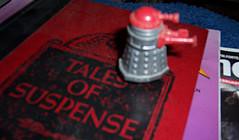


 The general consensus seems to be that curatorship is about the collecting and arranging of physical artefacts or artworks while librarianship is about the collecting and arranging of information. But when you consider the idea of realia, the vernacular theory doesn’t work.